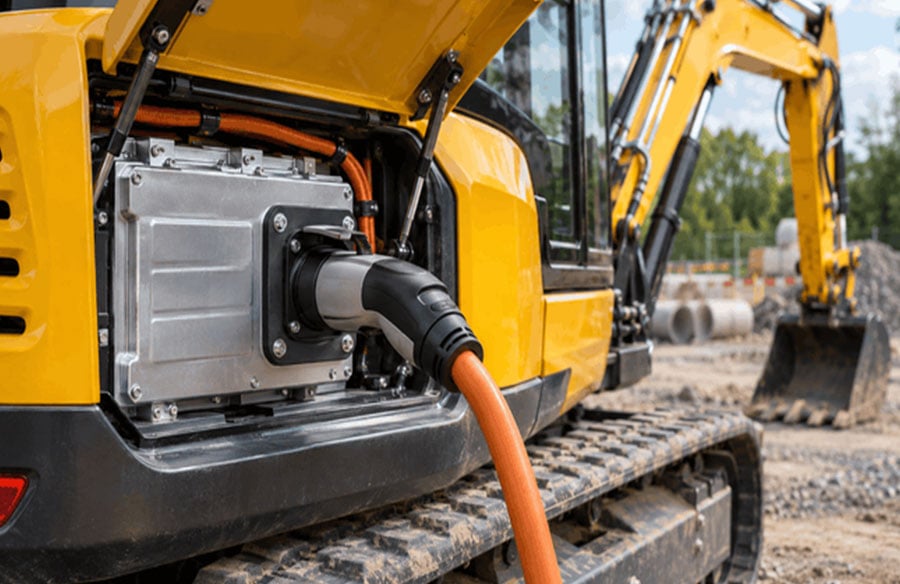
An electric excavator that performs well during a demonstration still has to earn its place on a muddy building site. It needs to handle demanding work, fit the charging schedule and keep moving when conditions change. Your battery partner plays a large part in whether that happens.
Choosing that partner starts with understanding the machine’s working day. A useful proposal connects battery performance to the jobs your equipment actually does, with clear responsibilities from development through to service.
Start with the machine’s actual working day
Give prospective partners a working profile before asking them to recommend a battery. Record operating hours, active work, idle periods, attachments and typical loads. Include demanding tasks, such as repeated lifting or digging in heavy ground, because daily averages can hide short periods of high demand.
Where possible, collect measurements from an existing machine or an instrumented prototype. A compact loader moving material intermittently has different requirements from equipment working almost continuously. If measurements are unavailable, ask the partner to explain its assumptions and identify which ones need testing.
Describe the conditions around the work as well. Cold starts, steep ground and frequent travel between working areas can all influence the design brief. The more accurately you describe the application, the easier it becomes to judge whether a proposed solution fits.
Separate battery capacity from working performance
Battery capacity describes stored energy, while power describes how quickly that energy can be delivered. Your equipment needs enough of both. A pack may contain sufficient energy for the planned work yet fall short when a demanding attachment needs sustained power.
Ask suppliers to distinguish nominal capacity from usable energy. Request runtime estimates that account for the workload, auxiliary equipment, temperature and intended operating reserve. A headline runtime figure only becomes useful when you understand the conditions behind it.
Physical fit deserves equal attention. Check pack dimensions, weight, mounting points and maintenance access before the design becomes difficult to change. The machine designer should also assess how battery placement affects weight distribution and access to other components.
Choose engineering support that fits your machine
A battery project involves connections between the pack, charger, machine controls and cooling system. Those connections need an engineering owner who understands how the complete installation should behave. Ask who investigates a fault when individual components appear to work but the machine still stops.
Limited installation space or a demanding shift pattern may call for a different approach to battery design. Fixed and swappable off-highway packs, with options for custom dimensions and joint development, are among the European battery solutions by Intercel that can be matched to machine requirements. Bringing that expertise into the design process early gives your team room to address packaging, charging and integration together.
Ask prospective partners to show how they have handled comparable applications. Similar working hours, vibration exposure and charging patterns make a project particularly useful for comparison. Discuss what required adjustment during development and how the supplier resolved it.
Build charging around the construction schedule
Charging plans should begin with the electricity available where the machine will work. Confirm the site connection, other equipment drawing power and the hours when charging is practical. A suitable charger still needs sufficient supply to deliver the expected charging rate.
Map charging against actual breaks and shift changes. Overnight charging may suit equipment returning to a depot, while remote projects may require another arrangement. Ask the partner to explain what happens when site power is lower than expected.
Evaluate removable packs with the same care. Battery swapping also requires suitable handling equipment, storage space and accessible connections. Include those arrangements in the trial before assuming an exchange will be quick enough for your schedule.
Check protection, diagnostics and service arrangements
Construction equipment faces dust, water, vibration and accidental damage. Ask which conditions the proposed pack has been tested for and whether those tests reflect its installed position. A protection rating needs context, especially around connectors, mounting arrangements and cleaning procedures.
Operators also need clear information when something requires attention. Ask what the display shows when temperature, charge level or a fault causes reduced power or a shutdown. Test those responses so the team understands both the warning and the recovery procedure.
Confirm who can diagnose faults and how replacement parts are supplied. Clarify whether remote diagnostics or software access involves additional charges. Written service arrangements help you assess how equipment will be supported when it works far from the supplier.
Compare lifetime costs and warranty conditions
Compare proposals over the same working period and expected operating hours. Include the battery, charger, integration work, maintenance and potential replacement costs. A lower purchase price becomes less attractive if it creates extra engineering work or longer interruptions.
Read warranty conditions alongside your intended use. Ask how coverage depends on calendar age, energy throughput, temperature and charging behaviour. Clarify what happens if capacity falls below an agreed level, including responsibility for diagnosis, transport and labour.
Supply arrangements deserve a place in that comparison. Ask where cells are produced, where packs are assembled and how future component changes are managed. These answers help you assess replacement availability and whether later packs will remain compatible with your equipment.
Test Your Construction Battery Partner Before Fleet Rollout
Shortlist partners using the same machine brief, then test the preferred solution under representative conditions. Agree on acceptance criteria before the trial begins. Measure completed work, energy consumption, charging time and interruptions rather than relying only on operator impressions.
Include demanding attachments and the charging arrangements your team expects to use. Record conditions so you can explain differences between working days. Choose the partner who can turn those results into clear decisions about the final design and ongoing support.