Green architecture is the new buzzword in the architecture industry. But many have the wrong idea of what makes a building green. It is far more than planters on a balcony or a solar panel on the roof.
According to Canada’s National Research Council, 28 to 35 per cent of LEED buildings use more energy compared to conventional buildings. Another study says that only two out of ten LEED Gold social housing buildings studied in British Columbia met their energy target, and all others used 22% to 282% more energy than anticipated.
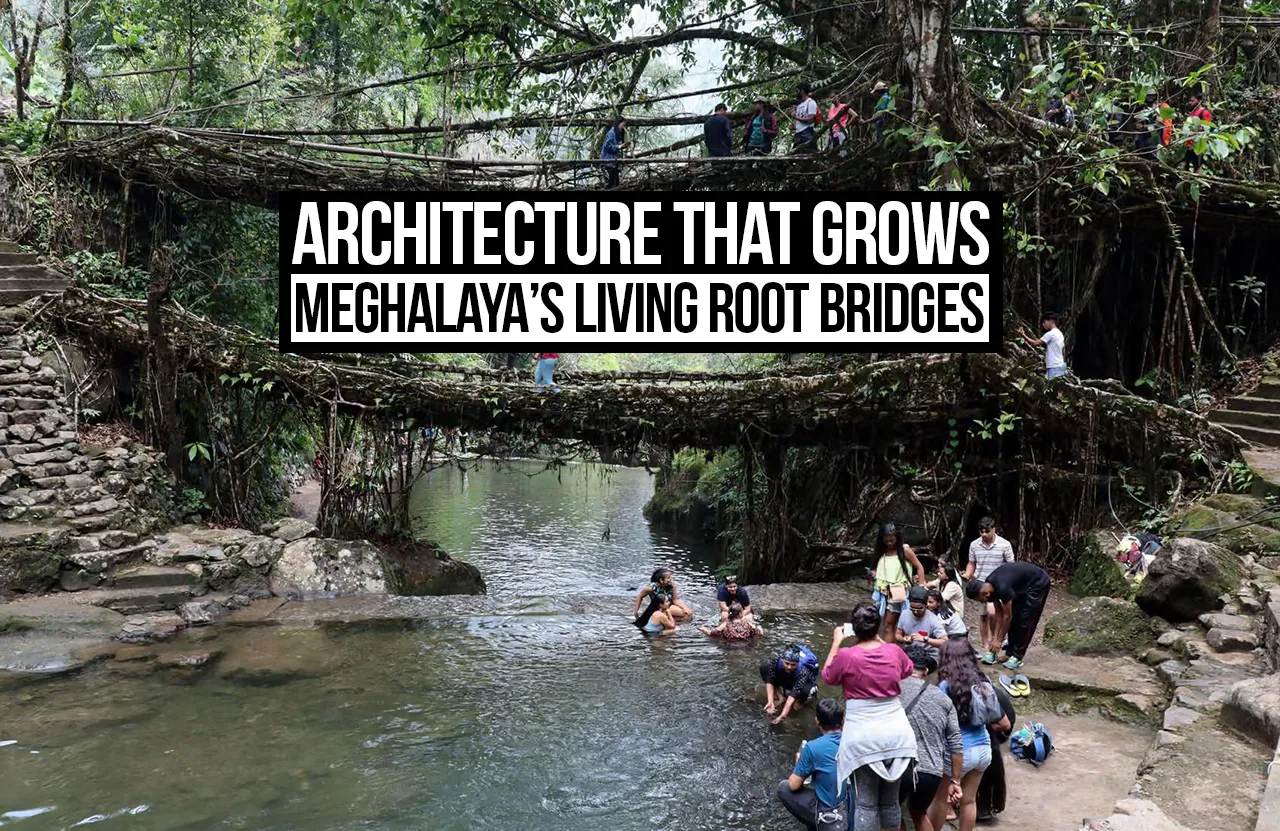
Far from all these green ratings, in the hills of Meghalaya, India, architecture is alive, breathing, and growing. This is the story of living root bridges, nature’s own design.

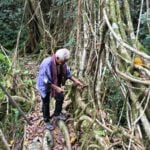
Meghalaya’s indigenous communities, Khasi and Jaintia, are pioneers in growing and shaping bridges out of trees’ aerial roots. In the Khasi language, these bridges are called jingkieng jri, simply meaning a bridge made from a living tree.
A living root bridge is created by manoeuvring the flexible roots of the rubber fig tree (Ficus elastica) across a stream or a river. The roots are allowed to grow and thicken until they can withstand a person’s weight. The young roots are woven together. Over time, they fuse into one through a natural process called inosculation, where two separate trees grow together and become a single, stronger structure connecting two banks of the stream. This process takes around 10 to 25 years, and the bridges are anywhere between 50 and 100 feet long. Some bridges, when fully grown, can carry up to 50 or even more people at once.
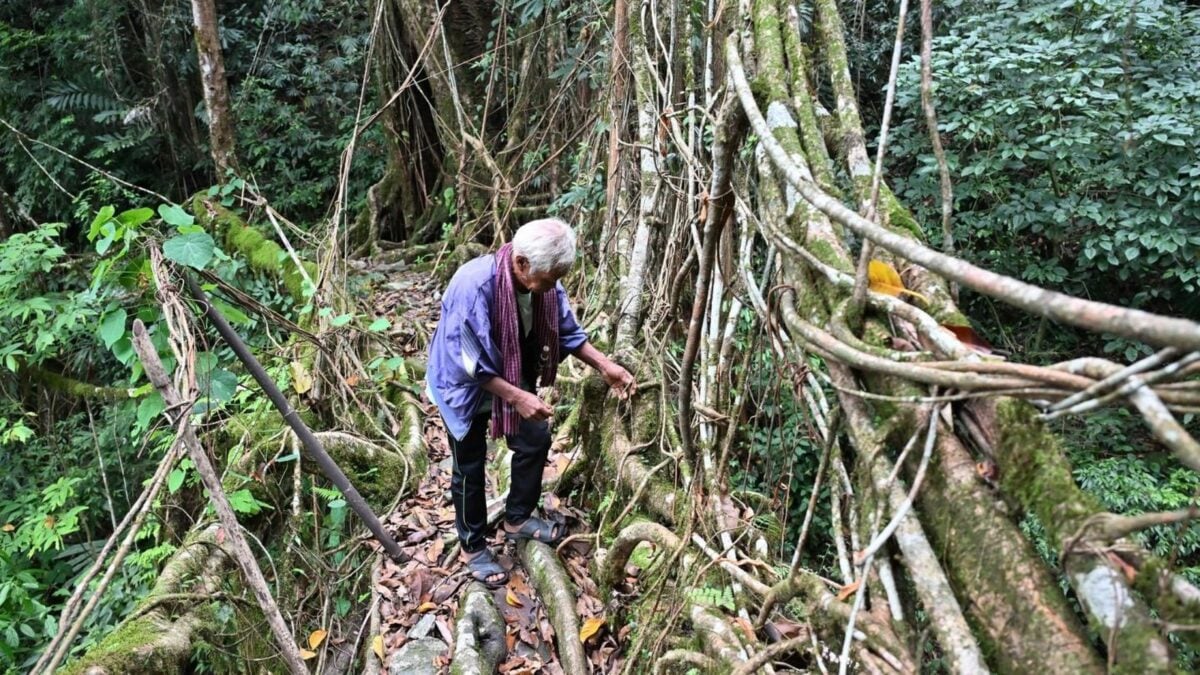
The lifespan of a living root bridge varies because it is a living organism. Provided that the tree from which the bridge is formed remains in healthy condition, the bridge continuously strengthens itself and lasts hundreds of years. New roots keep growing, and the older ones thicken and grow stronger with time.
There are about 100 known living root bridges across 72 villages, and in 2022 they were added to UNESCO’s tentative list as Jingkieng Jri.
The Indian state of Meghalaya, whose name literally means “Abode of Clouds”, is widely recognised as one of the wettest regions on Earth; here wooden bridges rot and steel ones rust. As NPR reported, concrete bridges are unlikely to last even a few decades there because of floods, earthquakes, and landslides. On the contrary, these living bridges get stronger as time passes, each year.
Could This Practice Extend Beyond Meghalaya?
Now the question arises: Can this model be replicated elsewhere? And be a breakthrough in the field of architecture and design? Scientists are working on this question. A team at the Technical University of Munich, led by architect Ferdinand Ludwig, studied 74 living root bridges and found that roots of the bridge grow thicker where the stress is highest, gets stronger the more people walk on it, which is quite the opposite of a contemporary concrete bridge, which wears out from use.
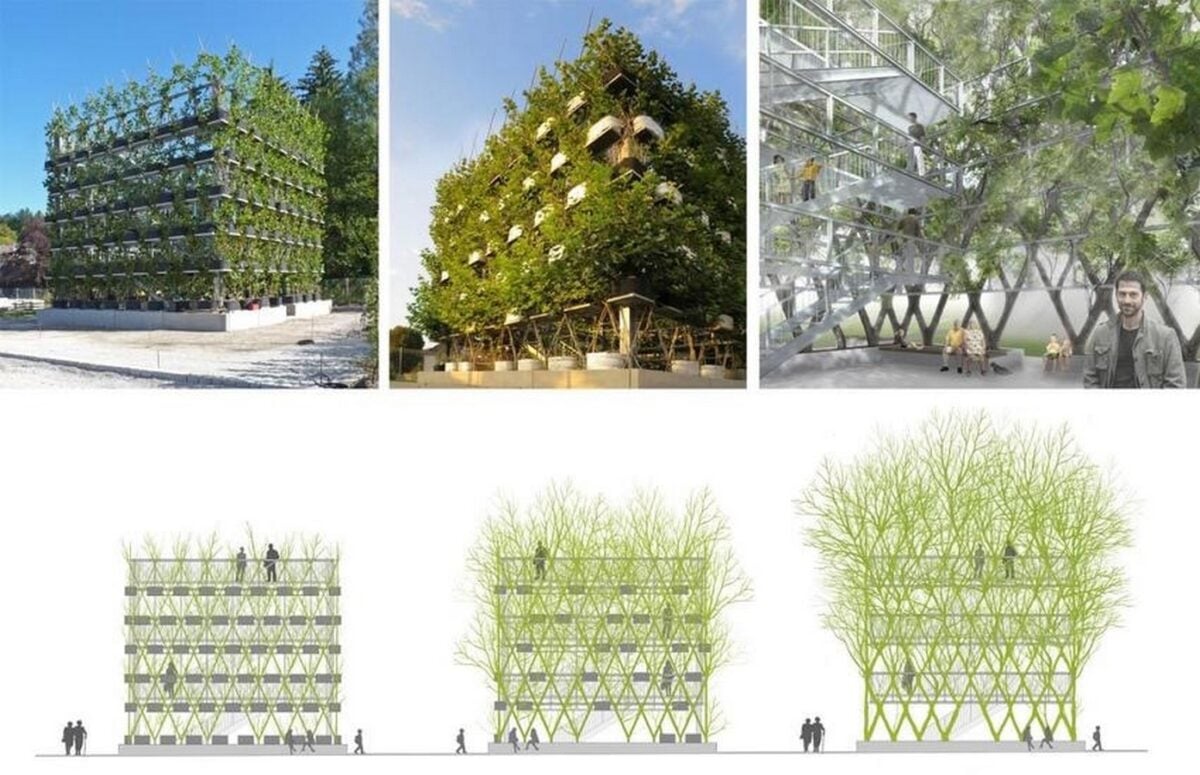
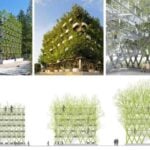
Ludwig works in Baubotanik, a field that builds with living plants. His team designed Plane-Tree-Cube in Nagold, Germany, in 2012. Trees grow around a metal frame, and the expectation is that at some point, the plants will take full charge of supporting the building.
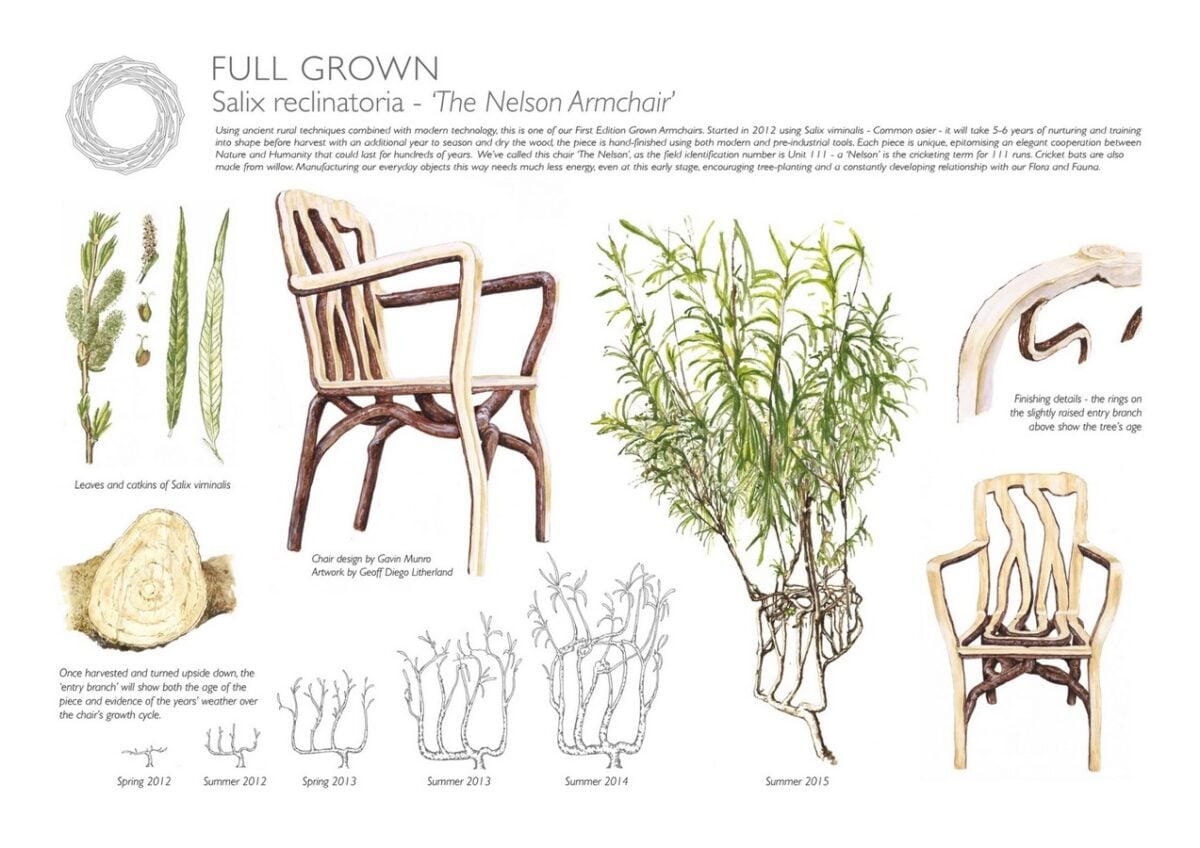
In England, a company called Full Grown trains willow and oak into chairs and lamps, which takes about four to five years for willow and nine or more for oak.\
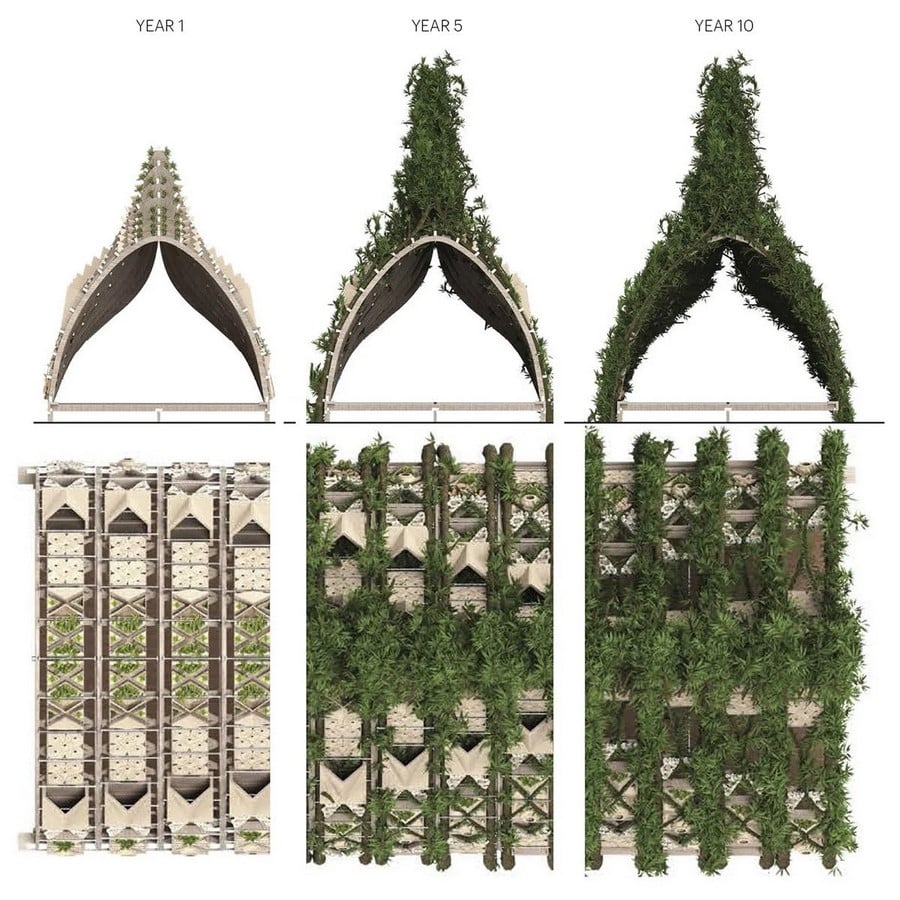
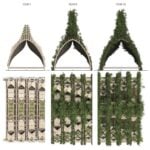
In New York, architect Mitchell Joachim’s studio Terreform ONE built the Fab Tree Hab, a shelter of grafted living trees shaped inside timber scaffolds, which won a 2024 Green Good Design Award.
The examples above grow plane trees, willow and oak, not rubber fig trees. A root bridge works because of a specific tree, a specific climate and a specific rainfall. Ludwig’s team highlighted that these bridges deserve attention, and now India should lead this research.
The root bridge is only a lesson, and it has its limitations. It is slow and requires a lot of patience, and depends on people tending these bridges. The newer generation of Khasi communities aspires to live a modern lifestyle, and without proper care, many bridges have decayed, grown wild and become unusable. The skills required to build these bridges are poorly documented, limiting knowledge to only a few communities.
Root bridges teach us three things: design for repair, design for shared ownership, design for patience. These are the biggest takeaways for any designer or architect.
References:
Ludwig, F., Middleton, W., Gallenmüller, F., Rogers, P. and Speck, T. (2019) ‘Living bridges using aerial roots of Ficus elastica – an interdisciplinary perspective’, Scientific Reports, 9, article 12226. doi: 10.1038/s41598-019-48652-w.
Newsham, G.R., Mancini, S. and Birt, B. (2009) ‘Do LEED-certified buildings save energy? Yes, but…’, Energy and Buildings, 41(8), pp. 897–905. doi: 10.1016/j.enbuild.2009.03.014.
Zhou, Q. (2018) Design versus actual energy performance in green buildings. Thesis. University of Victoria. Available at: https://dspace.library.uvic.ca/handle/1828/10416 (Accessed: 25 October 2026).
Press Trust of India (2022) ‘Meghalaya’s root bridges in UNESCO’s tentative list of World Heritage Sites’, EastMojo, 29 March. Available at: https://eastmojo.com/meghalaya/2022/03/29/meghalaya-root-bridges-in-unescos-tentative-list-of-world-heritage-sites/ (Accessed: 25 October 2026).
Meghalaya Biodiversity Board (n.d.) Living root bridges. Available at: https://megbiodiversity.nic.in/node/1074 (Accessed: 25 October 2026).
Technical University of Munich (2019) ‘Living bridges: how traditional Indian building techniques can make modern cities more climate-friendly’, press release, 18 November. Available at: https://www.tum.de/en/news-and-events/all-news/press-releases/details/35782 (Accessed: 25 October 2026).
Christian Science Monitor (2022) ‘Indigenous ingenuity: India’s living bridges inspire architects’, 8 June. Available at: https://csmonitor.com/Daily/2022/20220608/Indigenous-ingenuity-India-s-living-bridges-inspire-architects (Accessed: 25 October 2026).
UNDP India (2024) ‘Conserving the living root bridges of Meghalaya’, 22 May. Available at: https://www.undp.org/india/stories/conserving-living-root-bridges-meghalaya (Accessed: 25 October 2026).
Resilience.org (2015) ‘Baubotanik: botanically inspired biodesign’, 16 October. Available at: https://www.resilience.org/stories/2015-10-16/baubotanik-botanically-inspired-biodesign/ (Accessed: 25 October 2026).
Atlas Obscura (n.d.) Platanenkubus, Nagold, Germany. Available at: https://atlasobscura.com/places/platanenkubus (Accessed: 25 October 2026).
Agence France-Presse (n.d.) ‘British designer growing trees into furniture’, The Daily Star. Available at: https://www.thedailystar.net/offbeat/british-designer-growing-trees-furniture-87097 (Accessed: 25 October 2026).
Good Design Awards (2024) Fab Tree Hab: Multispecies Living Structure. Available at: https://gooddesignawards.org/project/fab-tree-hab-multispecies-living-structure-2022-2023 (Accessed: 25 October 2026).