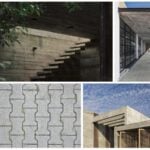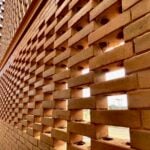
Concrete is the floor under the supermarket, the flyover above the road and the dam behind the city’s water, and we rarely notice it. Imagine it simply unavailable tomorrow. The usual answer is that the building would stall.
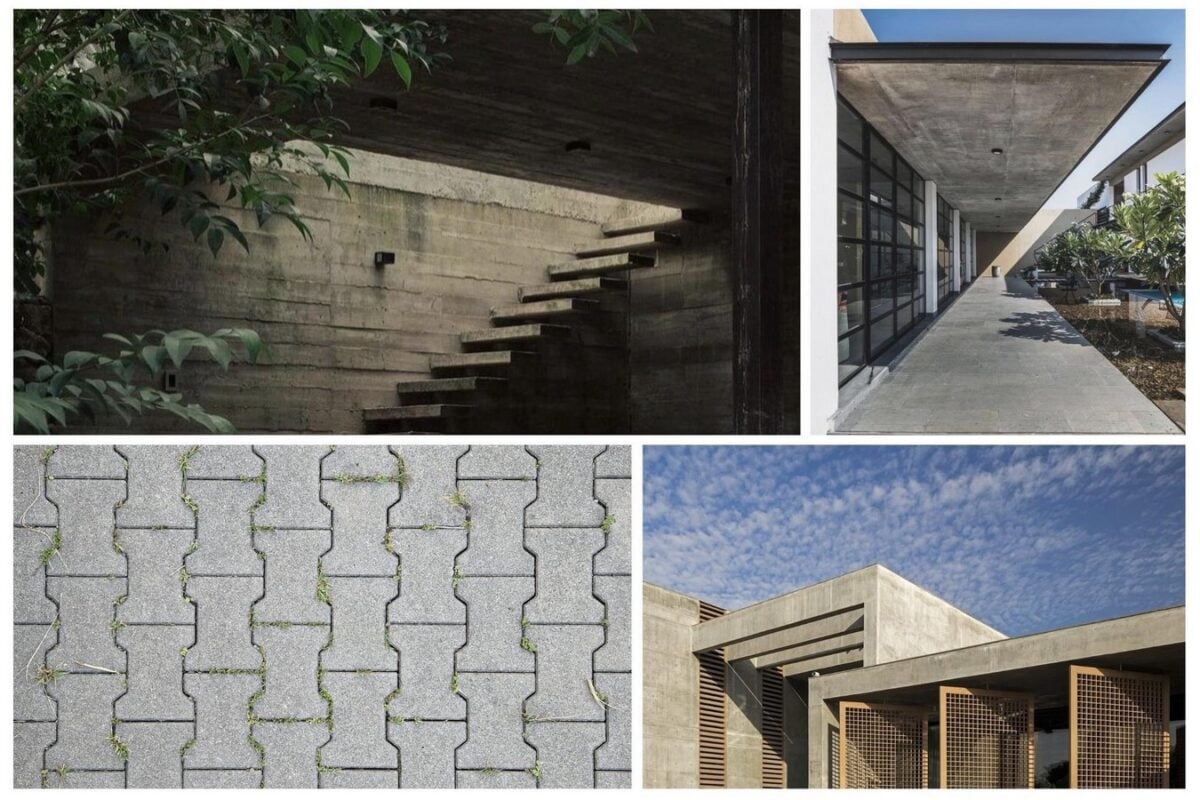
My argument is that concrete is less a material than a licence. It lets builders pour a building anywhere, in any shape, from ingredients shipped from almost anywhere. A world without it would revoke that licence. Some things would become harder or impossible. Others, from village schools to eighteen-storey towers, already exist without it.
The result might now no longer be a go back to the past, but rather a unique dating among structure and design, place, labour, and time.
This test additionally rests on a psychological premise.
Concrete is not a law of nature; it is a human invention, the product of a brain that has repeatedly turned scarcity into design: the arch, the dome, the jali, the vault. An organ that built the mixer can build what follows it. If concrete were removed, I doubt that something would take its place.
The useful question is how quickly, and what that replacement would value: speed or place, strength or repair.
Why concrete rules; a licence, not just a material.
More than 4 billion tonnes of cement are produced each year, accounting for around 8 per cent of global CO₂ emissions, and more than 10 billion tonnes of concrete are used annually, by some estimates the second most consumed substance on Earth after water (Lehne and Preston, 2018). Per kilogram, concrete is not especially carbon-intensive; the damage comes from sheer volume (Lehne and Preston, 2018).
India sits at the centre of this. It is the world’s second-largest cement producer, at about 13 per cent of global output, and a NITI Aayog report warns that production could grow nearly seven-fold between 2023 and 2070 (Global Cement, n.d.).
Yet concrete’s deeper enchantment is what it is let’s designers ignore.
A reinforced concrete frame needs no local craft tradition, no particular stone and no particular climate. The same flat slab can roof a house in Jaisalmer, Kochi or Shimla, though these sit in hot-dry, warm-humid and cold climate zones that demand opposite answers.
Concrete’s real achievement is indifference to place, and indifference is what a world without it could not afford.
The day the mixers stop-
Taken literally, a zero-concrete world would fail first below ground and near water. Foundations in soft soil, dam walls, bridge piers, tunnel linings and sea defences rely on a material that sets hard, resists water and can be poured into awkward shapes. No timber, brick or earth system I know of matches it at that scale.
The best alternatives admit this. Auroville’s earth blocks are stabilised with about 5 per cent cement by weight (Auroville Earth Institute, n.d.a). Hunnarshala’s post-earthquake rebuilding in Kutch used soil mixed with 7 per cent cement (Knowledge at Wharton, n.d.).
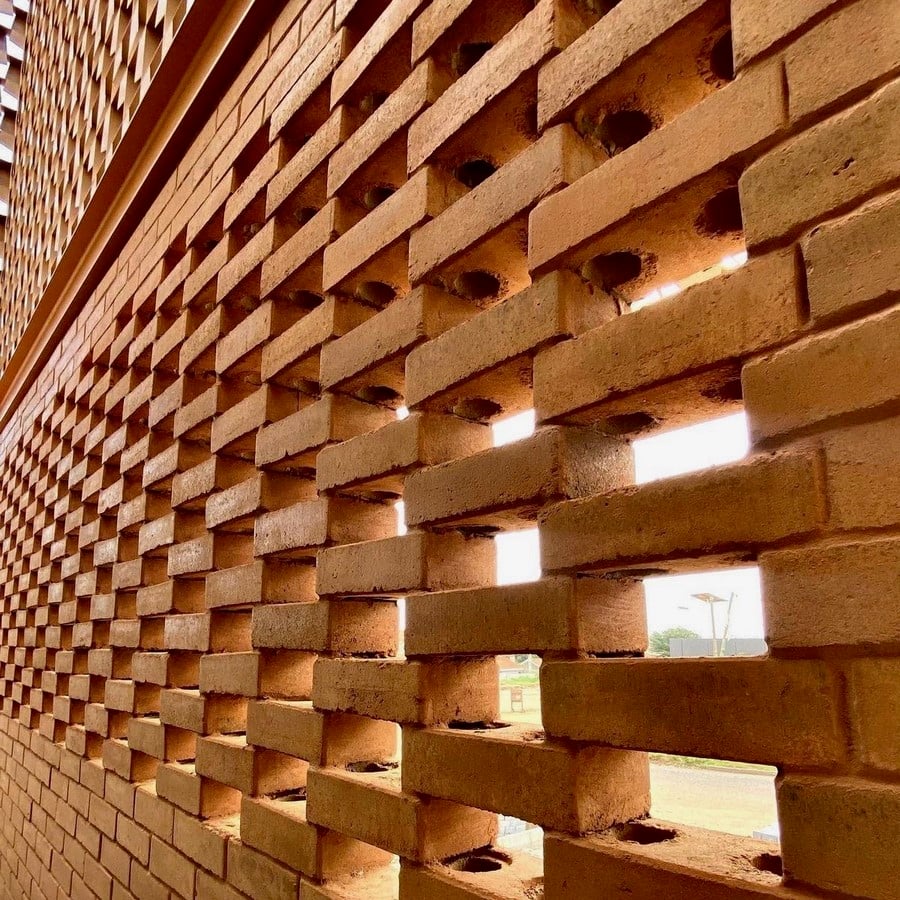
Satprem Maïni, who has promoted earth technologies in Auroville since 1989, reports using only two RCC slabs in 23 years of practice (Somvanshi, n.d.). Internationally, Mjøstårnet in Norway, at 85.4 metres the tallest timber building when completed in 2019 (Dezeen, 2019), reportedly used concrete on some floors to reduce movement in the upper storeys (Herald Business, n.d.).
The pattern is conveying. Those who build well without concrete still use a little, sparingly, for jobs nothing else does well. So the honest version of this thought experiment is “no concrete” but “concrete only where it is irreplaceable”.
What returns: materials that already work in India’s climates
India’s climate zones are not one problem but several, and each has an answer older than concrete.
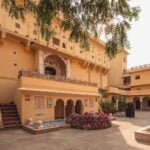
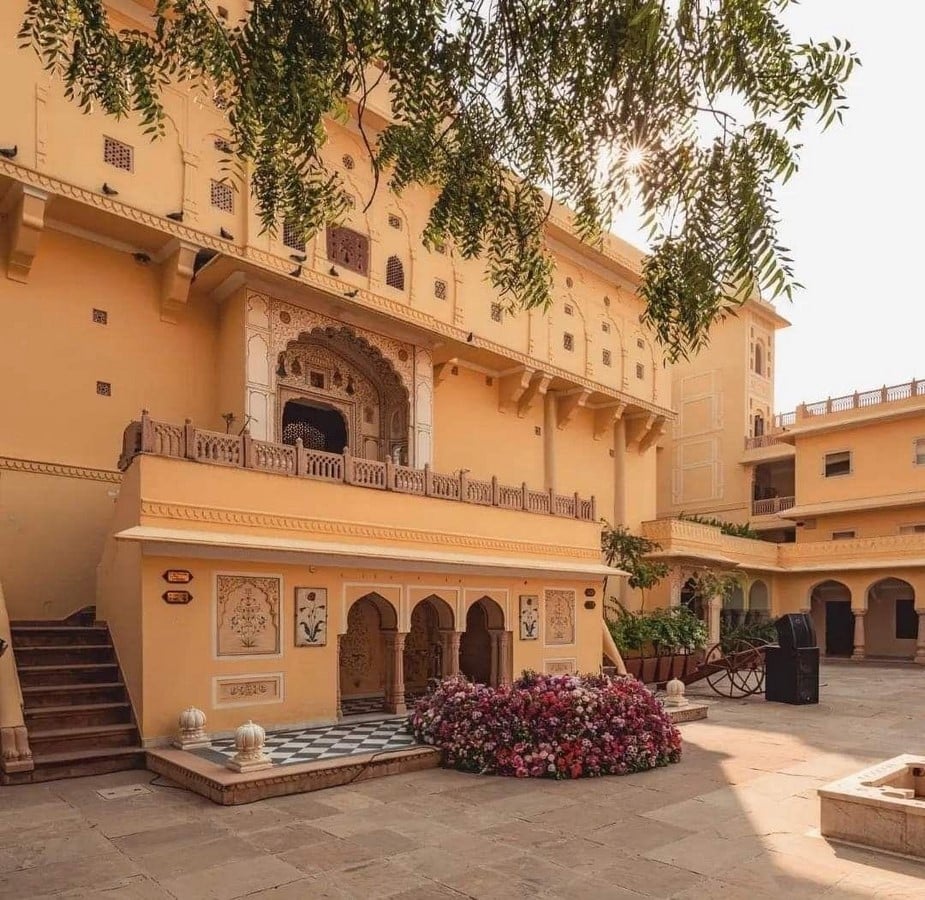
Hot-dry: Jaisalmer, Rajasthan. The yellow-sandstone havelis combine thick stone walls, inward-facing courtyards, deep balconies and perforated stone jalis. A 1984 IIT Delhi study found through temperature measurements that these buildings were reasonably comfortable in both summer and winter (Gupta, 1984). Thermal mass, shade and airflow do the work that a slab-and-glass box now outsources to air-conditioning.
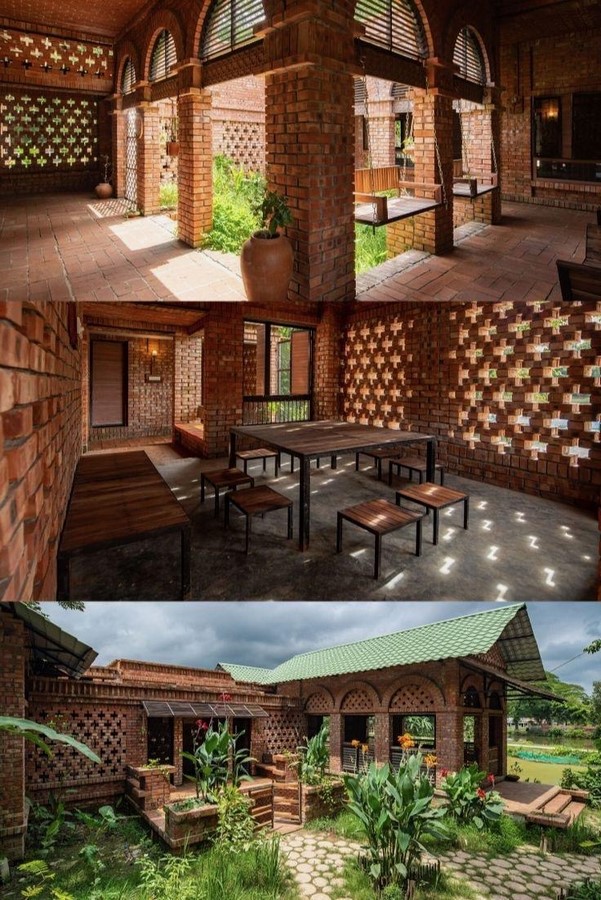
His filler-slab roofs still contain some concrete, but much less of it, which again supports reduction over elimination.
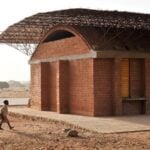
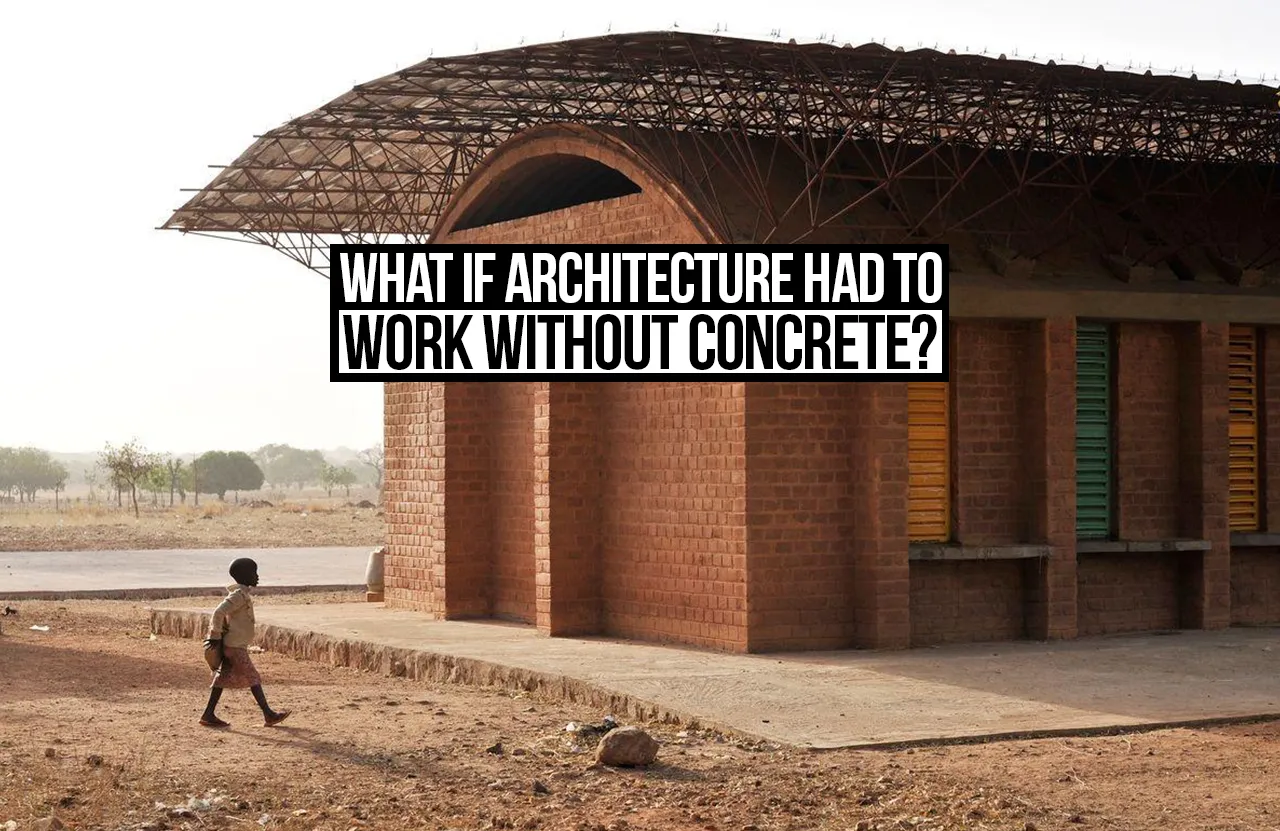
Beyond India, Francis Kéré‘s Gando Primary School in Burkina Faso, built with clay bricks made by the villagers themselves, won the Aga Khan Award for Architecture in 2004 (Aga Khan Trust for Culture, n.d.). In every case, material, climate and labour were decided together, which is exactly the decision concrete lets a designer avoid.
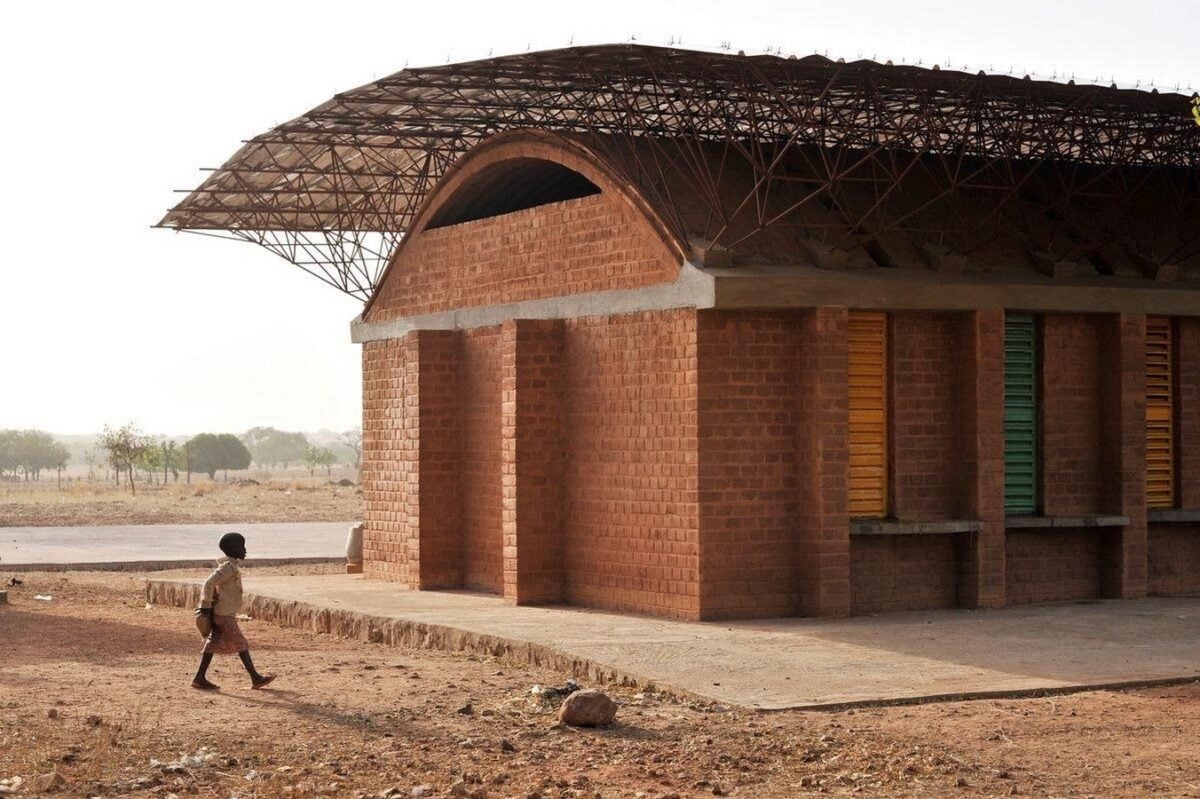
People- Building with local materials changes who builds. At Gando, villagers made the bricks and built the school, and the project secured government support to train people in building with local materials (Aga Khan Trust for Culture, n.d.). In Kutch, owner-driven rebuilding put communities in charge of their own homes (IIED, n.d.). Construction becomes slower and more labour-intensive, but the skills, income and pride stay in the village instead of flowing to a cement plant.
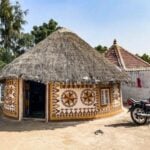
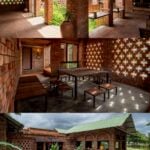
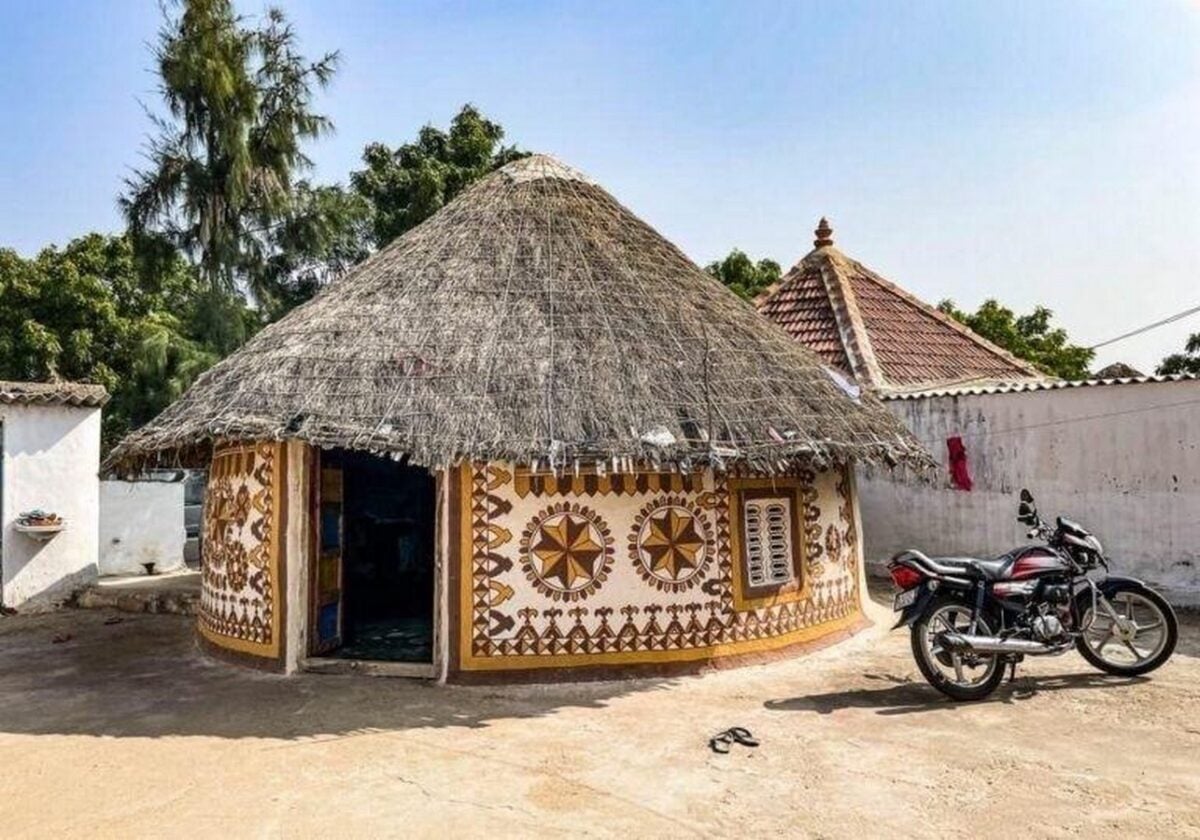
Spaces- Without the freedom of the slab, form follows material. Mud and brick want thick walls, deep eaves, vaults, courtyards and modest spans. The result is architecture that visibly negotiates with sun and rain: a jali that throws patterned light, a verandah that shades a wall, a dome that sheds heat. These buildings also ask for care; bhungas, for instance, need their mud plaster renewed every year (The Better India, n.d.). Tall buildings are not impossible, as Mjøstårnet shows, but the default skyline would be lower and more varied.
Environment – Cement accounts for about 8 per cent of global CO₂ (Lehne and Preston, 2018), so removing it cuts a major source. But changing concrete lowers embodied carbon most effectively if the alternative is local.
One study found that when cross-laminated timber was trucked over 6,000 km, a building’s global warming potential (252–270 kg CO₂/m²) exceeded that of an equivalent reinforced concrete building (245 kg CO₂/m²) (Atnoorkar et al., 2024). Distance matters as much as substance. Earth dug on site, brick fired nearby, and stone quarried regionally travel very little
Limits of the idea
Scale is the hardest limit. India’s cement demand is rising because the country is building housing, roads and metros at a pace no craft tradition can match, and the global sector must also answer a housing shortage (Lehne and Preston, 2018; Global Cement, n.d.). Earth, brick and timber cannot absorb that volume without their own costs: topsoil, kiln fuel and forests.
Knowledge and codes are a second limit. Seismic study of rammed-earth buildings, for instance, is still described as very limited (University of Porto, n.d.), which makes engineers cautious and regulators slow. Maintenance is a third: vernacular buildings need yearly care, and monsoon rain punishes neglect. Finally, the examples above are mostly low-rise, community-scale projects led by exceptional people, and they do not copy easily into a dense metropolis.
These limits no longer cancel the idea. They make it narrower and more credible: a discipline of using less concrete, not a promise of none.
Four lenses, one conclusion
As an architect, the experiment returns the question concrete lets us skip: what is this building made of, and who will make it? In the pov of a climatologist, it exposes how often a concrete box is a climate-blind answer, when hot-dry, warm-humid and composite zones need different buildings. As a designer, it trades freedom of form for freedom of intelligence: the jali, the vault and the courtyard are ideas, not constraints. As a user, it asks what we value: a cool room that needs no machine and a wall we can repair ourselves, or a faster, generic shell.
My conclusion is that concrete should be treated as medicine rather than food. Use it where nothing else can do the job, in foundations, water and critical structure, and design everything else as if it were scarce. That rule is the practical meaning of Architecture and Design in a carbon-constrained world: material choice is the first design decision, not the last specification.
Here the psychological premise returns. Concrete was invented by human minds, and those minds are still at work, from compressed earth blocks to engineered timber. Remove concrete and humanity will not stop building. It will remember how many other things it already knows how to build with.
References:
Aga Khan Trust for Culture (n.d.) Primary School at Gando. ArchNet. Available at: https://archnet.org/sites/4363
Atnoorkar, S., Ghatpande, O.A., Haile, S.L., Goetsch, H.E. and Harris, C.B. (2024) ‘Carbon intensity of mass timber materials: impacts of sourcing and transportation’, Frontiers in Built Environment, 9. Available at: https://www.frontiersin.org/journals/built-environment/articles/10.3389/fbuil.2023.1321340
Auroville Earth Institute (n.d.a) Earth in Auroville: introduction. Available at: https://www.earth-auroville.com/earth_in_auroville_introduction_en.php
Auroville Earth Institute (n.d.b) Visitors Centre. Available at: https://www.earth-auroville.com/visitors_center_en.php
Auroville Earth Institute (n.d.c) Construction projects. Available at: https://www.earth-auroville.com/construction_projects_en.php
Dezeen (2019) ‘Mjøstårnet in Norway becomes world’s tallest timber tower’, 19 March. Available at: https://www.dezeen.com/2019/03/19/mjostarne-worlds-tallest-timber-tower-voll-arkitekter-norway/
Global Cement (n.d.) ‘Think tank spells out decarbonisation path for India’. Available at: https://globalcement.com/news/20338-public-think-tank-spells-out-decarbonisation-path-for-india
Gupta, V.K. (1984) A study of the natural cooling systems of Jaisalmer. PhD thesis, Indian Institute of Technology Delhi. Available at: https://ir.iitd.ac.in/bitstreams/b61c14e9-b724-4947-b883-87d588a9039d/download
Herald Business (n.d.) Norway’s 85-meter Mjøstårnet uses engineered wood in place of steel and concrete. Available at: https://biz.heraldcorp.com/article/10892888
IIED (n.d.) Living heritage approach leads to owner-driven, post-earthquake reconstruction in Gujarat, India. Available at: https://www.iied.org/living-heritage-approach-leads-owner-driven-post-earthquake-reconstruction-gujarat-india
Knowledge at Wharton (n.d.) ‘In a quake’s wake, Hunnarshala builds homes and entrepreneurs’. Available at: https://knowledge.wharton.upenn.edu/article/in-a-quakes-wake-hunnarshala-builds-homes-and-entrepreneurs/
Lehne, J. and Preston, F. (2018) Making Concrete Change: Innovation in Low-carbon Cement and Concrete. London: Chatham House. Available at: https://www.chathamhouse.org/sites/default/files/publications/2018-06-13-making-concrete-change-cement-lehne-preston-final.pdf
Outlook India (n.d.) ‘Building on a dream’. Available at: https://outlookindia.com/society/building-on-a-dream-news-203150
Somvanshi, A. (n.d.) ‘Let’s play with mud’, Down To Earth. Available at: https://www.downtoearth.org.in/amp/story/environment/lets-play-with-mud-40456
The Aarch News (n.d.) ‘Laurie Baker: the quiet revolution in Indian architecture’. Available at: https://theaarchnews.com/?p=8103
The Better India (n.d.) ‘They rebuilt Bhuj after the 2001 earthquake’. Available at: https://thebetterindia.com/179625/bhuj-earthquake-low-cost-sustainable-homes-hunnarshala-gujarat
University of Porto (n.d.) Earthen construction research project. Faculty of Engineering. Available at: https://sigarra.up.pt/feup/en/PROJECTOS_GERAL.MOSTRA_PROJECTO?p_id=70235