A building that listens is a gift. A building that decides for you is a gamble.
Picture a Monday morning in any office. At nine, someone is shivering beneath the air-conditioning vent. At three, someone else is squinting into the glare, tugging down a blind that was never meant for that hour. Nothing about the people has changed. The building simply has not noticed.
That is the quiet stubbornness of most architecture. We pour concrete for one moment in time, then ask it to serve decades of changing lives: the newborn, the teenager working from home, the grandparent who can no longer manage the stairs. Stewart Brand made the point in How Buildings Learn: what matters about a building is largely what happens after it is built.
So here is the thought experiment. What if buildings could adapt to the people inside them, hour by hour and room by room? In Architecture and Design, the idea sounds like pure progress. I want to argue something more interesting. The question is not whether buildings can adapt, because in small ways they already do. The question is who is holding the controls when they do.
01 An old dream, and an older instinct
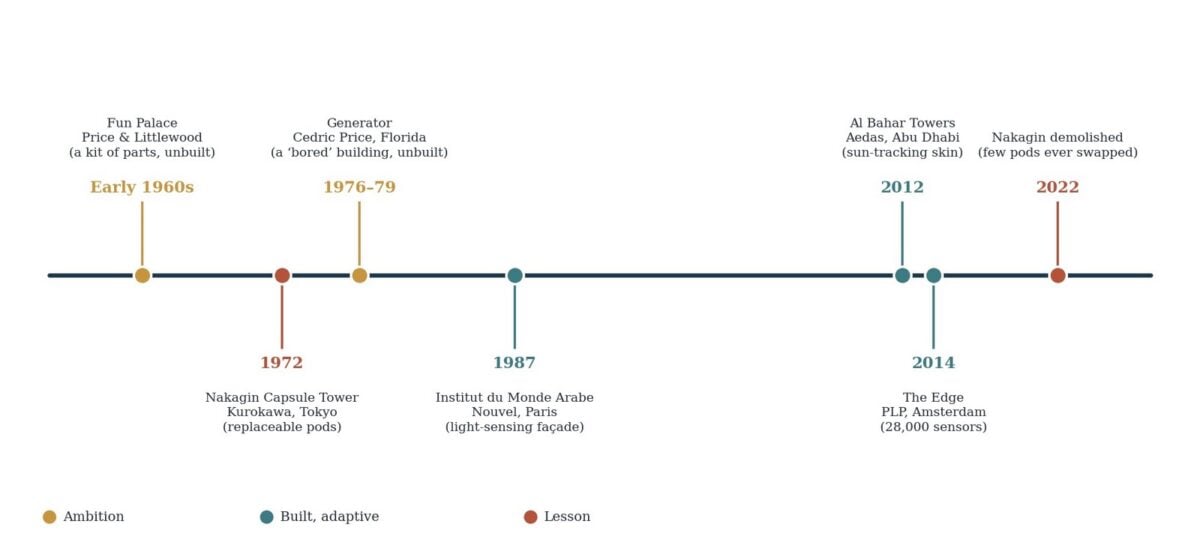
The ambition is far from new. In the early 1960s the architect Cedric Price and the theatre director Joan Littlewood imagined the Fun Palace, a kit of parts that its users would rearrange themselves. Price’s Generator, designed between 1976 and 1979 for a site in Florida, went further: movable cubes and walkways, and a computer programme meant to suggest new layouts. Accounts of the project say the software was even supposed to grow “bored” if nobody changed anything, and to nudge people into reconfiguring the place. Neither scheme was built. Both asked the right question: should a building ever be finished?
Ordinary builders answered long before computers. In many traditional homes across Rajasthan and Gujarat, families moved between cooler lower rooms and open upper terraces as the seasons turned. The courtyard worked as a climate machine, and the carved stone jaali filtered heat and glare while preserving privacy. Those buildings adapted, but they did it through people. Nobody needed a sensor, because the occupants were the sensors.
02 The dream, built (and a little bruised)
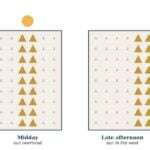
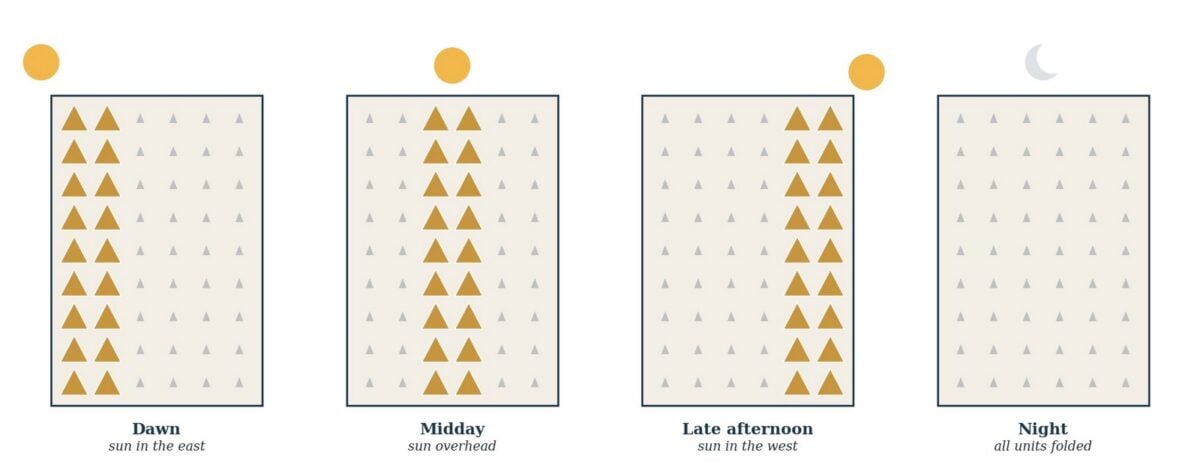
Today’s versions are more technical. Abu Dhabi’s Al Bahar Towers, completed in 2012, wear a second skin of roughly 1,000 umbrella-like units per tower (about 2,000 in all), reimagining the traditional mashrabiya screen. Driven by actuators, they open and fold as the sun moves round the building. The designers at Aedas estimated that the system would cut solar gain by around half and save over 1,750 tonnes of CO₂ a year. Those are design-stage estimates, but the logic is persuasive in a city where the sun is the enemy.
Paris tells the cautionary version. Jean Nouvel’s Institut du Monde Arabe (1987) wears a south façade of 240 moucharabiehs, reported to hold some 27,000 light-sensitive diaphragms that open and close like a camera lens. It is gorgeous. It also suffered technical failures and has had to be adapted, a reminder that motors age faster than masonry.
And then there is The Edge in Amsterdam. Completed in 2014 for Deloitte, it carries about 28,000 sensors and an app that finds each person a desk. It earned a BREEAM score of 98.36 per cent, the highest ever awarded at the time. Yet the detail that fascinates me is tucked into Bloomberg’s 2015 report: fewer than a quarter of employees actively used the app’s thermostat features, while three-quarters said they loved it. Having the option mattered even to those who never used it.
People did not need to use the control. They needed to know it was theirs.
03 If it became the norm
For people, the gains could be profound. A building that tunes light, sound and layout could be kinder to neurodivergent users, to older residents ageing at home, and to anyone whose needs shift with health or mood. Comfort would stop being averaged across a crowd and become personal. For space, adaptability is a form of generosity: a classroom that becomes a community hall at night, or an office that becomes housing as work patterns change. In Mumbai or Hong Kong, where floor area is the rarest luxury, one room doing the work of three is not a gimmick. It is a different way of making space.
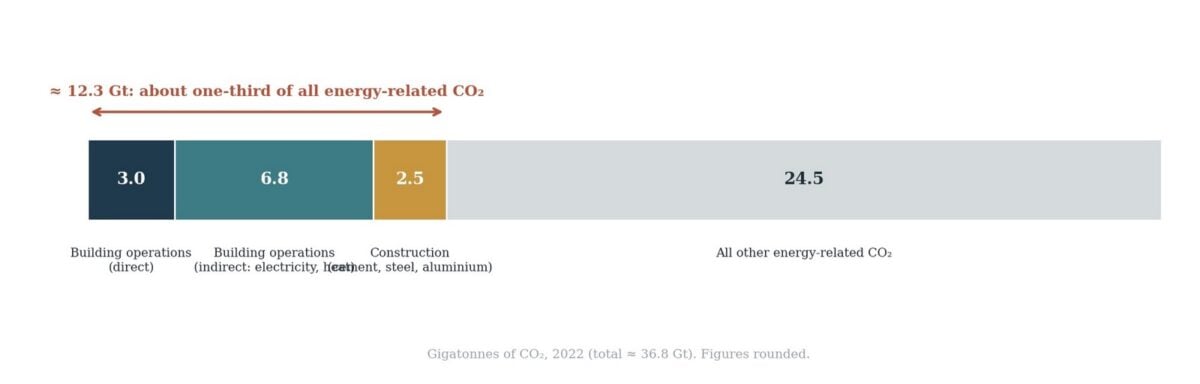
For the planet, the stakes are large. The International Energy Agency reports that the operation of buildings accounts for about 30 per cent of global final energy use and 26 per cent of energy-related emissions. Add the making of cement, steel and aluminium for construction and the sector accounts for one-third of all energy-related CO₂. A building that stays useful for a century, instead of being demolished at thirty, is one of the greenest things we can build.
04 Where the dream cracks
The thought experiment also exposes its limits, and they are instructive. Kisho Kurokawa’s Nakagin Capsule Tower in Tokyo (1972) was designed so its pods could be unplugged and replaced as needs changed. Almost none ever were, and the tower was demolished from 2022. Flexibility that is designed but never exercised is only decoration.
Then there is the question of whose comfort wins. Anyone who has endured an office thermostat war knows that “the occupant” is rarely one person. A building that adapts to you must first know you, which means tracking movement, habits and perhaps biometrics. Without privacy designed in, the smart home becomes a surveillance device. Sensors, motors and software carry their own embodied carbon, and they raise an uncomfortable question about who can afford them. If adaptive buildings become a luxury, they will widen the gap between homes that serve their owners and homes that merely contain them.
05 Control beats cleverness
The most useful research here is not about technology at all. The adaptive thermal comfort work of Richard de Dear and Gail Brager, published in 1998, found that people tolerate a wider range of conditions when they can act on their surroundings by opening a window, drawing a blind or changing a layer. Perceived control matters almost as much as the temperature itself. A perfectly optimised building that cannot be overruled can feel worse than a slightly imperfect one that answers a hand on a handle.
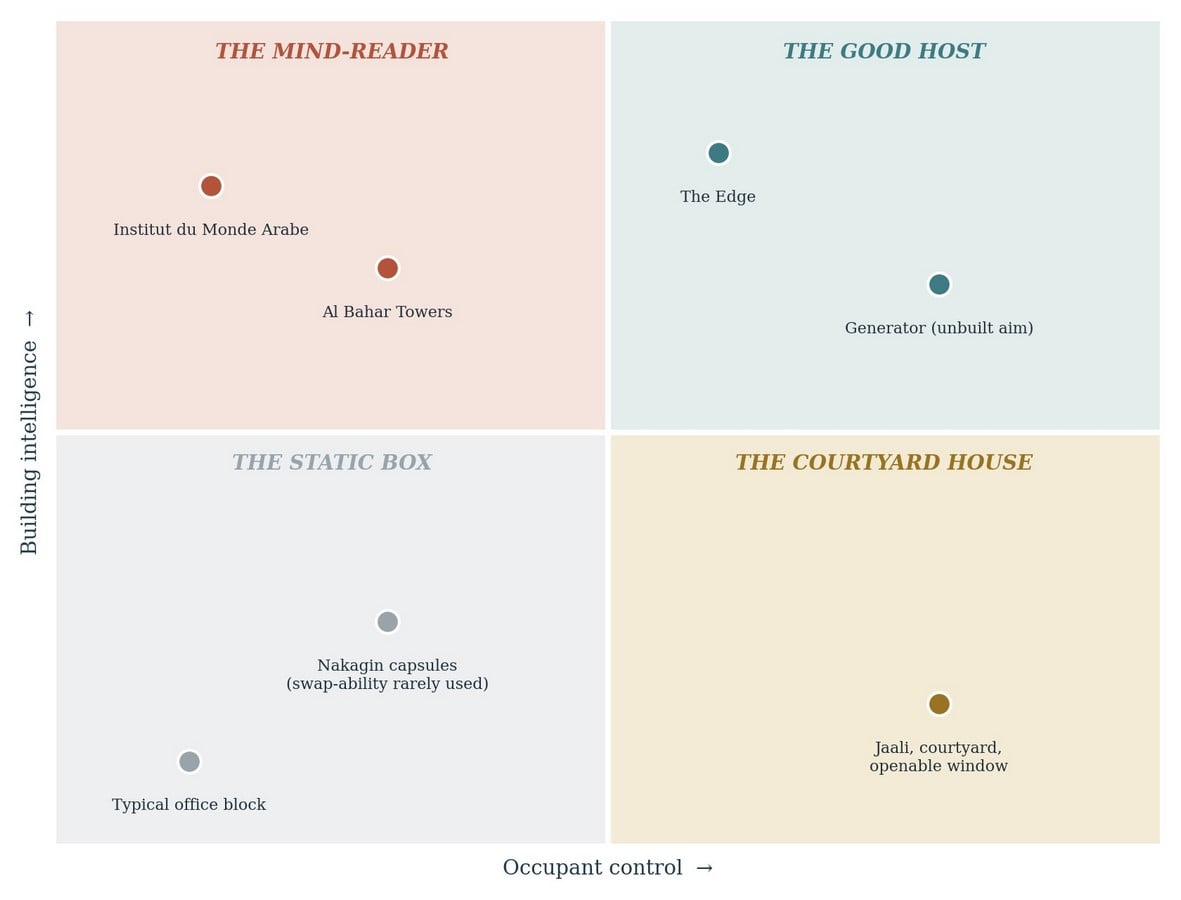
My position follows from that. The goal is not a building that predicts and manages its occupants, but one that behaves like a good host. Three principles would get us there. First, adapt slowly and legibly, so people can see why a wall moved, or a shade came down. Second, always allow a human override, because a building’s intelligence should be an offer and never an order. Third, adapt only with consent, keeping data local, minimal and visible. By those tests, a sliding screen, a deep window seat, a courtyard and a window that actually opens are as “smart” as any algorithm.
06 The last word
If buildings could adapt to their occupants, we would stop treating architecture as a finished object and start treating it as a relationship. That relationship could make our homes kinder, our cities leaner and our carbon budgets lighter. It could just as easily make them intrusive, fragile and unequal. The difference will not be decided by how many sensors we install. It will be decided by whether we remember that a building exists for the people inside it, and that they are best placed to say what they need.
The most adaptive building of the future may be the one that listens, answers, and then lets us have the last word.
Sources and image references:
- Brand, S. (1994). How Buildings Learn: What Happens After They’re Built. Viking.
- de Dear, R. and Brager, G. (1998). Developing an adaptive model of thermal comfort and preference. ASHRAE Transactions, 104(1a).
- Energy Digital. Developing a construction strategy with a clean energy focus (summary of IEA data). https://energydigital.com/renewable-energy/developing-a-construction-strategy-with-a-clean-energy-focus
- GlobalABC. IEA Tracking Report: Buildings (2022). https://globalabc.org/index.php/resources/publications/iea-tracking-report-buildings
- Gulf Construction. Challenging innovation (Al Bahar Towers, interview with Peter Oborn, Aedas). https://www.gulfconstructiononline.com/Article/13188/Challenging_innovation
- The Structural Engineer. The impressive Al Bahar Towers. https://www.thestructuralengineer.info/news/the-impressive-al-bahar-towers
- Randall, T. (2015). The Smartest Building in the World. Bloomberg. Photographs by Ronald Tilleman and Raimond Wouda. https://www.bloomberg.com/features/2015-the-edge-the-worlds-greenest-building/
- World Economic Forum (2017). Is this the world’s greenest, smartest office building? https://weforum.org/agenda/2017/03/smart-building-amsterdam-the-edge-sustainability
- ArchDaily. AD Classics: Institut du Monde Arabe / Jean Nouvel (photography by Georges Fessy appears in ArchDaily, Light Matters: Mashrabiyas, https://www.archdaily.com/510226). https://www.archdaily.com/162101/ad-classics-institut-du-monde-arabe-jean-nouvel
- Cedric Price Fonds (Fun Palace and Generator), Canadian Centre for Architecture, Montréal. Nakagin Capsule Tower: Kisho Kurokawa Architect and Associates.
- Figures 1 to 4 and the cover pattern are original illustrations created for this article.