
Keeping track of employee hardware once meant sprawling spreadsheets, frantic email threads, and devices vanishing the moment someone quit. The best device lifecycle management platforms swap all that chaos for automated workflows covering procurement, deployment, tracking, retrieval, and disposal, often from one dashboard. This roundup covers six platforms worth evaluating in 2026, ranging from global automation tools to lightweight asset trackers.
What device lifecycle management platforms actually do
A device lifecycle management platform gives IT teams a single system to manage hardware from the moment a purchase order goes out to the moment a device gets wiped and resold. That sounds simple, but the hard part is connecting the stages: procurement links to deployment, deployment links to employee records, and when someone leaves, the system should automatically trigger retrieval without IT chasing anyone down.
These platforms vary widely in scope. Some focus on discovery and CMDB mapping for complex data center environments. Others prioritize physical asset tracking with barcode scanning. The strongest options for distributed teams tie into HRIS and MDM tools, so that a new hire in the system sets off a chain of events ending with a pre-configured laptop on their doorstep.
1. Workwize
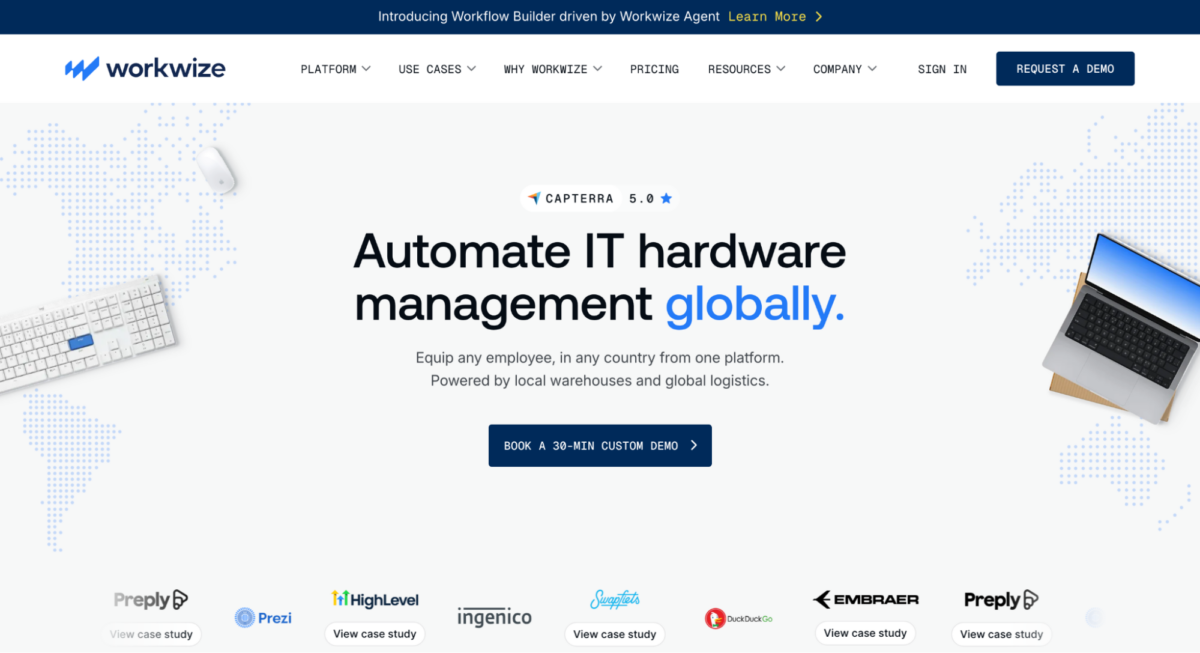 Workwize covers the full hardware lifecycle: procure, deploy, track, retrieve, and dispose: across 120 countries from one platform, with HRIS-triggered automation removing the manual handoffs.
Workwize was founded in Amsterdam in 2020 and now manages 120,000+ devices, giving IT teams a single registry with 100% chain-of-custody visibility. Local warehouses in 120 countries mean hardware ships at regional retail prices instead of cross-border rates, and new hires typically get pre-configured, MDM-enrolled devices within 2 to 7 days. Retrieval rates when employees leave reach up to 98%, and certified ITAD recovers roughly 45% of device value on resale.
- Automation: HRIS events (new hire, departure, role change) trigger deployment or retrieval automatically; 95% faster approvals vs. manual
- Connections: 80+ HRIS, MDM, and identity tools – including Jamf, Microsoft Intune, BambooHR, Okta, and Slack – with SSO, SCIM, and a public API
- Security: ISO 27001 certified, SOC 2 Type II compliant, GDPR compliant
- Pricing: Quote-based across three tiers (Starter, Professional, Enterprise); no public list price
2. Anunta
 Anunta is an India-headquartered managed workspace provider specializing in Desktop-as-a-Service and endpoint management for mid-size and enterprise organizations.
Founded in 2012 with around 794 employees, Anunta has migrated 1 million remote desktop users and landed in the Gartner Magic Quadrant for DaaS four consecutive years. Its suite – DesktopReady™, CloudOptimal®, and EuVantage® – spans deployment, monitoring, and performance tuning across private, public, and hybrid cloud environments. Partner integrations include Omnissa, Nutanix, Azure, and Hexnode, and the company draws on case studies across aerospace, banking, healthcare, and retail. Device Lifecycle Management sits inside a broader DaaS and Modern Desktop Management offering rather than standing alone, so buyers focused mainly on physical hardware tracking may find the scope wider than they need.
- Automation: Device Lifecycle Management is part of a broader managed service; workflow automation is handled within the DaaS and Modern Desktop Management suite rather than as a standalone capability
- Connections: Partner integrations include Omnissa, Nutanix, Azure, and Hexnode
- Security: Custom quotes; pay-per-user billing referenced on the site
- Pricing: Custom quotes; pay-per-user billing referenced on the site
- Considerations:
– 1M+ remote desktop users migrated
– $3.78M raised from Bessemer Venture Partners
– Ranked in MSP 501 Top 100
– Services span Enterprise DaaS, VDI Migration, Modern Desktop Management, Mobile Device Management, and Device Lifecycle Management
3. Teqtivity
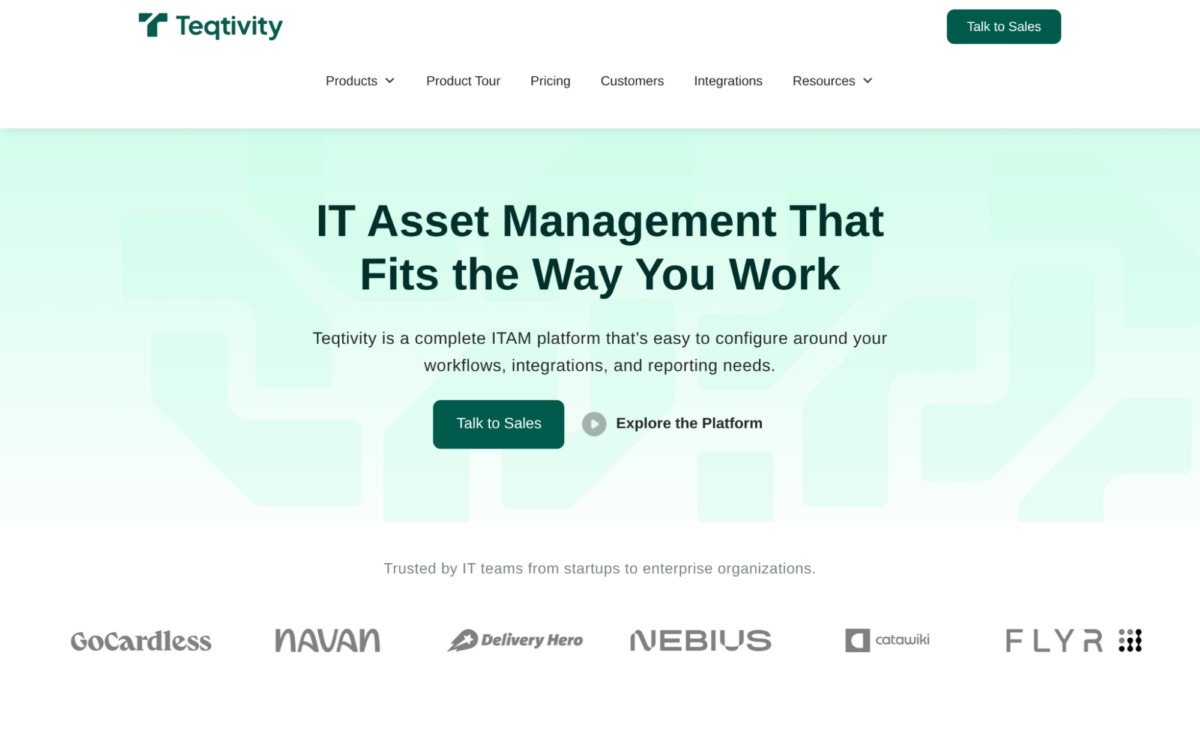 Teqtivity is a California-based IT asset management platform built for teams that want unlimited device tracking tied to user count rather than asset volume.
Founded in 2017 and based in Cerritos, California, Teqtivity covers the full asset lifecycle – procurement, deployment, storage, maintenance, and disposal – backed by a dashboard reporting layer and a compliance and security module. Its user-based pricing keeps costs predictable; organizations pay per user managing assets, not per device, which suits fast-growing teams where device counts outpace headcount. The support team acts as an extension of the customer’s IT department rather than a conventional help desk, and feature development follows directly from what users request. Teqtivity currently employs 11 to 50 people and targets financial services, healthcare, education, manufacturing, and tech industries.
- Automation: Workflows cover people joining and leaving; feature development follows directly from user requests, keeping automation aligned with real team needs
- Connections: Dashboard reporting layer connects to compliance and security tracking across the full asset lifecycle
- Security: Compliance and security tracking module included across all plans
- Pricing:
– Tiered by number of users managing assets
– Enterprise plans available on request
– Unlimited devices across all tiers
- Considerations: Best suited to growing IT teams that need flexible per-user pricing and a high-touch support relationship
4. Device42
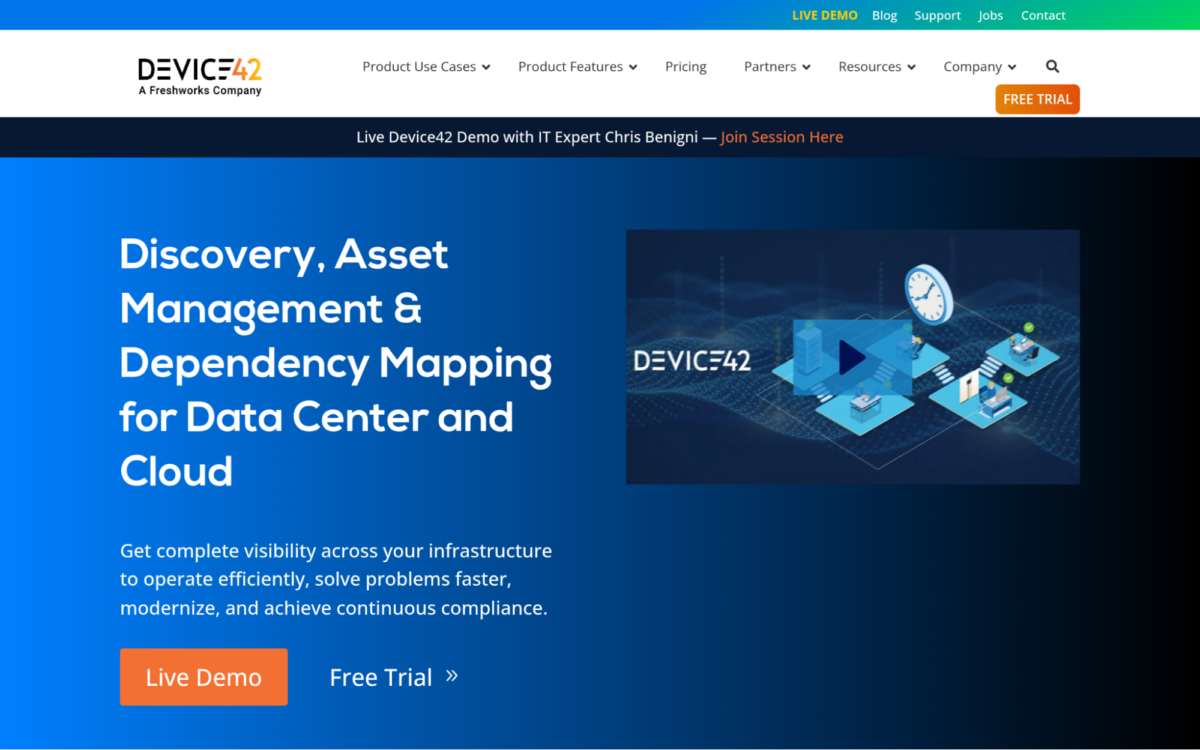 Device42 is a hybrid IT discovery and dependency mapping platform acquired by Freshworks in May 2024 for $230M, now operating as a separate business unit.
Founded in 2010 in West Haven, Connecticut, Device42 is built around agentless discovery, scanning on-premises infrastructure, cloud environments, and containers without installing agents on every endpoint. Its CMDB, application dependency mapping, IPAM, and SSL certificate management tools are designed for organizations managing complex hybrid environments. InsightsAI adds natural language query processing to reporting. According to the company, users resolve outages 10x faster on average and see a 4.8x return on investment. Device42 integrates with 30+ tools including ServiceNow, Jira, and Ansible, and serves organizations across 70+ countries. Pricing isn’t published publicly.
- Automation: Agentless, near-real-time CMDB with automated application dependency mapping; InsightsAI adds natural language query processing to reporting
- Connections: ServiceNow, Jira, Ansible, and 30+ others
- Security: Serves organizations across 70+ countries; pricing isn’t published publicly
- Pricing: Not published publicly; contact sales for a quote
- Considerations: Skewed toward infrastructure discovery rather than physical hardware logistics
5. Asset Tiger
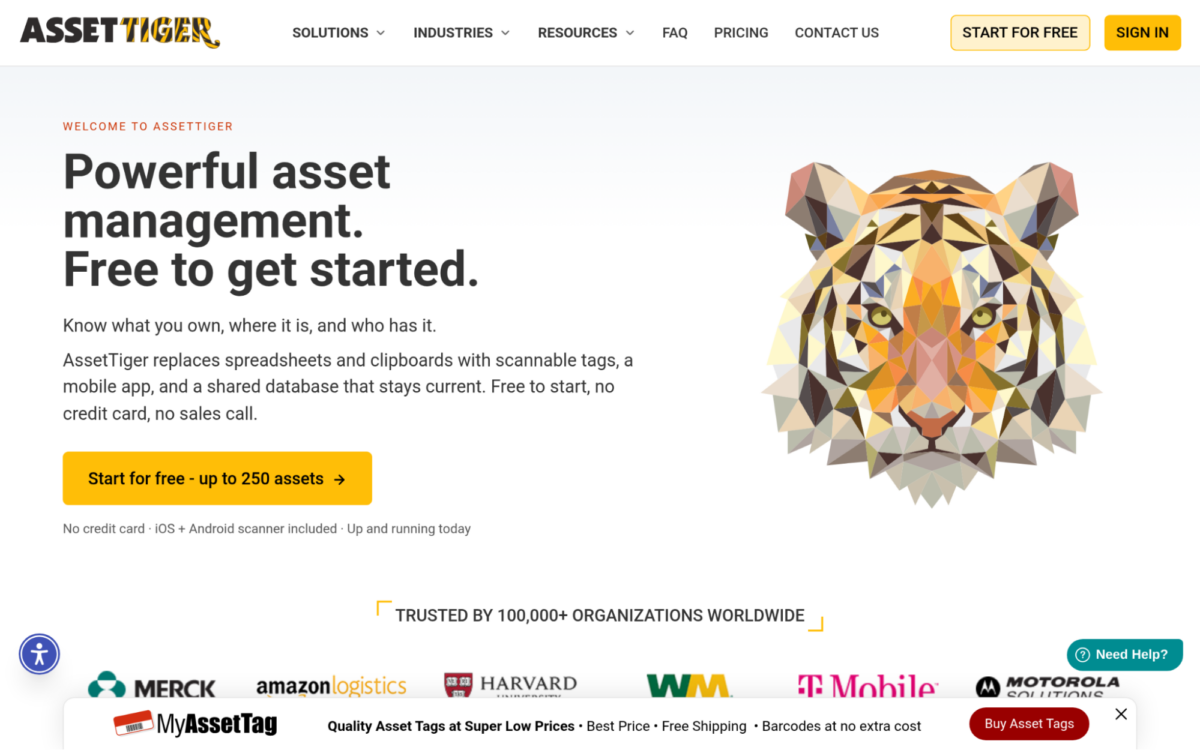 Asset Tiger is a free-to-start asset tracking platform built and operated by SmartSign LLC, the team behind MyAssetTag.com, serving 100,000+ organizations.
The platform launched in 2013 as a value-add for barcode label customers and has since grown into a standalone tool with barcode and QR code scanning, check-in and check-out custody logging, maintenance and warranty tracking, and 80+ built-in report types covering depreciation, audit reconciliation, and contract expiries. Its pricing inverts what most competitors charge. Plans scale by asset count, never by user count, so the entire team’s always included, from a free tier capping out at 500 assets up to 250,000 assets. The platform holds a 4.6 rating across 271 Capterra reviews and has earned recognition from GetApp and GoodFirms. SmartSign has 133 employees and is based in Brooklyn, New York.
- Automation: Lightweight on automation; no native HRIS connection for triggering workflows when people join or leave
- Connections:
– Barcode and QR code scanning
– 80+ built-in report types
– No native HRIS integration
- Security: Audit reconciliation reporting included; maintenance and warranty tracking available across all plans
- Pricing:
– Free up to 500 assets
– Scales by asset count
– Unlimited users on every plan
- Considerations: Best suited to schools, nonprofits, government agencies, and small IT shops with tight budgets
6. Work Elevate
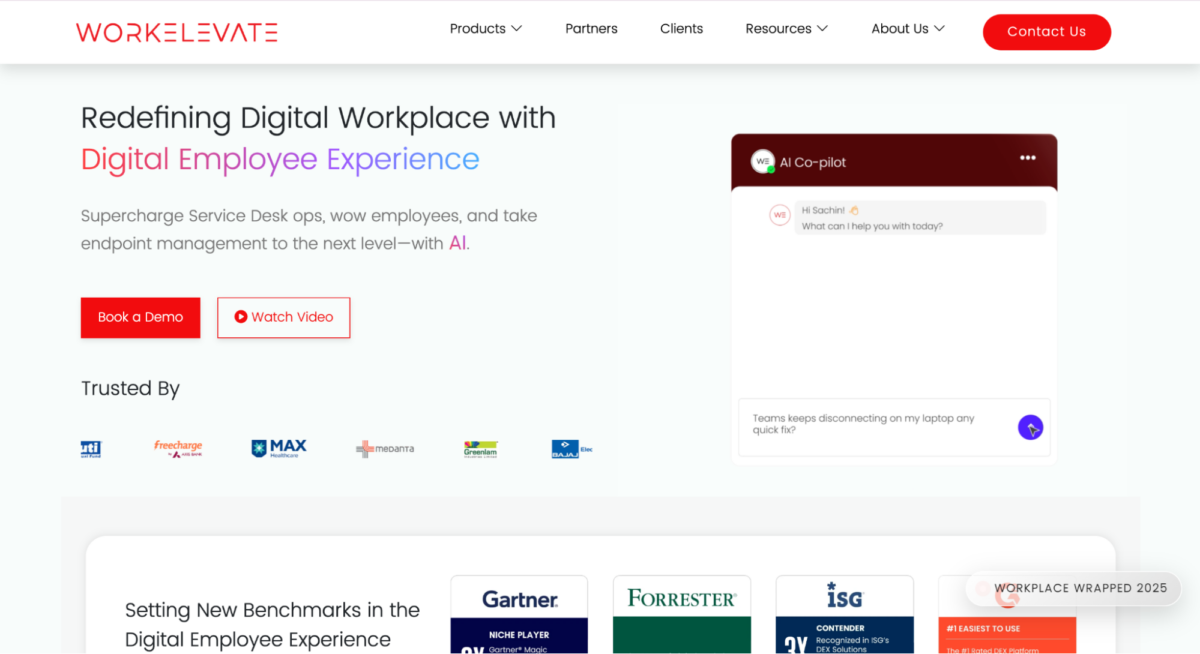 Work Elevate is a digital workplace platform by Progressive Infotech that combines an IT copilot, endpoint management, and digital employee experience tools in a single subscription.
The product originally launched in 2018 as a script-based automation tool called AutomateNext, was renamed Workelevate in 2019, and is now headquartered in Noida, India, with 24 employees. Its AI Copilot handles routine tickets – password resets, software installs, troubleshooting – and connects with ServiceNow, Jira, BMC, ManageEngine, and Freshservice. Workelevate reports automating 70 to 75% of repetitive IT tickets, with customer examples showing 25% to 42% reductions in ticket volumes. It ranked #23 on G2’s Best Indian Software Companies list and #48 on G2’s Best APAC Software Companies list. Pricing follows a subscription model tiered by user count and feature access.
- Automation: 70 to 75% of repetitive tickets automated; proactive monitoring included
- Connections: ServiceNow, Jira, BMC, ManageEngine, and Freshservice
- Security: Subscription model; pricing tiered by user count and feature access
- Pricing: Subscription model tiered by user count and feature access; no public list price
- Considerations: Small team (24 employees); better suited to IT helpdesk automation than end-to-end hardware lifecycle management
What to consider when choosing a platform
The right platform depends on which part of the lifecycle is actually broken. Teams managing distributed hires across multiple countries need strong procurement and retrieval automation, plus HRIS connections that trigger workflows without manual intervention. For data center and hybrid cloud environments, discovery-first tools with a CMDB like Device42 handle dependency mapping that physical asset tools don’t touch.
Budget structure matters too. Asset Tiger’s asset-count pricing works for cost-conscious organizations. Teqtivity’s user-count model suits teams where devices outnumber the people managing them. And for anyone running complex desktop-as-a-service setups, Anunta and Work Elevate bring managed service depth that pure-SaaS platforms don’t replicate.
Security and compliance requirements should filter the list early. SOC 2 Type II and ISO 27001 certification aren’t universal across this field, and for companies in regulated industries, that gap isn’t minor.
Bottom Line
These best device lifecycle management platforms span a wide range of needs, from agentless infrastructure discovery to global hardware logistics to budget-friendly asset tracking. The strongest fit comes down to four questions: how distributed is the workforce, how much HRIS and MDM automation is required, what the compliance posture demands, and whether physical hardware or virtual desktop environments are the main concern. Matching the platform to those specifics, rather than to a feature checklist, is what actually determines whether the tool cuts IT workload or just adds another dashboard to manage.