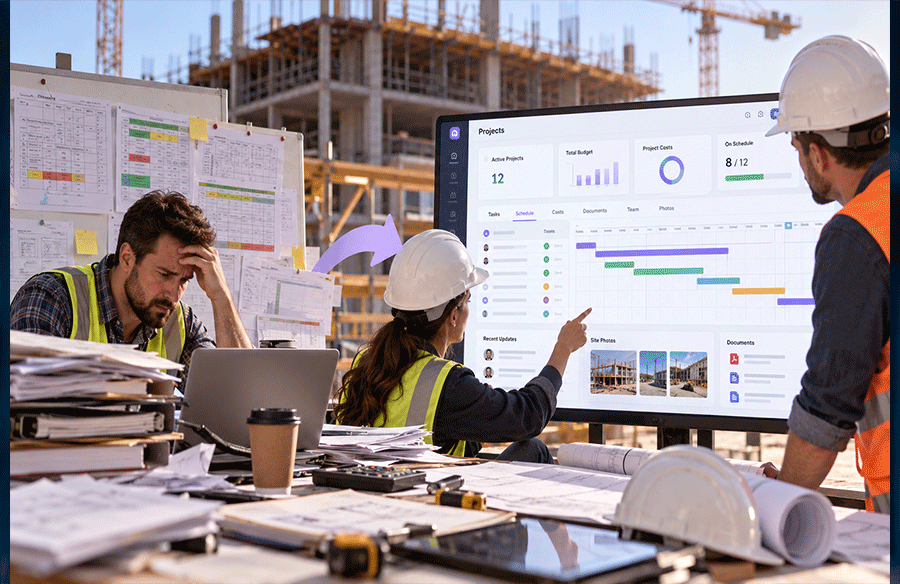
It is the last Thursday of the month. Your controller is trying to close out three jobs at once, but the labor hours in one spreadsheet do not match the totals emailed by the superintendent. A change order worth tens of thousands was approved by text message two weeks ago and never made it into the budget file. By Friday, a project that looked profitable all quarter lands in the red. This is not a hypothetical. It is a Tuesday morning reality for midsize contractors running their operations through spreadsheets, email threads, and personal phones. This is the point where key construction software becomes essential to regain control and visibility.
How Construction Companies Really Run Before Modern Software
Most construction businesses start the same way. Job lists live in Excel files. Budgets sit in another workbook. Timesheets get entered into Google Sheets. Payroll runs through a separate app. Estimating happens in yet another tool. Communication is a mix of email, group texts, and photos saved on personal phones.
For a small business running a handful of projects with a tight crew, this patchwork works. But once headcount crosses a threshold, subcontractor lists grow, and the company juggles concurrent jobs across regions, the fragile system cracks.
Warning Signs You Have Outgrown Spreadsheets and Ad Hoc Tools
If any of the following sound familiar, you have likely outgrown your current systems:
- Version conflicts: Different project managers updating their own copies of the same budget. One superintendent works from an outdated file, and the office discovers the mismatch only after an invoice goes out.
- Double data entry: Hours keyed from paper into Excel, then re keyed into accounting software. Vendor invoices entered into both accounting and a separate job cost workbook.
- No real time job status: The office cannot see whether inspections passed, whether materials landed on site, or whether crews were pulled to another job.
- Budget surprises: Receipts sit in truck glove boxes. Nine out of ten construction projects face cost related challenges, and construction projects experience an average cost overrun of 28 percent.
- Invoicing pain: Billing requires pulling data from timesheets, email approvals, and multiple excel files, increasing the risk of missed billable items and delayed cash flow.
- Knowledge locked in heads: One foreman knows the real punch list status. One coordinator understands the spreadsheet formulas.
Why Generic Construction Software Often Still Disappoints
Not all construction software is equal. Construction management software should match specific job needs, but many platforms are designed around a particular type of contractor or project size, forcing everyone else to bend their process. Here is a closer look at how popular tools specialize:
| Platform | Best For | Key Capability |
| Workyard | Contractors needing job costing and compliance | Automates job costing with real time updates |
| Procore | Large scale general contractor project management | Integrates with Oracle, Sage, and Microsoft Project |
| Buildertrend | Client communication for residential projects | Supports scheduling in Gantt, list, and calendar views |
| JobTread | Connecting estimating and job costing in one system | Allows unlimited jobs and document access on every plan |
| Fieldwire | Fast plan markup and punch list tracking | Enables real time updates for task lists and punch lists |
| Planera | Scheduling and planning | Uses critical path method for scheduling |
For many growing firms, the right software is not another template or subscription. It is a thoughtful spreadsheets replacement built as custom construction software around their specific workflows. As the SoftDoes team puts it, “When your business has outgrown the tools you started with, we build something that actually fits.”
What a Real Spreadsheets Replacement Should Look Like
A genuine spreadsheets replacement is a single platform that centralizes documents, costs, schedules, workflows, and communication. Construction software lets team members comment on tasks, share documentation, and track progress without switching between apps, so every stakeholder, from foremen to CFOs, works from the same data. As VentureBeat notes in its analysis of how software is helping construction scale
, construction is collaborative at its core, so the tools behind it need to connect every team member in real time.
What this looks like in practice:
- Real time task tracking: Construction management software allows real time task tracking and updates. Mobile access allows real time updates from job sites so the office never waits for a phone call. Real time monitoring prevents cost overruns and maintains profitability.
- Automated workflows: Construction software can automate workflows and reduce administrative tasks. Time entered in the field flows into job cost, payroll export, and invoicing without re keying. Real time job costing allows managers to catch overruns mid job.
- Centralized cloud storage for project documents ensures everyone accesses current revisions. Construction management software helps track project expenditures in real time and provides insights into project profitability.
- Integrated tools: Effective project management relies on integrating specialized tools. Construction software addresses specific bottlenecks in workflow processes, and construction management software helps track project stages effectively. Data driven dashboards improve decision making and project visibility.
- End to end coverage: Real time communication tools improve collaboration among contractors and construction teams. Construction project management software improves efficiency and reduces errors across the entire project lifecycle.
Soft Landing Into the Future of Construction Operations
Most contractors start with spreadsheets. That is natural. But there is a point where errors and delays eat margin faster than new projects can create it. Unlike Excel, a tailored platform matches how you actually bid, build, and bill. It does not force your processes into someone else’s workflow or charge you per seat as your team scales. Investors have taken notice of how much value sits in better construction data: TechCrunch covered Bridgit’s funding round for a platform that replaces scattered workforce planning with a single source of truth. The only sustainable spreadsheets replacement is one built around your operations, not a free plan you have outgrown or a licensed tool billed annually that never quite fits.
Conclusion: Embrace Custom Software for Sustainable Growth
For growing construction companies, the limitations of spreadsheets and disconnected tools become painfully clear as projects multiply and complexity increases. The hidden costs of errors, delays, and lost margins add up quickly, undermining profitability and operational control. Generic construction software often falls short, forcing teams to adapt to rigid workflows that don’t fit their unique needs. The future lies in custom software solutions designed specifically as a comprehensive spreadsheets replacement. Such platforms unify project management, budgets, crews, subcontractors, documents, and payments into one accessible, secure, and scalable system.