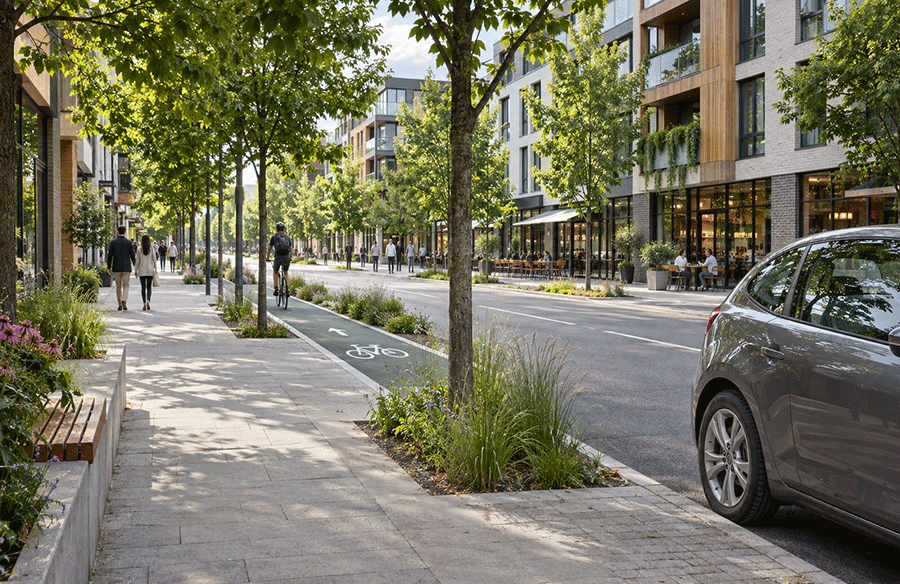
A street can have generous sidewalks, carefully chosen paving and a row of healthy trees, yet its environmental performance still depends partly on what moves through it. Vehicles bring material consumption, energy demand and noise into the spaces between buildings. Their tires connect these impacts to the road itself.
Sustainable tires therefore deserve a place in discussions about better cities. Their potential extends from renewable and recycled ingredients to more efficient use, while their limitations remind designers to consider the whole transport system. For architects, planners and development teams, the useful question is how tire technology can support a street that already makes walking, cycling and public transport practical.
Start with the journeys a place creates
Consider two hypothetical residential developments. Both have efficient buildings and electric-vehicle charging. In one, residents can reach shops, a bus stop and a school along direct walking routes. In the other, those destinations require a drive along disconnected roads.
A vehicle specification alone cannot describe the difference between these places. Their layouts shape how often people need to drive, how much space goes to parking and where traffic meets public space. Tire improvements belong within that wider design discussion.
This gives project teams two connected responsibilities. They can make everyday destinations easier to reach without a car, and they can ask better questions about vehicles used for journeys that remain. A development with a shared-car service, for example, has an opportunity to connect its mobility plan with the operator’s purchasing and maintenance decisions.
Apply a life cycle approach to tire materials
Architects already ask where a building material comes from, how it performs and what happens when it leaves service. Tires deserve the same scrutiny. A higher recycled-content figure answers one part of the question; it does not describe the product’s complete environmental impact.
Research into sustainable tires illustrates how material choices are changing. Giti reports a prototype containing 93 percent sustainable materials, divided into 53 percent renewable and 40 percent recycled content. Its examples include pine resin, rice-husk-derived silica, recovered carbon black and recycled steel. These are manufacturer-reported prototype figures, not specifications for every tire in its commercial range.
The distinction is useful for anyone familiar with experimental construction materials. A promising demonstration shows what may be technically possible. Procurement still needs evidence for the product that will actually be supplied, including its performance, availability and documented composition.
For a project’s shared vehicles, that means asking the operator to identify the exact tire model and specification behind an environmental claim. A company-wide sustainability ambition should not become an assumed attribute of an individual purchase.
Treat road noise as part of public-space design
The sound of a street affects how people experience a café terrace, a residential entrance or a route to school. Tire noise is one part of that acoustic setting, making it relevant beyond the vehicle cabin.
The European Commission’s tire-label guidance distinguishes external rolling noise from other performance measures. The label also reports energy efficiency through rolling resistance and wet grip. These separate measures help explain why a single description such as “quiet” or “efficient” cannot stand in for a complete assessment.
When comparing passenger car tires, the distinction between cabin comfort and external noise is particularly important. For example, the linked P10 product page describes tread design intended to improve noise inside the car. That claim does not by itself establish how quiet a neighboring sidewalk will be.
For an architect or public-realm designer, the practical response is to include acoustic questions early. Where will vehicles pass close to outdoor seating? Which building entrances face the busiest route? Can service access be arranged without placing routine vehicle activity beside a quiet courtyard? Tire selection can contribute, while the layout still determines where people encounter traffic.
Look beyond the exhaust pipe
Electric vehicles remove exhaust emissions at the point of use, but contact between tires and roads remains. The OECD’s work on non-exhaust particulate emissions identifies tire wear, road wear and resuspended road dust as continuing sources associated with electric vehicles. It also explains that emissions depend on factors including vehicle weight, material composition and driving behavior.
For urban design, this broadens the environmental brief. A charging strategy addresses one aspect of mobility; it does not answer every question about traffic near homes, schools or planting areas.
A 2023 study in the journal Toxics examined tire particles in relation to urban parks and highlighted gaps in understanding their effects on soil organisms. Its relevance for landscape practice is the connection between a road and its surroundings. Planting beside traffic should be considered alongside the movement of road runoff and deposited particles, rather than treated as evidence that the traffic impact has been resolved.
These findings support coordination between transport, drainage and landscape specialists. Project teams can ask where runoff travels, who maintains drainage features and what site-specific evidence is needed. A row of trees and an electric charging point are useful elements, but the environmental brief must also account for the less visible effects of vehicle use.
Connect the design brief to everyday operation
The most useful contribution a design team can make is to carry its intentions into the way a place is managed. For a hypothetical mixed-use development with shared cars, that could mean a short set of questions agreed with the operator before opening.
First, what evidence supports the tire specification? Keep material claims separate from energy-efficiency and noise information, and identify which evidence applies to the supplied product.
Second, who owns the maintenance process? The brief can require a documented arrangement for professional inspection and servicing, without asking architects or residents to make technical tire judgments.
Third, what happens to tires when they leave service? Ask the operator to identify the collection provider and recovery route. Treat an end-of-life plan as something to document rather than assume from a recycling symbol.
Finally, how will the mobility plan be reviewed? Useful records might include shared-car use, vehicle distance traveled and the reasons tires were removed. These records will not establish a complete environmental footprint on their own, but they can show whether the project’s operating arrangements match its original intentions.
Frequently asked questions
What makes a tire sustainable?
The term describes efforts to reduce environmental impacts across materials, production, use and end of life. Renewable or recycled content is one factor; energy efficiency and documented performance also matter. A material-content percentage alone does not establish a tire’s overall environmental footprint.
Do sustainable tires eliminate tire pollution?
No. Renewable or recycled ingredients do not by themselves demonstrate that a tire produces no wear particles. Tire wear remains relevant, including on electric vehicles. Product improvements should accompany transport planning that makes fewer car journeys necessary.
Does a quieter cabin mean a quieter street?
Not necessarily. In-cabin comfort and external rolling noise describe different outcomes. For public-space decisions, use relevant external-noise information alongside a site-specific acoustic assessment, rather than treating a cabin-comfort claim as evidence of reduced noise for pedestrians.
Better materials within better streets
Sustainable tires connect product engineering with the everyday performance of cities. Their materials, efficiency and noise characteristics matter because vehicles operate beside buildings, people and landscapes. Making those connections visible gives designers a more complete brief.
The strongest approach combines better-documented products with places that reduce the need for routine car travel. Direct walking routes, usable cycling connections and accessible public transport address the journeys a development creates. Responsible tire choices improve part of the system that serves the journeys still made by car. Together, those decisions bring sustainability beyond the building envelope and into the daily life of the street.