Architects have spent decades pulling the outdoors into the buildings we live in. Courtyards, timber, stone, skylights and green roofs all grow from the same idea: people feel better when they can see, touch and smell living things. That idea is called biophilic design, and research keeps supporting it.
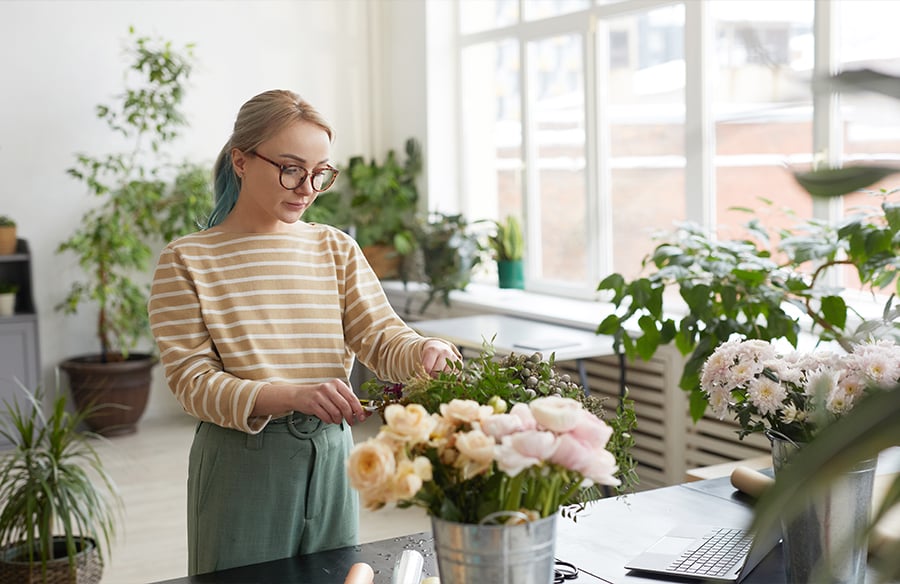
Most homeowners cannot add a courtyard or a living wall overnight. But there is one biophilic element almost anyone can use this week: fresh flowers. Treated like any other design material, they respond to light, scale, colour and climate.
In short: Fresh flowers are the simplest and most flexible way to apply biophilic design at home. They add living colour, texture and scent to a room, can be changed weekly to suit the season, and work best when chosen for the room’s light, scale, material palette and climate.
What is biophilic design?
Biophilic design is an approach to architecture and interiors that connects people with nature through the spaces they use every day. The word “biophilia” was used by psychologist Erich Fromm and later popularised by biologist Edward O. Wilson in his 1984 book Biophilia, which argued that humans have an innate bond with other living systems. Social ecologist Stephen Kellert turned it into design principles, and Terrapin Bright Green’s 14 Patterns of Biophilic Design (2014) gave architects a practical framework.
Those patterns are often grouped into three categories:
- Nature in the space: plants, water, natural light, airflow and scent.
- Natural analogues: materials, patterns and forms that recall nature, such as timber grain or organic curves.
- Nature of the space: spatial qualities such as prospect, refuge and mystery.
Do fresh flowers count as biophilic design?
Yes. Cut flowers sit firmly in the “nature in the space” category. They are alive, they change day by day and they carry scent, one of the strongest links between a space and memory.
The evidence for living elements is solid. Roger Ulrich’s well-known 1984 study in Science found that hospital patients with a window view of trees had shorter post-operative stays than those facing a brick wall. A 2005 study led by Jeannette Haviland-Jones at Rutgers University found that receiving flowers produced genuine smiles in every participant and improved reported mood for days afterwards.
Flowers also have a practical advantage over permanent planting: they can be replaced weekly. That makes them a low-cost way to test colour and mood in a room before committing to paint, fabric or furniture.
Treat an arrangement like a piece of architecture
Good arrangements follow the same rules as good rooms.
- A small posy disappears on a long dining table, while a tall arrangement blocks sightlines across a kitchen island. Low and wide suits dining tables; tall and narrow suits entry consoles, stair landings and double-height corners.
- A common florist’s guide is that the arrangement should stand roughly one and a half to two times the height of the vase, much like balancing a building’s base, body and top.
- Repeating one variety across two or three small vessels creates rhythm along a shelf or window sill, in the same way repeated columns define a colonnade.
- Negative space. Minimal interiors suit loose, airy arrangements with visible stems. Dense, rounded bouquets sit better in traditional rooms with more ornament.
How should light and orientation guide flower choice?
Light changes how colour reads, so the same bouquet can look completely different in two rooms.
- Sun-facing rooms (north-facing in the southern hemisphere, south-facing in the northern) receive strong, warm light. Whites, creams and soft greens stay crisp, while deep reds can look heavy.
- Rooms facing away from the sun receive cooler, softer light. Peach, coral, yellow and burnt orange stop them feeling flat.
- Rooms with little daylight suit pale flowers and glossy foliage that bounce light back into the space.
Matching flowers to a material palette
Flowers can echo a material palette or contrast with it. Proteas, dried grasses and soft pinks pick up the warmth of oak and other timbers. Concrete, steel and glass interiors are softened by a single strong colour, such as a mass of white roses, while colourful maximalist rooms can hold a mixed seasonal bouquet.
A useful starting point is the designer’s 60-30-10 rule: one dominant flower colour, one supporting colour and one foliage tone.
Designing for climate: lessons from Perth
Climate matters indoors as much as outdoors. Perth, in Western Australia, has a Mediterranean climate with long, hot, dry summers, strong western sun and heavy use of air conditioning, all of which shorten the life of cut flowers. Designers there follow a few simple rules:
- Keep vases away from windows, heaters and air-conditioning vents. Direct airflow dries petals quickly.
- Use clean vessels and cool water. Change the water every two days and re-trim stems at an angle.
- Choose for the season. Western Australian natives such as kangaroo paw, waxflower and banksia tolerate heat far better than delicate imported blooms, and they add a regional, place-based story to an interior.
- Move arrangements to the coolest room during heatwaves, then return them to feature positions in the evening.
Local florists are often the best source of climate-specific advice. A Perth florist such as Perth Petals hand-ties bouquets locally and includes care instructions with each order, which helps flowers last in a hot, dry city. In fast-growing southern suburbs, where many newer homes have open-plan living areas, residents can keep a weekly routine going with same-day flower delivery in Canning Vale when they order by 4 PM, Monday to Saturday.
Frequently asked questions
What are the main principles of biophilic design? The main principles are a direct connection with nature (plants, light, water and air), the use of natural materials and patterns, and spatial qualities such as prospect and refuge that make people feel safe and curious.
How can I add biophilic design to a home without renovating? Bring in living elements such as fresh flowers and plants, maximise natural light, use natural materials like timber, stone and linen, and position seating to give views of greenery.
Which flowers last longest in a hot climate? Hardy natives such as banksia, protea, kangaroo paw and waxflower generally last longer in heat than soft-petalled flowers such as tulips or hydrangeas.
Conclusion
Architecture gives a home its bones, and nature gives it life. Fresh flowers are the most flexible biophilic element available: they respond to light, echo materials, mark the seasons and cost far less than structural change. Choose them with the same care as any other design decision, and they will make any room feel more alive.