Your breaker flips for the third time this month, and you are standing in the dark holding a flashlight with your phone. That little switch is not being dramatic. It is doing its one job, which is telling you something in your wiring or your habits is asking for more current than the circuit can safely give.
The good news is that most tripping breakers have a small set of causes, and you can work through them in an afternoon. The tricky part is that older homes around here hide a few specific quirks, and those quirks change what you should do next. If the tripping keeps coming back after basic fixes, it is worth bringing in an electrician in Fredericksburg, VA, to trace the circuit properly instead of resetting the switch one more time.
Below is how to read the signal, what makes Fredericksburg homes a little different, and a decision checklist you can run through before you spend a dime.
What a Tripping Breaker Is Actually Telling You
A breaker trips for one of two reasons. It is either overloaded, meaning too many things are drawing power on one circuit, or it is detecting a fault, meaning current is leaking somewhere it should not. Those are very different problems, and confusing them is how people end up ignoring a genuine hazard.
Overload feels routine. You run the microwave and the toaster at the same time, and the kitchen circuit gives up. Unplug something, reset, and life continues.
A fault feels random. The breaker trips when nothing much is running, or it trips on a circuit where you have not changed anything. That pattern deserves more respect than a quick reset.
Here is the part people skip: a breaker that trips, gets reset, and trips again is not protecting you anymore if the underlying issue stays put. You have just trained yourself to ignore the alarm.
Why Fredericksburg Homes Age Differently
A lot of the housing stock in this area is older than the electrical demands we now put on it. According to Census Bureau housing data, a large share of American homes were built before modern code requirements caught up with today’s appliance loads. That single fact explains more tripping breakers than any other.
Older homes were wired for a few lights, a radio, and maybe a refrigerator. Today that same circuit might carry a space heater, a gaming setup, a coffee maker, and a phone charger bank. The wire never got bigger. The demand did.
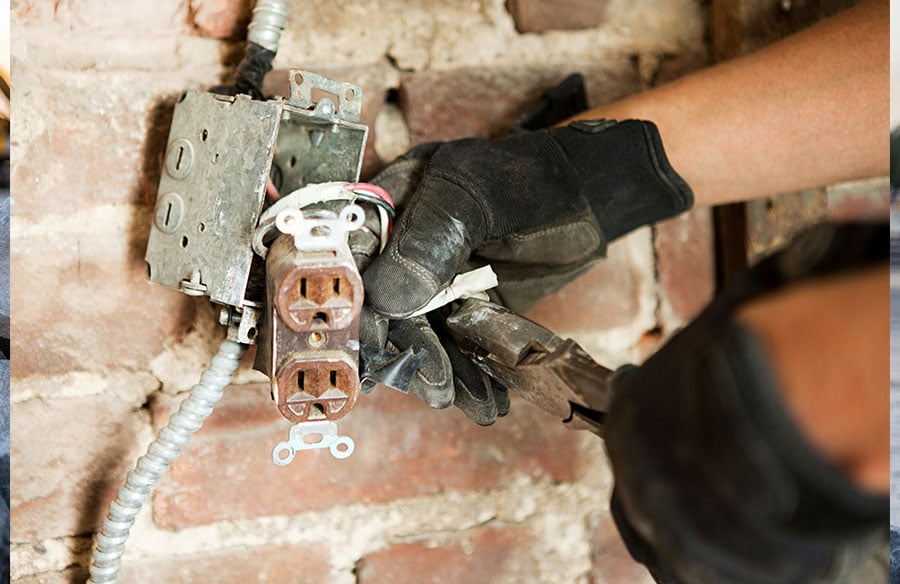
Add in the renovation history of a typical older house and you get surprises. An addition wired by a previous owner. A basement outlet tapped off a circuit that was never meant to carry it. A panel that got a new breaker slapped in without anyone checking the load calculation. None of that is unusual, and all of it shows up as a breaker that keeps flipping.
Run This Checklist Before You Call Anyone
Work through these in order. Most homeowners find the answer in the first three.
- Map the circuit. Turn the breaker off and walk the house with a plug tester or lamp to see exactly which outlets and fixtures it controls. You cannot fix a load problem on a circuit you do not understand.
- List what was running. Next time it trips, write down every device on that circuit. Heaters, hair dryers, and anything with a motor draw far more than people expect.
- Split the load. Move a high draw appliance to a different circuit, ideally one that stays cool under normal use. If that ends the tripping, you had an overload, and you are done.
- Look for heat and smell. Warm outlet covers, a faint burning odor, or scorch marks mean you stop here and call a professional. Do not reset that breaker again.
- Check for moisture. A garage, basement, or exterior outlet that trips after rain points to water intrusion, which is a fault, not an overload.
If the breaker trips on an empty circuit, or if it will not stay set even with nothing plugged in, that is your signal to bring in someone who can meter the wiring and open the panel safely.
Panel Age, Capacity, and the Honest Trade-Off
Here is where I will give you a straight opinion. If your panel is decades old and you have already added an electric vehicle charger, a heat pump, or a finished basement to the load, patching the problem with another breaker is the wrong spend. Put the money toward a panel evaluation instead.
Panel upgrades are not cheap, and I get why people put them off. But an undersized panel does not fail politely. The National Fire Protection Association ties a meaningful share of home electrical fires to problems in the distribution system itself, which is exactly the equipment a tired panel represents. You are not buying convenience. You are buying headroom and a lower risk profile.
The counterargument is real too. A newer panel that was installed correctly and has spare capacity does not need replacing just because a breaker trips. Get the load measured before you let anyone talk you into a big ticket job.
The Fredericksburg Lightning and Storm Factor
This region sees its share of summer storms, and surges travel through the grid into your home. A single big surge can weaken breakers and electronic devices without destroying them outright, which then shows up as nuisance tripping months later.
Whole home surge protection is one of the few upgrades I would recommend to nearly every homeowner with modern electronics. It is modest compared to a panel replacement, and it protects the appliances you already paid for. If you have lost a fridge, a router, and a TV to storms over the past few years, that pattern is not bad luck. It is a gap in your protection.
When to DIY and When to Step Back
Resetting a breaker, mapping a circuit, and unplugging a space heater are all fair game. Anything past the cover plate is not. The Electrical Safety Foundation is blunt on this point: electrical work is a leading cause of home fires, and it is not a hobbyist category.
I would draw your line at the panel door. If the fix requires opening it, testing live conductors, or replacing a device behind the drywall, that is a licensed job, and it is worth the call. The cost of an hour of a professional’s time is trivial next to the alternative.
One more thing. Ask any electrician you hire two questions: are you licensed in Virginia, and will you pull a permit for the work? A confident yes to both tells you more than any review score.
The Bottom Line on a Breaker That Keeps Flipping
Map the circuit, list the load, split the demand, and watch for heat, smell, or moisture. That sequence solves most tripping breakers and tells you clearly when the problem is bigger than a reset. If the pattern keeps returning on an old panel with modern loads, treat it as a capacity conversation, not a nuisance.
What is your breaker actually trying to tell you, and have you been listening?