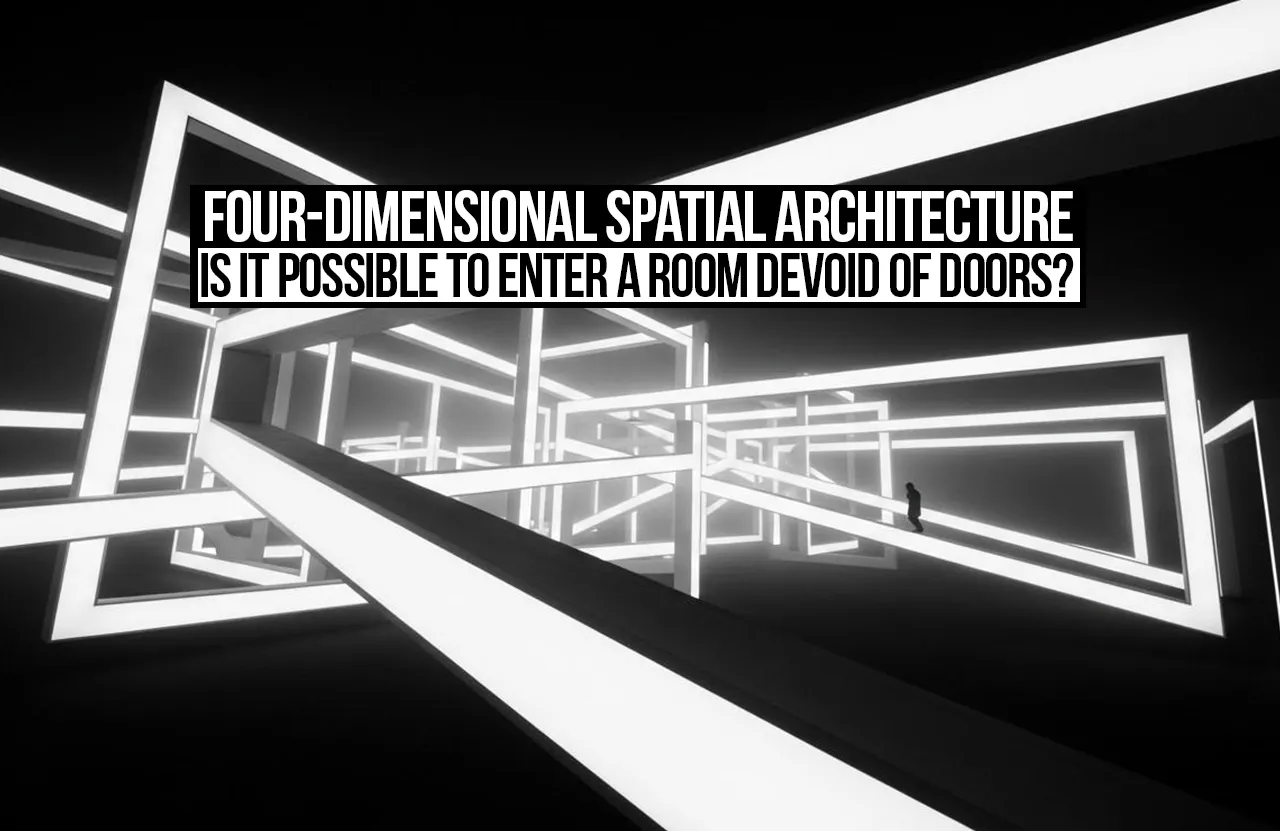
Many of the currently established theories began with hypotheses. Modern mathematics has established that spaces with more than three dimensions are mathematically possible, so do not rule out the existence of a fourth dimension, which we cannot view with our senses or perceive it and that is a result of us being three-dimensional beings living inside a three-dimensional space, nothing more. We can inspect all dimensions lower than the dimension in which we live; we comprehend the binary, unary, and even zero dimension. (Banchoff, 1990) However, we cannot actually see the fourth dimension and realise it optically, but what if there were four-dimensional beings able to observe us? Able to see and reveal what we cannot discover in our world.
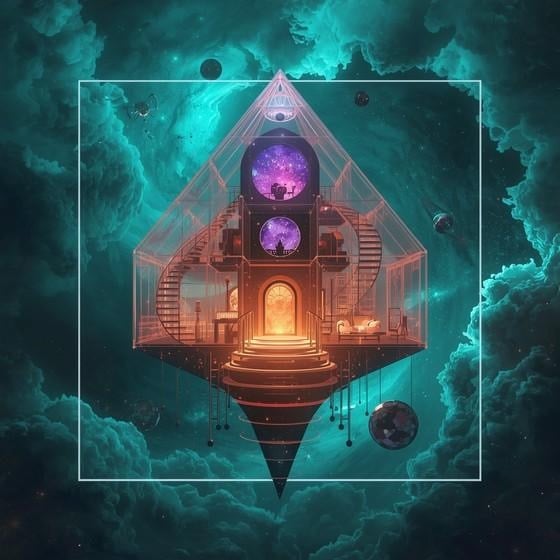
Infinite spatial dimensions
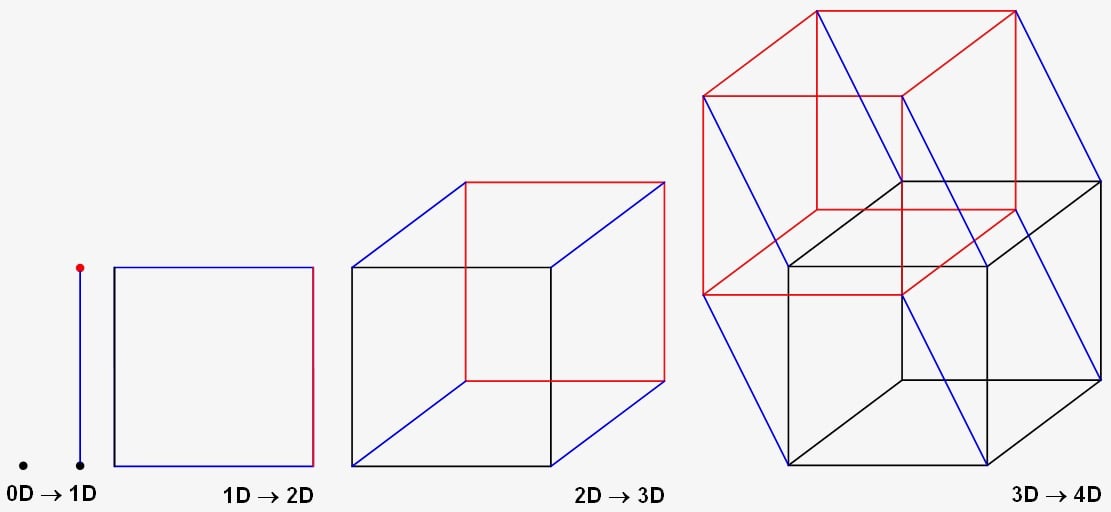
We can mathematically explain the existence of an infinite number of spaces, with each space containing a further dimension which adds a direction perpendicular to the prior directions, creating a whole new space; simply, the zero-dimension is represented by a dot. The first dimension is represented by a straight line between two points. (Banchoff, 1990) Still, the binary dimension is one flat space in which lives a virtual one- or two-dimensional object, unable to experience dimensions higher than itself, such as the third dimension, which represents any space perpendicular to its binary dimension. (Abbott, 1884) But it can deduce the existence of a third dimension without actually viewing it, and that is done through the effect of this dimension in its binary space. For example, the two-dimensional projection of the third dimension can be depicted on any two-dimensional plane as well; therefore, the two-dimensional observer who lives virtually in this dimension can read this projection in a one-dimensional way in the form of lines. (Abbott, 1884)
And with that exact sequence, we can assume an infinite number of orthogonal dimensions, and that does not exclude the existence of a fourth dimension which we, as third-dimensional observers in a third-dimensional space, cannot directly perceive. (Banchoff, 1990) But we can read the trace of this dimension in our world through a group of two-dimensional images, which are captured by the instrument of vision, the human eye; (Hollasch, 1991)with the same logic, an observer who lives in a four-dimensional space can have an organ of vision entirely different from ours; that four-dimensional instrument could see the three-dimensional world in a very different way than we can see. (Rucker, 2014) Plenty of books have addressed the idea of four-dimensional architecture from a point of view that the human mind may fail to fathom as spatial observation, but its consequence can be fully understood and interpreted as much as the two-dimensional observer’s interpretation in a two-dimensional world. (Abbott, 1884)
How can one enter a room without a door?
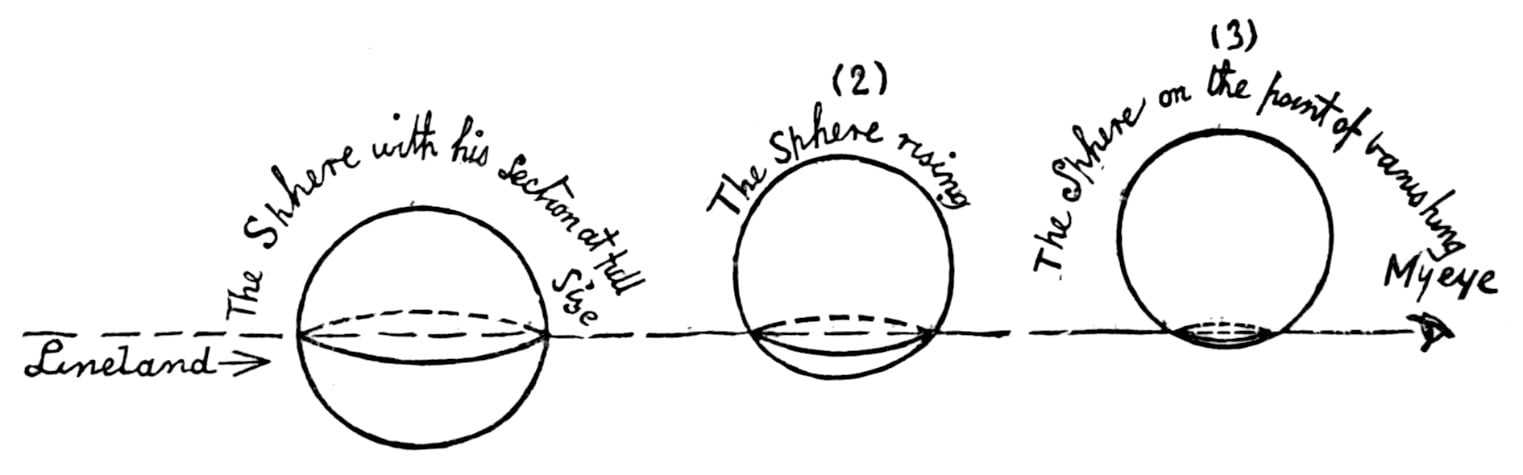
When thinking about this question, we consider first how a two-dimensional observer in a two-dimensional space can move inside a two-dimensional closed square in its own space, the only solution is for it to move vertically – That is, being perpendicular to its binary space – and then be dropped inside the square, The observer will seem to other observers to be on the same level, as if it disappeared from their plane and appeared inside the square, while in reality it did not vanish but rather moved vertically on their level in a dimensional direction which they couldn’t grasp with their two-dimensional senses. And that observer inside will never be able to get outside of the closed square without moving in the same magical way it had disappeared from its world. Although we as three-dimensional beings cannot see any magic in this matter, the whole issue lies solely in the two-dimensional observer. (Abbott, 1884)
With that same logic, we can assume that there is a three-dimensional room in a three-dimensional world totally devoid of all doors or openings; how can a person standing outside this room move inside of it without crossing an actual door? If this three-dimensional being can move perpendicular to its three-dimensional space, it can disappear in our world and emerge inside the room. (Rucker, 2014) It may seem to the other outside observers that it vanished in a way that is supernatural, as the perception of the three-dimensional beings is limited to the three dimensions and the three-dimensional instrument of vision. Hence, the two-dimensional observer can elucidate to the other observer the impact of its movement within the square in a theoretical manner. But they cannot envision that spatially; we can also explain how there can be a four-dimensional architecture, even if we cannot perceive it spatially with our present givens. (Abbott, 1884)
All our houses’ walls are transparent; we are infiltrated.
Similarly, by that same principle which concedes that we as three-dimensional beings can see what two-dimensional virtual beings in a two-dimensional space cannot, if a two-dimensional being stands behind a line, it cannot see what’s behind that line, (Abbott, 1884) despite that we are in a third-dimensional world, we can easily see what’s the furthest; behind and behind what’s behind the line, by the same token, if we assume the existence of four-dimensional beings, they may not be obstructed by walls in the way it hinders us, thus, if a human can swim in this fourth-dimension and perceive it, he can see his third dimension free from any shackles whatsoever, and can move without crossing a door or an opening, that literally he would vanish from a place only to emerge in another, relevant to an observer in the three-dimensional space. (Rucker, 2014)
But is everything always transparent? This too is a question worth discussing, because this theory does not propose that every closed room will be totally transparent to any observer in any place in the fourth dimension, but it is not as such, as there are other considerations too: (Hollasch, 1991) the observer must own a four-dimensional instrument of vision; thus, through it, they can rotate the three-dimensional reality or circulate multiple axes to inspect, which we cannot. (Rucker, 2014) We also need to rotate a two-dimensional panel at different angles to examine its details. (Banchoff, 1990) Also, if there is a three-dimensional projection of the fourth dimension of our space, it means that we can understand and infer this image in mathematical terms. Works in computer graphics have strived to simulate this vision by calculating three-dimensional volumetric images through a hypothetical four-dimensional viewpoint and then displaying them in ways that allow the human eye to explore them. (Hollasch, 1991)
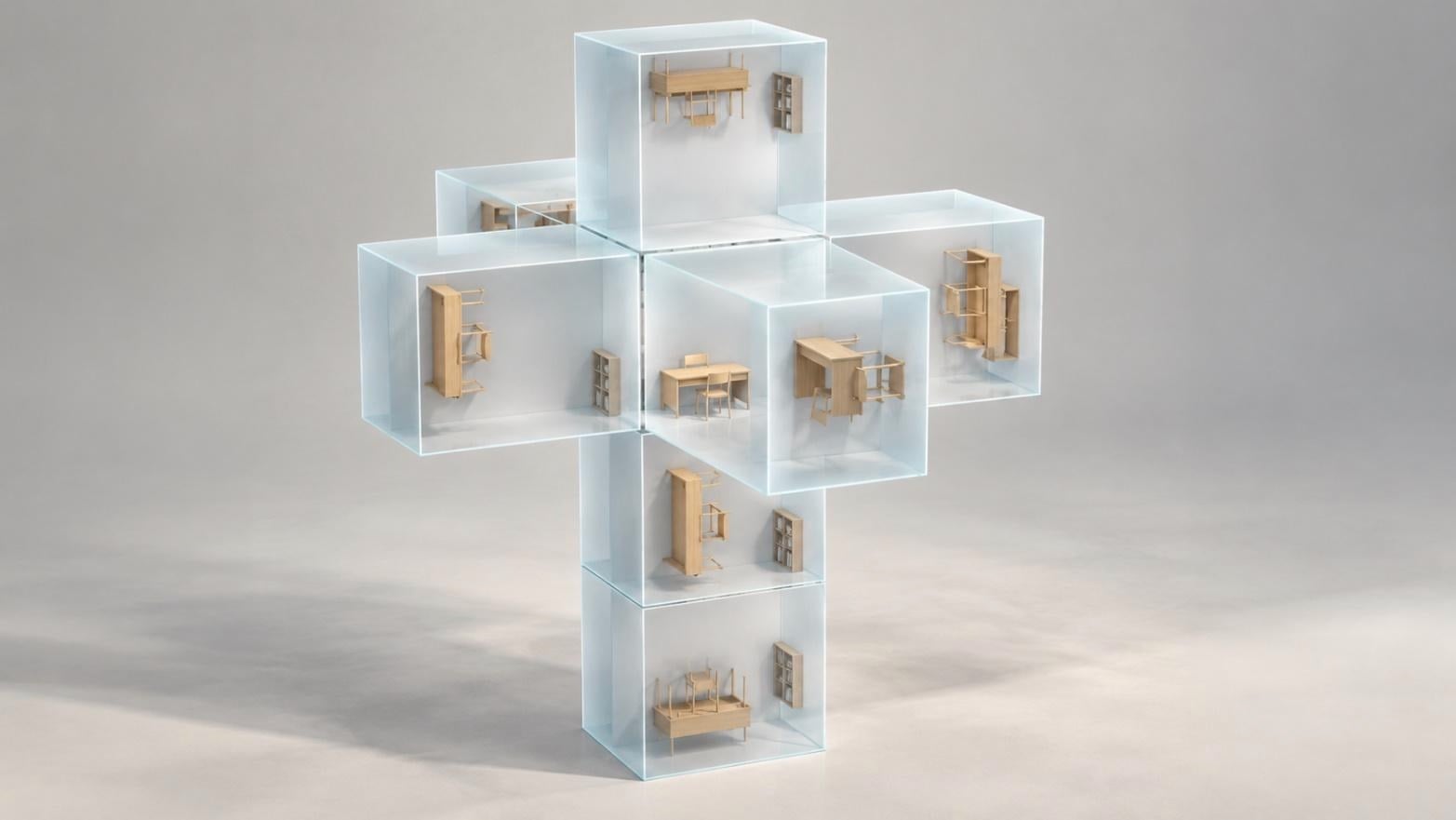
Science fiction ignites curiosity about architecture
Architecture cannot be excluded from the zone of science fiction when it comes to tackling the subject of the fourth dimension. The existence of two whole buildings in the same third-dimensional place without ever intersecting is just pure fiction to us; however, if these two constructions are sited at two different values of the fourth spatial coordinate, they do not intersect in the fourth-dimensional space; that is possible through mathematical conception. (Banchoff, 1990) And that could spark plentiful questions of a science-fiction nature: can there really be a four-dimensional architecture? And can science reach the day it understands the mechanism of using that dimension, even if we don’t fully grasp it? Can even one room be designed which includes a fourth dimension, or will it remain nothing more than a fictional theory? We cannot predict an answer to any question. For scientific success has taught us throughout history that many eccentric theories could be explained later on, and that the transmission of sound and image over hundreds of kilometres was once science fiction, but today it is a reality. (Engineering and Technology History Wiki, 2014) Will we actually witness four-dimensional architecture?
References:
Abbott, E. A., 1884. Flatland: A Romance of Many Dimensions. London: Seeley and Co..
Banchoff, T. F., 1990. Beyond the Third Dimension: Geometry, Computer Graphics, and Higher Dimensions. New York: W. H. Freeman and Company.
CERN, n.d. Extra dimensions, gravitons, and tiny black holes. [Online]
Available at: https://home.cern/science/physics/extra-dimensions-gravitons-and-tiny-black-holes/
[Accessed 1 October 2026].
Engineering and Technology History Wiki, 2014. Picturephone. [Online]
Available at: https://ethw.org/Picturephone
[Accessed 1 October 2026].
Hollasch, S. R., 1991. Four-Space Visualization of 4D Objects, Tempe, AZ: Arizona State University.
Rucker, R., 2014. The Fourth Dimension: Toward a Geometry of Higher Reality. 2 ed. Mineola, NY: Dover Publications.
Image1: StockCake (n.d.) Cosmic Crystal Home [AI-generated image]. Available at: https://stockcake.com/i/cosmic-crystal-home_3378925_1718054 (Accessed: 1 October 2026).
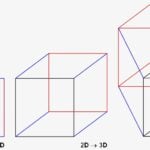
Image2: Three configurations of the HAVSTEN outdoor sofa. [Photograph]. Available at Spiritia (2008) Hypercube-construction-4d.png [Diagram]. Wikimedia Commons. Available at: https://commons.wikimedia.org/wiki/File:Hypercube-construction-4d.png (Accessed: 1 October 2026).
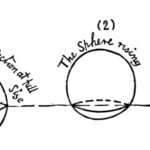
Image3 Abbott, E.A. (1884) Flatland: A Romance of Many Dimensions. London: Seeley and Co. [Illustration of a sphere leaving the plane]. Available at: https://commons.wikimedia.org/wiki/File:Flatland_(first_edition)_page_71.png (Accessed: 1 October 2026).
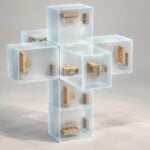
Image4: Kassem, S.O. (2026) Imagining four-dimensional architecture [AI-generated image created using OpenAI’s ChatGPT]. Created 4 October 2026.
Image5: StockCake (n.d.) Geometric Light Labyrinth [AI-generated image]. Available at: https://stockcake.com/i/geometric-light-labyrinth_2934490_1622551 (Accessed: 2 October 2026).