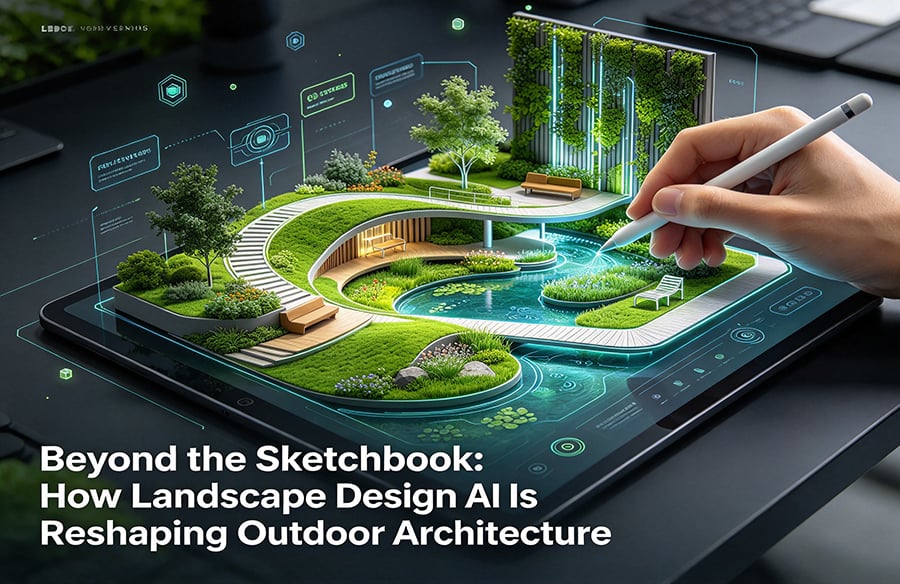
Landscape architecture has always been a patient discipline. A single residential garden might begin as a dozen pencil studies, move through layers of tracing paper and a mood board, and only then find its way to a planting plan or a construction drawing. The work rewards slowness, and for generations that slowness has been treated as a virtue rather than a cost. But the tools available to designers are changing faster than the habits of the profession, and the arrival of generative tools — most visibly landscape design AI — is forcing a conversation that many practitioners have been quietly avoiding: what happens to the craft when the visualization becomes instant, and who gets to hold the pencil at the end of it all?
A Profession Built on the Hand
To understand what landscape design AI changes, it helps to remember what came before it. For most of its history, the discipline leaned on hand drawing, physical models, and a slow process of layering ideas onto paper. A designer would sketch, erase, trace, and sketch again, refining a scheme through countless small decisions. That process was not an inconvenience; it was the method itself. It taught proportion, forced attention to light and shadow, and left room for intuition.
None of that disappears overnight. But a new generation of tools is compressing the loop between idea and image, and the effect is already visible in how studios pitch, how clients react, and how quickly a concept can be tested against a real photograph of a real site. The discipline has absorbed disruption before — the move from drafting tables to CAD, from watercolor renderings to photorealistic engines — and each time the profession found a way to fold the new instrument into its practice without losing its soul. The arrival of generative tools looks like the next turn in that same long road.
What Generative Tools Are Actually Doing
It is worth being precise about what a landscape design AI actually does, because the term gets thrown around loosely. In practice, these tools take a single photograph of an outdoor space — a backyard, a front yard, a courtyard, a balcony — and return a photorealistic rendering of that same space redesigned. You choose a style, and the tool rebuilds the image with new planting, hardscape, and layout while keeping the walls, fences, and existing trees intact.
This is not a filter, and it is not a one-size-fits-all template. The better tools, including landscape design AI platforms, adapt to the shape of the space and to the specific elements the user wants to add, from pergolas and water features to garden beds and pathways. The result reads like a design proposal rather than a novelty image.
From Weeks to Seconds: A New Design Rhythm
The most obvious change is speed. Commissioning a landscape designer has historically meant a consultation, a site visit, a concept package, and a fee that can easily run to two thousand dollars or more before a single plant is specified. A landscape design AI, by contrast, can turn a snapshot into a polished plan in seconds, often for free and without any software to install or account to create.
That speed does not replace professional judgment, but it does change where that judgment gets spent. Instead of laboring over whether a seating area should sit on the left or the right, a designer can generate a handful of options in an afternoon and reserve their expertise for the decisions that actually matter: grading, drainage, plant selection, and the long-term health of the scheme.
Visualizing Before You Dig
Anyone who has worked with a client knows the moment of truth arrives not at the plan, but at the first visualization. A plan view is a language that most homeowners do not speak. A photorealistic before-and-after, on the other hand, is immediately legible. This is where landscape design AI earns its keep as a communication tool.
When a client can see their own yard transformed — the flower bed moved, the path curved, the pool surrounded by greenery — the conversation shifts from abstract preferences to concrete choices. Misunderstandings surface early, before any earth is moved. The same image then serves as a briefing document for contractors, a reference for materials, and a persuasive case for approvals, whether from a homeowners association or a planning committee.
Designing With Climate, Not Against It
One of the quieter promises of landscape design AI is its ability to think locally. A garden that thrives in coastal humidity may fail in desert heat, and a layout that works in a cold northern climate may make no sense in the tropics. The better platforms fold location, season, and local climate into their recommendations, steering users toward plants, materials, and layouts that actually stand a chance of surviving.
This matters more than it used to. As summers grow hotter and water becomes scarcer, a design that looks good on screen but demands constant irrigation is a liability. Climate-aware generation nudges the whole discipline toward gardens that are sustainable in practice, not just pretty in a render. A homeowner in Phoenix gets a palette of drought-tolerant natives and gravel; a client in a rainy coastal city is steered toward plants that can handle standing water and salt. That local intelligence, even when imperfect, is a meaningful step beyond the one-style-fits-all approach that generic rendering tools have always suffered from.
A Shared Language for Clients and Designers
There is a democratic streak in all of this that should not be dismissed. For decades, a professional landscape plan was something you had to pay for and wait for. Landscape design AI lowers that barrier to nearly nothing, which means a homeowner can arrive at a first conversation with a designer already carrying three or four visual references they made themselves.
That is a better starting point than a vague description of wanting something “modern but cozy.” It is also genuinely useful for people who will never hire a designer at all: the DIY homeowner planning a weekend project, the real estate agent staging a listing, the small business owner refreshing a courtyard. Giving more people a visual vocabulary for outdoor space raises the quality of the entire conversation.
Who Is Actually Using It
The early evidence suggests three groups are adopting landscape design AI fastest, and each for a slightly different reason. The first is the professional: landscape architects and garden designers who use the tool to explore options quickly and to show a client a photorealistic direction before committing hours to detailed drawings. For them, the tool is a productivity lever — a way to spend less time rendering and more time designing, and a way to close the gap between what a client says they want and what they can actually see.
The second group is the DIY homeowner or renter who simply wants to imagine a space differently before spending a dollar. A free, no-login landscape design AI lets them test a dozen ideas on a Sunday afternoon — a pergola here, a fire pit there — without the pressure of a professional engagement. The result is often a clearer sense of their own taste, which they can then bring to a real project or a real designer.
The third group is the property professional. Real estate agents have long known that an empty or tired yard drags down curb appeal, and a listing photo that shows a barren lawn simply does not convert the way a lush, imagined garden does. A landscape design AI lets an agent drop a fresh look into a listing image in minutes, giving buyers a reason to picture themselves in the home. Developers use the same trick at the front end, testing how a scheme will read before breaking ground.
Where the Machine Stops and the Designer Begins
None of this is to say the algorithm can do the designer’s job. A landscape design AI does not know your soil type, does not measure the fall of the land, does not understand local building codes, and cannot account for how a tree will look in ten years. It will happily propose a retaining wall in a spot that cannot support one, or a plant that will outgrow its bed by a wide margin.
The skill of the professional lies precisely in catching those things. What the tool offers is a faster way to explore form and style; what the designer offers is the knowledge that turns a beautiful image into a buildable, durable landscape. The two are complements, not competitors, and the studios that treat them that way are likely to be the ones that thrive.
The Ethics of the Algorithmic Garden
There is a legitimate worry lurking beneath the enthusiasm. If everyone generates from the same pool of thirty or so styles, do we risk a global monoculture of gardens that all look faintly alike? A Japanese garden generated by an algorithm is not the same as one composed by a master of the form, and the cultural weight of certain styles deserves more than a stylistic filter can give it.
The responsibility here falls on designers and toolmakers alike. Styles should be treated as starting points, not destinations. The best use of landscape design AI is as a sketch engine that a thinking person then corrects, personalizes, and grounds in a specific place. Used that way, it expands possibility rather than flattening it.
What Comes Next for the Field
The trajectory is fairly easy to read. The next generation of these tools will almost certainly plug into geographic data, plant databases, and building information models, so that the render you generate is not just pretty but measured. The gap between concept image and construction document will keep shrinking, and the profession will absorb these tools the way it absorbed CAD, then digital rendering, then parametric modeling.
What will not change is the thing that made landscape architecture worth practicing in the first place: the judgment of someone who understands how a place works, how a plant grows, and how people actually live outdoors. Landscape design AI is a powerful new pencil. But it is still the hand holding the pencil that decides what gets drawn, and why.
For the practicing designer, the sensible posture is curiosity rather than alarm. Try the tools. Put them in front of a client. Notice what they are good at — speed, iteration, communication — and what they are blind to, which is everything that happens after the image. The firms that learn to separate those two things will find that the machine makes them more valuable, not less, because it hands back the one resource no designer ever has enough of: time.