For a long time, artificial grass was something designers hid: a patch behind the pool equipment, a dog run nobody photographed. That has changed. In South Florida, where real lawns fight heat, salt air, drought rules and summer storms, synthetic turf has become a design material in its own right. Used well, it draws clean lines, frames architecture and stays the same color in August as it does in January. Used badly, it looks like a carpet left outside. The difference is almost always in the landscape design, not the turf.
Here are the artificial grass design ideas we see working best on modern Florida homes, and the details that make them look intentional.
Why Artificial Turf Belongs in Modern Landscape Design
Modern landscape design is about restraint: a limited palette, strong geometry and planting that reads as a composition. A natural lawn rarely holds that line in Florida. It browns at the edges, thins under palms and needs weekly mowing to look crisp. Artificial turf gives the designer a stable plane of green that behaves like any other hard material. You can cut it to a precise edge, run it flush against concrete, stone or wood, and trust it to look the same years later.
There is a practical side too. A well-built synthetic lawn needs no irrigation, no fertilizer and no mowing, which makes it a natural fit for drought-tolerant, low-maintenance outdoor spaces. It also brings green into places grass never survived, such as deep shade, rooftops and narrow side yards, which matters for biophilic design, the idea that people feel better with living-looking surfaces around them.
7 Artificial Grass Landscape Design Ideas for Your Backyard
1. Checkerboard pavers around the pool
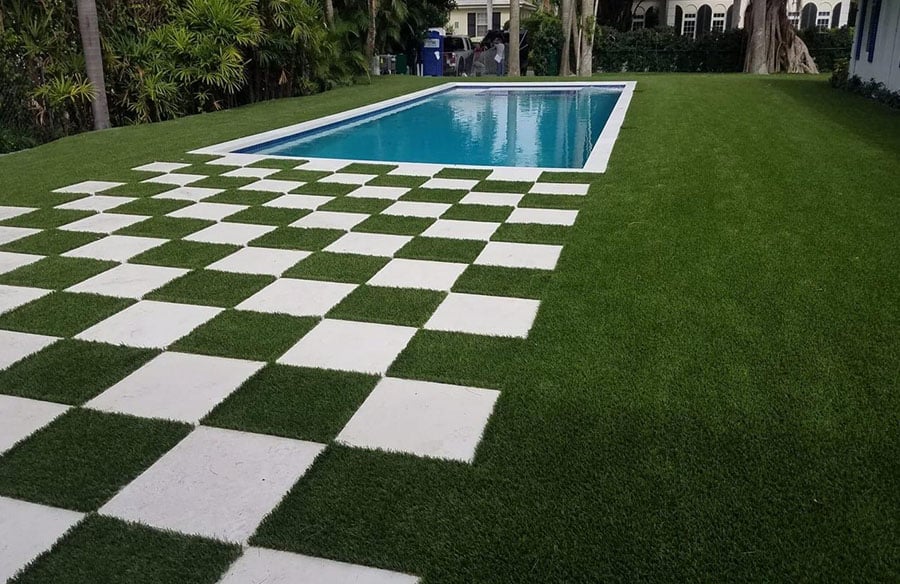
Alternating square pavers and artificial grass is one of the most photographed backyard looks in Florida, and for good reason. The grid echoes the geometry of a rectangular pool and softens a wide hardscape without giving up a dry, clean surface. Keep the paver joints wide enough for the turf to read as a pattern, around a third of the paver width, and choose a turf with a short, dense pile so the squares stay sharp. Around pools, pick a product rated for chlorine or salt water and good drainage.
2. Stepping-stone slabs and walkways
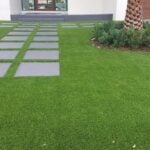
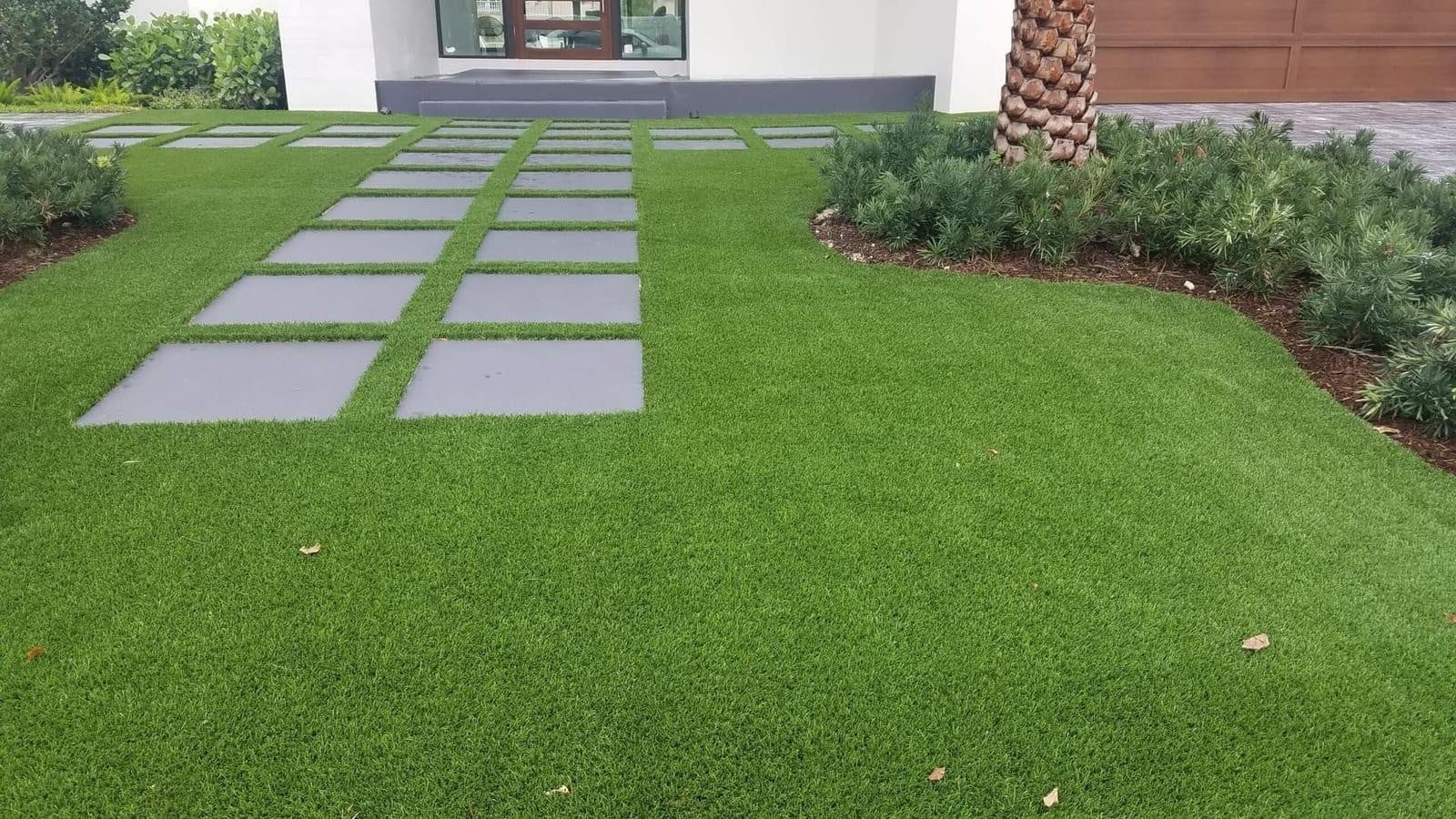
Large concrete or stone slabs set into a field of synthetic turf make a walkway that feels light and architectural. It works in front yards as an entry path and in side yards where a solid walkway would feel heavy. The trick is to set the slabs on the same compacted base as the turf, so they never tilt, and to leave consistent joints. A linear rhythm of slabs pairs well with modern façades and flat roofs.
3. Turf under pergolas and around outdoor kitchens
Outdoor living areas are high-traffic areas: chairs move, people stand at the grill, kids run through. Natural grass under a pergola usually dies from shade and wear. Artificial grass handles both, and it frames an outdoor kitchen or fire pit like a rug frames furniture. Keep turf away from the direct heat of grills and fire features with a border of stone or pavers.
4. A backyard putting green
A backyard putting green is the feature clients ask about most. Even a small green, with two or three cups and some contour, turns a dead corner into the reason people go outside. Use a dedicated putting turf for the green and a longer landscape turf around it, so the two textures read like a fringe on a golf course.
5. Rooftops, terraces and balconies
On rooftops and condo terraces, lightweight artificial grass adds softness without soil or irrigation. Ask the building for weight limits and drainage paths before you design, use a turf with a perforated backing, and leave the drains accessible. Planters, outdoor furniture and a strip of green turf can make a terrace feel like a garden.
6. Modern front yard landscaping
A front yard is where artificial grass can do the most for curb appeal. Pair a crisp rectangle of turf with ornamental grasses, white gravel or pebble borders and a few sculptural plants for a drought-tolerant front yard that looks designed rather than just maintained. In HOA communities, a turf with varied blade lengths and a natural color blend is the easiest to get approved.
7. Edges, borders and slopes
The edge is where artificial grass looks real or fake. Finish it against a hard material: a concrete curb, a steel or aluminum edge, a retaining wall, planter boxes or a band of mulch or gravel. Avoid feathering turf into soil. On slopes, use a heavier product and extra anchoring, and make sure the base drains toward a safe outlet.
 Designing the Base: What to Put Down Before Laying Turf
What you put down before installing artificial grass decides how it will look in five years. The old sod and roots come out, the ground is graded so water runs away from the house, and a compacted aggregate base goes in, with a weed barrier where weeds are a problem. In Florida’s sandy soil and heavy rains, drainage is not optional: good synthetic turf drains through the backing, but only if the base below lets the water go. For pet areas, an antimicrobial infill keeps the surface fresh.
The Downsides, and How Design Solves Them
Artificial turf is not perfect, and good landscape design plans for its limits. In full sun it gets warmer than natural grass. Shade trees, pergolas and lighter, heat-reducing products help, and a quick rinse cools it down. It costs more up front than sod, although it removes years of mowing, irrigation and fertilizer. And it has to be installed well: cheap installations show seams, wrinkles and soft spots. The most realistic-looking turf combines a few blade shapes and two or three shades of green with a brown thatch layer, and it is laid in one direction so the light hits it evenly.
Planning a Backyard Renovation With Synthetic Turf
For a homeowner planning a backyard renovation or a front yard remodel, the best first step is a simple plan, even a hand sketch or a photo mockup, that shows where the hard surfaces, planting and turf go. Decide the paver patio, walkways and stepping stones first, then fill the remaining lawn design with synthetic grass. It is easier to cut turf around a finished hardscape than the other way around. Ask your installer to show photos of similar projects, and to walk you through irrigation that can be capped, weed control at the edges and how the turf will meet each material.
One honest note on fake grass versus real grass: the goal is not to remove every plant. The most eco-friendly designs combine artificial grass with drought-tolerant shrubs, trees for shade and mulched beds, so the yard still supports pollinators and stays cooler, while the turf takes the high-traffic areas where a green lawn would never survive.
Turf Landscaping Trends Worth Following
The strongest trend in turf landscaping is restraint. The best artificial grass landscaping does not try to imitate a golf course everywhere. It uses turf where green makes the design stronger, like between pavers, under a pergola, on a terrace or as a calm plane in front of the house, and lets stone, wood and planting do the rest. In a climate as hard on lawns as South Florida’s, that is how a garden stays as sharp as the architecture it surrounds.
About the author: Catalin Chiticaru is the founder and CEO of Smart Synthetic Turf LLC in Boca Raton, Florida, a Synthetic Turf Council Certified Installer with nearly 20 years of experience in artificial grass and sports-surface construction across Palm Beach and Broward counties. See more of his artificial grass landscaping work.