Sydney’s coastline is a difficult place to put a roof. Within a kilometre of the surf a roof is in a severe marine environment, with salt loading that halves the life of unsuitable metal. Behind the beaches sit some of the most exposed wind sites in the city. And a surprising amount of that coast is also bushfire prone, with national park running down to the back fences from Palm Beach to the Royal National Park. A roof specified for an inner suburb will fail early in any of the three. Here is what changes, and what a brief for a coastal house should actually say.
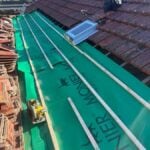
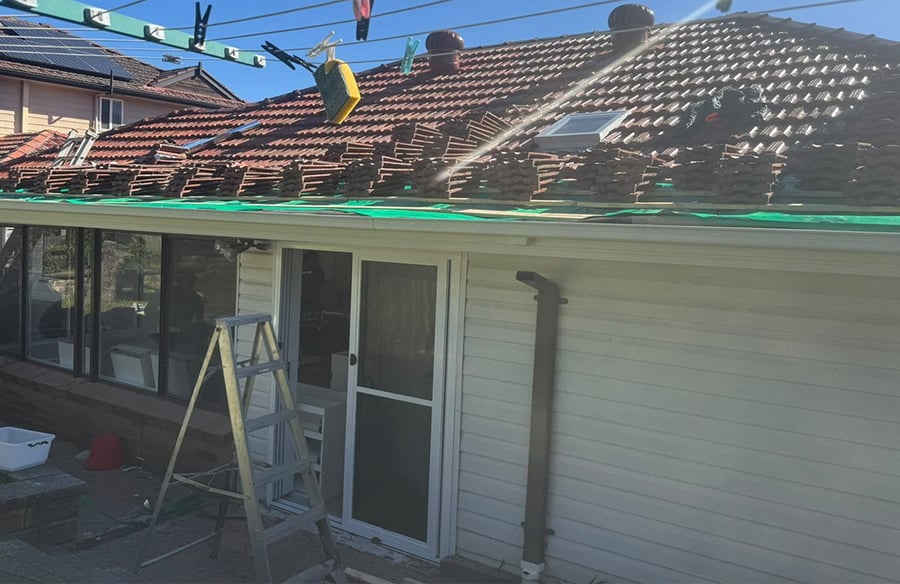
A 1970s tile roof mid repair. The failures were at the valleys and the ridges, which is where coastal wind and salt do their work first.
Salt
The Australian standard for metal roofing in marine environments, and the manufacturers’ own warranty maps, divide the coast into bands by distance from breaking surf. In the first few hundred metres, standard coated steel is either outside warranty or on a reduced one, and the specification moves to the higher grade marine coatings or to aluminium. The fastenings matter as much as the sheet. A stainless or class 4 screw in a standard sheet, or a standard screw in a marine sheet, sets up galvanic corrosion at every fixing, and the roof fails at the screw lines in a decade.
Tile roofs handle salt better than most people expect. Concrete and terracotta do not corrode, which is why so many of the older houses on the Northern Beaches and in the Sutherland Shire still carry their original tiles. What fails on a coastal tile roof is everything that is not tile: the mortar bedding under the ridge caps, the valley irons, the flashings and the sarking. Roofers doing roof repairs on the Northern Beaches will tell you the valley iron is the first thing they check on any house within sight of the water, because a rusted valley lets water straight into the ceiling and is invisible from the ground.
Wind
Coastal Sydney sits in wind region A, but the site classification matters more than the region. A house on a headland or on the exposed side of a ridge can be two terrain categories worse than one in the street behind it, which changes the fixing schedule for the whole roof. On a metal roof that means more screws per sheet and cyclone washers at the edges. On a tile roof it means every tile in the perimeter courses clipped or screwed, not just the ridge and the eaves.
Wind also drives rain uphill. Roof pitches that are fine inland leak at the laps in a southerly, and that is before the gutter overflows at the back because the wind is holding the water against the fascia. Overflow provision, a slotted gutter or a gap behind it, is a small line in the brief that saves a ceiling.
Ember
A large share of the coastal suburbs north of the harbour and south of Botany Bay fall inside bushfire prone land mapping. A house on that land is built or substantially renovated to a Bushfire Attack Level under AS 3959, and the roof is where most of the requirements land. The roof covering is sealed against ember entry, every gap over three millimetres at the ridge, the eaves and the valleys is closed with ember guard mesh or metal, sarking under tiles is non combustible, gutters have guards, and roof penetrations for vents and flues are sealed and metal.
The design consequence is that the roof becomes a continuous sealed element rather than an assembly of parts with air gaps. Ventilation that would normally happen through the tile gaps has to be designed in elsewhere. Skylights are specified differently. Even the gutter guard has a required aperture. None of it is difficult, but it has to be in the brief from the start, because retrofitting ember protection to a finished roof is slow and expensive.
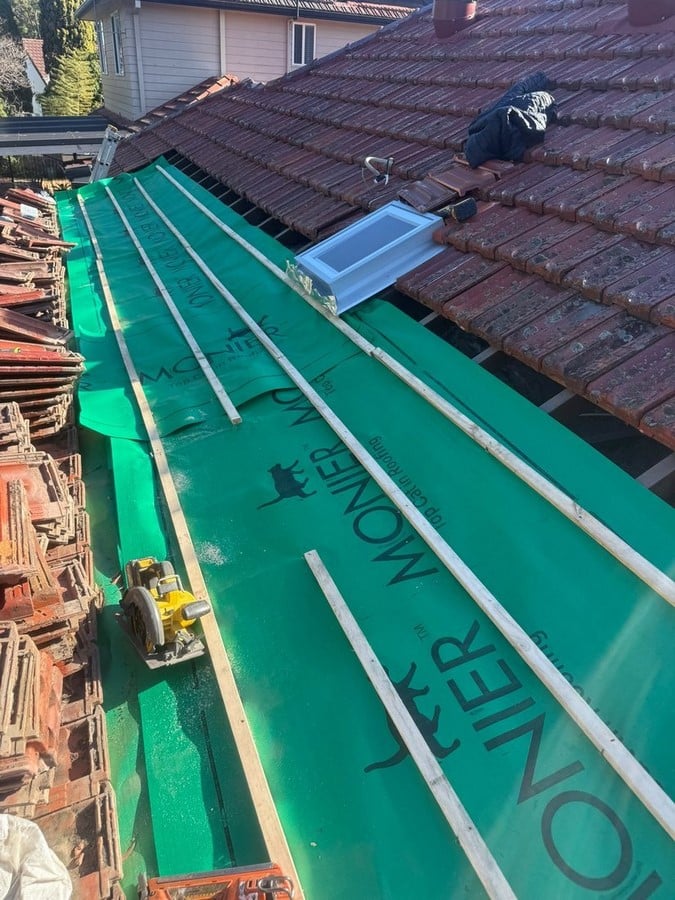 New battens and sarking going in before the tiles are relaid. In a bushfire zone the sarking grade and the sealing at the edges are both specified.
The three together
The difficult sites are the ones where all three apply, and much of the coast does. A house at Cronulla backing onto the national park, or at Avalon under the escarpment, needs marine grade metal or a tile roof with marine fixings, a fixing schedule for an exposed site, and ember sealing to its BAL. The materials that answer one problem sometimes work against another. Aluminium handles salt well, but aluminium ember mesh is not permitted at the higher BAL ratings, so the gutter guard and vent screens go to steel or bronze and the dissimilar metals have to be isolated. Heavy concrete tiles resist wind uplift but demand more of the frame. A sealed ember proof roof traps the salt laden air that an unsealed roof would have vented.
The architects who get coastal roofs right treat the roof as a system and write the brief that way: the salt band and the fixing metal, the site wind classification and the fixing schedule, the BAL and the sealing details, all on one page, before anyone chooses a profile or a colour. The ones who treat it as a finish selection hand their clients a roof that needs repairs in the Sutherland Shire or on the Beaches inside ten years, usually at the valleys, the ridges and the screw lines, which is exactly where the brief was silent.
What the brief should say
- Distance from breaking surf, and the coating class or material that follows from it, for sheet, flashings and fastenings alike.
- Site wind classification, not just the region, and the fixing schedule it requires for the covering and the frame.
- Bushfire Attack Level, with the ember sealing, sarking grade, gutter guard and penetration details written out rather than referenced.
- Valley and gutter design for wind driven rain, including overflow provision.
- Access for maintenance, because a coastal roof needs its valleys and gutters looked at twice a year, and a roof nobody can safely get onto does not get looked at.
A roof specified this way costs more on the day. The alternative is a roof that looks the same on the drawings and is being repaired before the mortgage is half paid.
Photos supplied by Aussie Roof Repairs, a licensed Sydney roofing contractor.