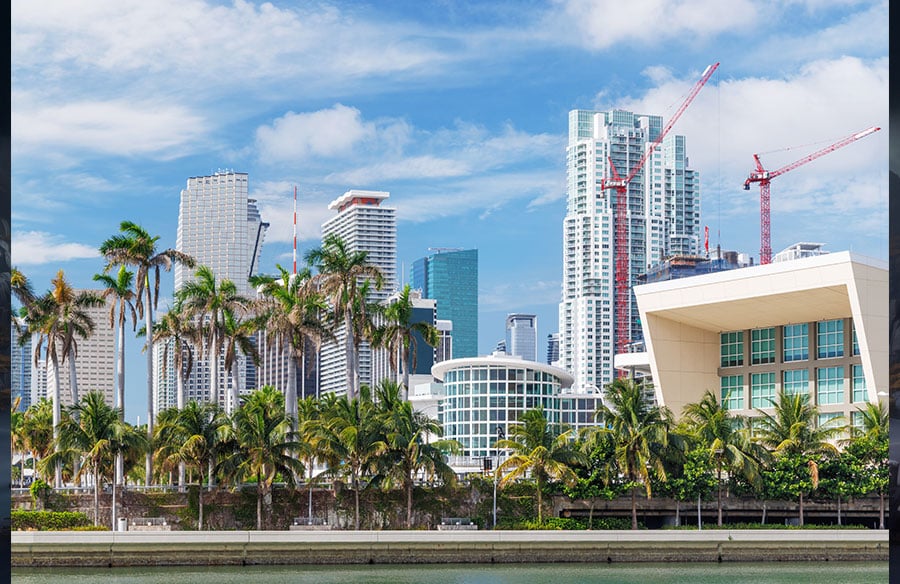
Few skylines have changed as fast as Miami’s. Within a few decades, the city went from low-rise resort hotels and modest garden apartments to a dense vertical landscape of glass towers along Biscayne Bay. For anyone buying a home here, that history matters. Two condos listed at the same price can feel completely different to live in, and the reasons are rarely in the listing photos. They lie in the building itself: when it was built, how it was engineered, which way it faces, and how well its spaces were planned.
Reading a Miami condo the way an architect reads a building means looking past marble countertops and staged furniture to the decisions that shape everyday life. This guide sets out those decisions.
1. Read the Building’s Era
Every Miami condo carries the design logic of its time. Post-war Miami Modern, or MiMo, shaped much of the city from the late 1940s through the 1960s, from the resort hotels of Collins Avenue to the low-rise garden apartments of North Beach and Normandy Isles. These buildings have real character, but they also come with the demands of maintaining decades-old concrete in a salt-air climate.
Later decades brought taller towers, more amenities and, often, more standardized layouts. The most recent generation of residential towers, several of them by internationally known architects, favors floor-to-ceiling glazing, deep terraces and resort-style shared spaces. Many newer towers were built under Florida’s modern statewide building code, developed in the years following Hurricane Andrew.
No era is better than another by default. Each comes with its own trade-offs, and a building’s age is the first lens for understanding what you are looking at.
2. Look Closely at Structural Health
The 2021 collapse of Champlain Towers South in Surfside permanently changed how Floridians think about condo buildings. In response, the state introduced milestone structural inspections for older condominium buildings. Qualifying associations must also complete structural integrity reserve studies at least every ten years. These studies identify major repair and replacement costs, and state law restricts waiving or reducing reserves for specified structural components.
For buyers, this means asking questions that once seemed technical:
- Has the building completed its required inspections, and what did the reports find?
- Are reserves adequately funded, or are special assessments likely?
- Is concrete restoration, balcony repair or facade work planned?
A building’s structure is one of its most permanent features, and major structural repairs can be among the most expensive issues an association faces. A well-designed unit in a poorly maintained building is still a risk.
3. Evaluate Hurricane-Ready Design
In South Florida, resilience is a design requirement, not an optional feature. Miami-Dade and Broward are the only counties in Florida’s High-Velocity Hurricane Zone, which applies some of the strictest wind standards in the country. Look for impact-rated windows and doors, and confirm that all exterior openings have appropriate hurricane protection. Impact-resistant glazing can reduce the need for separate shutters, but protection requirements depend on the building and its approved systems.
Elevation matters as much as glazing. Find out the property’s flood zone, ask whether an elevation certificate is available, and check where critical equipment such as electrical rooms, generators and pumps is located. Buildings that keep mechanical systems above flood level tend to recover faster after storms, and flood exposure can also affect insurance costs.
Wind resistance alone is not enough on Florida’s coast. The Cape Romano dome homes near Marco Island were designed to shed hurricane winds, yet they were eventually lost to the shoreline eroding beneath them. It is a reminder that a site’s relationship to the water matters as much as its structure.
4. Consider Orientation, Light and Views
In a subtropical climate, orientation affects both comfort and cost. East-facing units catch morning light and, depending on location, views of Biscayne Bay or the Atlantic. West-facing units get intense afternoon sun, which brings sunsets but also heat gain and higher cooling bills. Good architects respond with deep overhangs, recessed terraces and high-performance glass. Buildings without these features rely heavily on air conditioning.
Views also deserve scrutiny. A clear water view today may face a construction site tomorrow. Before committing, find out which neighboring parcels are zoned for development and whether a view is protected by the water itself or only by an empty lot.
5. Study the Floor Plan
The floor plan reveals more about livability than any rendering. Split-bedroom layouts, with bedrooms on opposite sides of the living area, offer privacy that suits roommates, guests or working from home. Ceiling height shapes how spacious a room feels, and a ten-foot ceiling can make a modest unit feel generous.
Pay attention to how the square footage is used. Long hallways and awkward corners count toward the total but add little value. Terraces deserve the same scrutiny. In Miami, a deep, usable balcony works as an outdoor room for most of the year, while a narrow ledge is mostly decorative. Kitchens and storage are where shortcuts tend to appear, so check pantry space, closet depth and whether the kitchen is designed for cooking or only for display.
Comparing floor plans side by side makes these differences easier to spot. When exploring Miami condos for sale, look beyond the listed square footage and compare room proportions, ceiling heights, storage and usable outdoor space. Two condos with similar dimensions can offer very different living experiences.
6. Weigh the Amenities Against Their Cost
Miami’s condo market is known for its amenities: rooftop pools, spas, private cinemas and concierge services. But every amenity carries an ongoing cost through association fees. The question is not how impressive the amenity list looks but whether it fits how you actually live.
Look at maintenance as much as design. A worn pool deck or a gym with outdated equipment can suggest an association under financial pressure. Practical details such as parking, valet operations, package rooms and elevator capacity often affect daily life more than a sky lounge.
Interior design plays a growing role in how these shared spaces age. The work of interior designers in Miami increasingly sets a building’s identity through its lobby and amenity floors long after the sales gallery closes.
7. Understand the Neighborhood Context
A building is part of its surroundings, and context shapes everyday experience. Brickell offers walkability, transit and urban density. Edgewater combines bayfront towers with a quieter residential feel. South Beach brings Art Deco heritage and an active street life, while Coconut Grove favors lower density and a mature tree canopy.
Consider how the building meets the street. Does it have an active ground floor with shops and cafés, or a blank podium of parking garage? Is the waterfront accessible, and how close are daily errands? Architecture that connects well with its surroundings can make a building more enjoyable to live in and contribute to its long-term appeal.
Many of the city’s most recognizable residential projects come from local practices, and the work of Miami’s leading architecture firms shows how closely design and place are tied together here.
8. A Quick Checklist for Viewings
- Era: When was the building completed, and what has been renovated since?
- Structure: Are inspection reports and reserve studies available, and are assessments planned?
- Resilience: Are all openings protected, and where do the flood zone and mechanical systems sit?
- Orientation: Which way does the unit face, and could future construction block the view?
- Layout: Is the floor plan efficient, with usable outdoor space and real storage?
- Amenities: Do the shared spaces fit your lifestyle, and are they well maintained?
- Context: How does the building connect to the street, the water and daily errands?
Conclusion
The best Miami condo isn’t necessarily the newest tower, the tallest building or the unit with the most impressive view. It’s the one where design, structural condition and everyday functionality work together. Understanding these details before buying can help you make a more informed decision and choose a home that works just as well beyond the first viewing.