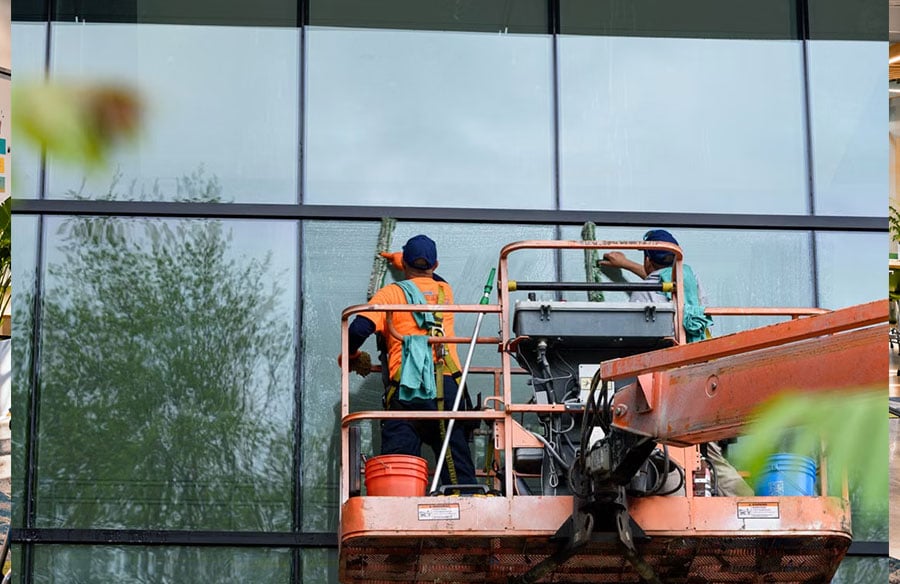
A new curtain wall looks finished the day the scaffolding comes down. Six months later, that same facade might show chalky rings, a faint haze, or hairline scratches that flare in afternoon light. Statistics Canada counted $23.6 billion in building construction investment for July 2026 alone, and much of that spending becomes glazing parked on active jobsites.
The harm those panes suffer often arrives after installation, from sources that can give little warning: mineral-heavy water, alkaline construction debris, and sunlight. Knowing how each one behaves changes what post-construction window cleaning should involve and when it has to happen.
Hard Water Starts as a Stain and Can End as Etching
Every droplet that dries on glass leaves its minerals behind. Calcium and magnesium carbonates crystallize along the rim of the evaporating bead and form the white spots everyone recognizes. A mild acid wash still lifts them off completely.
If moisture lingers in a gasket corner or along a sill, water draws sodium ions out of the glass surface, and the trapped film grows more alkaline. Vitro Architectural Glass identifies pH 9.0 as the point where Stage 2 corrosion begins attacking the silicate network, leaving microscopic pits no cleaner can dissolve.
In Calgary, treated water carries between 141 and 274 mg/L of hardness depending on the plant and season. One sprinkler aimed at a storefront can coat the lower lites with scale-forming water every morning.
Add summer sun and the timeline shortens. “Allowing mineral runoff to bake into the glass under high UV exposure can accelerate chemical etching,” note the facade window cleaning and maintenance experts from Winducks Calgary.
“When our crews arrive at a building, we start by reading the stains. Consistent commercial window cleaning is fundamentally about asset preservation: neutralizing alkaline deposits and atmospheric pollutants before they can permanently compromise the glazing matrix.”
Cement, Grit, and Sparks on the Jobsite
Construction debris is harsher than the word “dust” suggests. Wet Portland cement, mortar, and stucco sit between pH 12 and 13.5, far beyond the level where glass chemistry breaks down. A splash rinsed off within minutes does no harm. Left to cure, it bonds to a surface it has already etched, and prying it loose can pop clamshell chips out of the pane.
Then there is quartz sand, rated 7 on the Mohs scale against roughly 5.5 to 6 for soda-lime glass. Grit resting on a window causes nothing; dragged under a dry squeegee, it carves a scratch. Welding and grinding sparks go further by fusing molten iron into the surface, a defect glass manufacturers classify as irreparable.
Cold-end edge grinding ahead of the tempering furnace generates microscopic glass fines that are notoriously difficult to rinse away, and any left behind can bond permanently to the surface once the panes go through heat treatment. Glass Magazine warns that scraping heat-treated glass can dislodge those particles and drag them across the lite. Many breakage and blemish complaints aimed at glazed facades trace back to handling like this, and a rushed post-construction window cleaning crew armed with razor blades is often where the worst scratching begins.
UV Exposure Works as an Accelerant
Sunlight gets blamed for more than it does. Terrestrial UV lacks the photon energy to break the silicon-oxygen bonds in ordinary float glass, so the pane itself stays remarkably stable. The organic materials around it fare worse.
Most temporary protective films carry an outdoor rating of roughly 30 to 90 days. Past that window, UV cross-links the acrylic adhesive until it behaves like part of the glass, and removal usually means scraping, which loops back to scratches. Edge sealants in insulated glass units and PVB interlayers in laminated glass also degrade under prolonged, unshielded exposure.
Tinted and spandrel glass can reach 50 to 75°C on a clear afternoon. Because chemical reaction rates roughly double with every 10°C rise, a cement splash on a sun-baked pane etches far faster than the identical splash on a shaded wall.
Protection Belongs in the Site Plan
Everything described above is cheaper to prevent than to repair. The site controls with the clearest payoff for preventing post-installation glass damage are simple:
- Film removal dates written directly on the protective wrap, with trades held to them
- Immediate flushing of any cement, mortar, or stucco splash before it sets
- Fire-retardant blankets or plywood screens between welding work and installed glass
- Mixers, concrete trucks, and staging areas kept at least six metres from the envelope
- Sprinkler heads adjusted so irrigation never reaches the facade
At handover, tap water can undo a careful cleaning by leaving hundreds of milligrams of dissolved solids behind for every litre that evaporates. With deionized pure water systems, that figure drops below 10 ppm, and the glass dries clear on its own.
Where Commercial Glass Restoration Hits Its Limits
Run a fingernail across the mark. If it glides, polishing can usually remove the flaw; if it catches, the gouge is probably too deep to fix in place.
| Condition | What You See | Typical Remedy |
|---|---|---|
| Mineral scale | Chalky rings with no depth | Mild acid wash |
| Staining or light corrosion | Iridescent or milky film | Chemical compounding and cerium oxide polish |
| Light scratches | Felt by touch, but the nail glides | Multi-stage mechanical grinding |
| Deep gouges or weld pits | Nail catches, or metal is fused in | Lite or IGU replacement |
| Internal fogging | Condensation between panes | Full IGU replacement |
Polishing and aggressive stain removal fall under what the IWCA classifies as non-routine work, and reputable contractors ask for signed waivers and test mockups before starting. Too much grinding in one spot creates lens-like distortion. Exposed Low-E coatings are worse off still, since polishing them leaves a visible bald patch.
Glass Ages at the Pace of Its Upkeep
The buildings that hold up for generations tend to share one habit: somebody kept maintaining them. Glazing follows the same logic. Book the first post-construction window cleaning with pure water and no scrapers, then schedule two to four washes a year, or monthly where sprinklers reach the glass.
Hard water, construction residue, and UV-driven damage can sometimes be reversible early on, but they may become permanent if the damage etches or bonds to the glass. For more on how material choices shape a building’s long-term performance, follow RTF’s ongoing coverage of facade design and maintenance, or explore the projects recognized through RTF’s Architecture Awards.