The Anatomy of the Living Room: Why the Coffee Table Matters More Than You Think
Person to person, our living room objectives might be quite different: to carve out a softly healing space, to make room for socialising, to create something photogenic, to get the most out of its awkward dimensions. Whatever the case, your coffee table plays an integral, albeit misunderstood, role in your space.
If you ever felt like something was ‘off’ or unfinished, perhaps missing your characteristic sparkle in your living area, the coffee table – its design, placement, or the lack thereof – could well be the culprit.
Because, sometimes, you have the right pieces but the wrong arrangement; at other times, you have the right arrangement but one missing piece needed to anchor the entire scheme. Let’s see which category your living room falls into.
What Purpose Does the Coffee Table Serve? (Outside of Accumulating Coffee Cups)
I think most of us are guilty of plonking a coffee table into the centre of the living area because it’s the done thing; they’re living room staples, after all. However, I want to stress that there should always be a deeper justification for your coffee table setup. Otherwise, what should be a beautiful, functional, social piece ends up being a mere clutter collector.
Besides accumulating miscellaneous ‘stuff’, your coffee table can be many things:
- A focal point that gives your eyes a sense of direction and visual hierarchy to follow
- The anchor point to ground the other furniture, preventing pieces from becoming unmoored within the negative space
- An opportunity to improve the sociality of your interior, particularly when clusters of armchairs are arranged around the locus of the coffee table
- Multipurpose surface space for casual hobbies and activities, such as board games, jigsaw puzzles or sketching
- In open concept living areas, a zoning tool that delineates the entertainment hub from dining nooks or a WFH corner or otherwise provides structure to the layout
- A linking piece that bridges distinct aesthetic elements, such as a mix of materials or varied shapes
- Another way to layer on texture and detailing to elevate your room
- A conversation starter that draws guests into spirited discussion
Coffee Table Considerations That Seriously Impact the Design
We’ve just looked at how coffee tables can make your living room scheme more considered; now, it’s time to pick the designs that will.
Silhouette
The shape of your coffee table and, more crucially, how it relates to the other elements of the room’s design can quietly kill or tap into its energy.
If your living room feels stiff, the silhouette probably needs to change. A common misstep is to go all in on rectangular shapes; the overabundance of straight lines, in this instance, makes everything feel stale and boxy, when subtle variety is what you want.
Ovals and circular coffee tables work wonders to soften out these harsh edges. But, me, I’m partial to a kidney-shaped design for a touch of editorialised refinement. That said, if you are a fan of the classic rectangular coffee table surface-wise, why not pick a waterfall design that introduces curves at the corners within the same profile?
All in all, the silhouette, how slimline or substantial it is, dictates the visual weight of the piece. So your aim here is to find visual balance with your neighbouring furniture and, of course, the architecture of the room.
Dimensions
Size, ostensibly, is a major concern to living room designers as it has serious knock-on effects on what you can do with the layout.
My recommendation is to balance out the scale of the sofa with something proportional: two thirds of the sofa’s length is the golden ratio, whilst 30-45cm is ample breathing space between the sofa and tabletop edges.
Of course, don’t forget about height. The coffee table should enhance, not impede, the functionality of the space, so any snacks you place there should be within comfortable arm’s reach. These are the standards; however, feel free to play around with contrast. Often living areas with items at varied heights are more dynamic.
Placement
You might think that there is but one place to put your coffee table: floated in front of the sofa, slap bang in the middle of the room. In actuality, there are several options for you to mull over.
- You could push a rectangular or half-moon coffee table against an empty wall or under a window as a makeshift console
- ‘Dead’ corners benefit from circular corner coffee tables, paired with an armchair or two
- And snug between multiple seating options is always a crowd pleaser; I’m thinking in the middle of a scattering of armchairs or a sectional sofa
The bottom line is that as long as it’s styled correctly, feels anchored in place, and can enjoy the optimal level of clearance, anywhere can work.
Material
Humans biologically respond to materials; thus, it makes sense that a glass, metal, travertine, wood or acrylic coffee table would each bring a drastically different vibe into the same space.
Denser, manmade materials are usually perceived as colder, more modern, a little edgy and eclectic, whereas deeply veined surfaces that come from nature are universally understood as warm and grounded. Your choice depends on your living room objective.
Versatility
Picking a coffee table with hidden talents – concealing unsightly clutter or slotting Russian doll-style into a nest of its siblings – is a clever way to adapt your living room to flexible modern living.
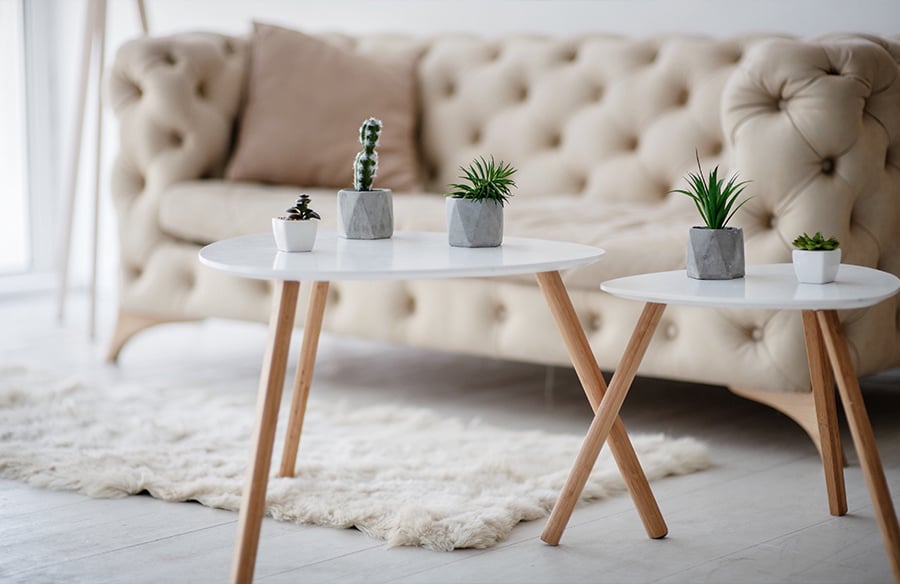
Personally, I love coffee tables with deep drawers – they’re the perfect place to hide your less attractive essentials, e.g., TV remotes or chargers. Likewise, nested coffee tables, which you can rearrange and stack at will, ensure their modest surfaces pack a punchy, outsized impact. Dotting the smaller tables around the room can work much more seamlessly than one central piece, especially in rooms with high through-traffic.
When Should You Ditch Your Coffee Table? (5 Key Scenarios)
I’m sorry to say it: coffee tables aren’t a catch-all solution, despite their beautiful versatility. There are, indeed, some cumbersome interiors that just won’t accommodate them alongside the bulkier pieces.
Here’s when you should reconsider…
- When your living room’s footprint leaves inadequate walkways throughout the room. That’s 45-60cm of clearance so folks can navigate the room comfortably.
- When you simply won’t compromise on a footstool; although you’ll find that ottomans blend the functionality of both pieces into one showstopping form.
- When the room is particularly narrow. Here, a handful of side tables for each cluster of seating is the more flexible, convenient option.
- When you have energised children or pets in the space. Sometimes it’s best to leave the floor space open for play. No sharp corners to bump into or dog-height snacks to be snapped up when you’re not paying attention.
- When you feel boxed in by a sectional sofa. Again, a side table may present the more efficient, people-friendly solution. You can even get curved designs that bend lower over the sofa and your lap, making film night mealtimes less of a risky business on the spillage front.
Conclusion: See? Coffee Tables are Powerful Ambience Modifiers
You’d be surprised at how much of an impact reshuffling these squat, little tables can make on your daily evening unwind. Or perhaps not, now that you’ve come to the end of this guide.
Whatever your coffee table conundrum, the answer is always to take a step back and tinker. Tweak the overall arrangement, see if a new layout works better, and if it doesn’t, then begin the hunt for a coffee table that fits your room and your vibe to a tee. The most elevated spaces find this sweet spot between authenticity and timeless design.
Coffee Table Design FAQs
To wrap up, allow me to answer some of the common questions that always crop up among the house-proud homeowners and design-attuned renters we speak to.
Why are Coffee Tables an Important Element of the Living Room?
Coffee tables serve multiple functions: they often anchor the space; provide extra surface space and storage; act as focal points; and overall make the space more pleasant to be in.
What are Some Coffee Table Mistakes to Avoid?
Choosing the wrong size for your space, prioritising looks over function, and overlooking cohesion.
What Size Coffee Table Should I Pick?
Interior designers recommend coffee tables two-thirds the size of your sofa for visual balance and comfort. Also, the tabletop should ideally match your seat height.
Round or Quadrilateral Coffee Tables: Which is Best?
It depends on your priorities and personal taste. Rounded tables help soften harsh edges in your living room, make corners work harder, and are perceived as safer, comforting, organic or more elevated. Square or rectangular coffee tables add a more rigid structure, formality and ‘bite’.