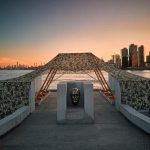
Ai Weiwei is one of the most influential figures in contemporary art and architecture, known for blending aesthetics with political critique, cultural commentary, and human rights activism. His most recent piece of work, Camouflage, opened on 10 September 2025 in the Franklin D. Roosevelt Four Freedoms State Park on Roosevelt Island, New York, and is a landmark event in the convergence of public art, architecture, and political conversation (The Guardian, 2025). It is a giant installation and the first commission of the Art X Freedom program, which will make socially responsible and justice-driven public art interventions in New York City.
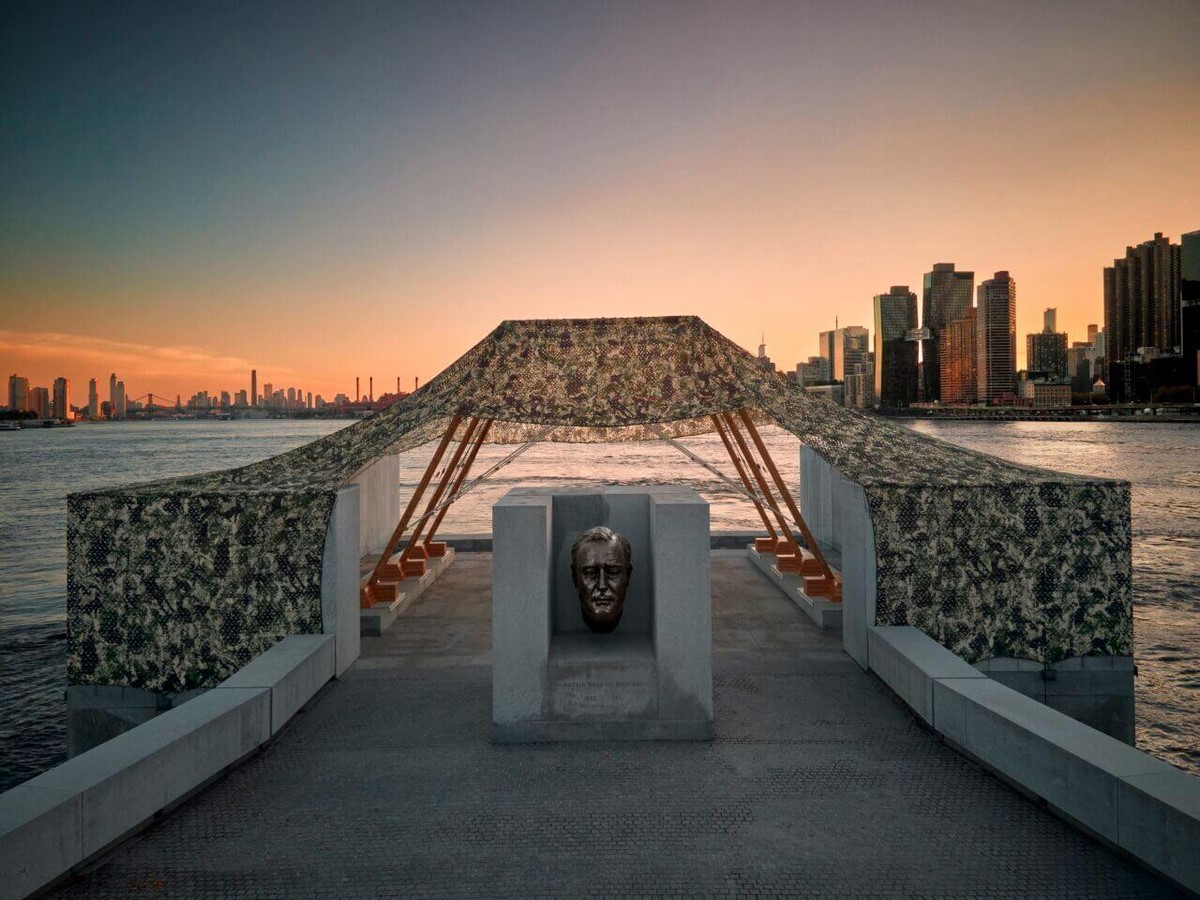
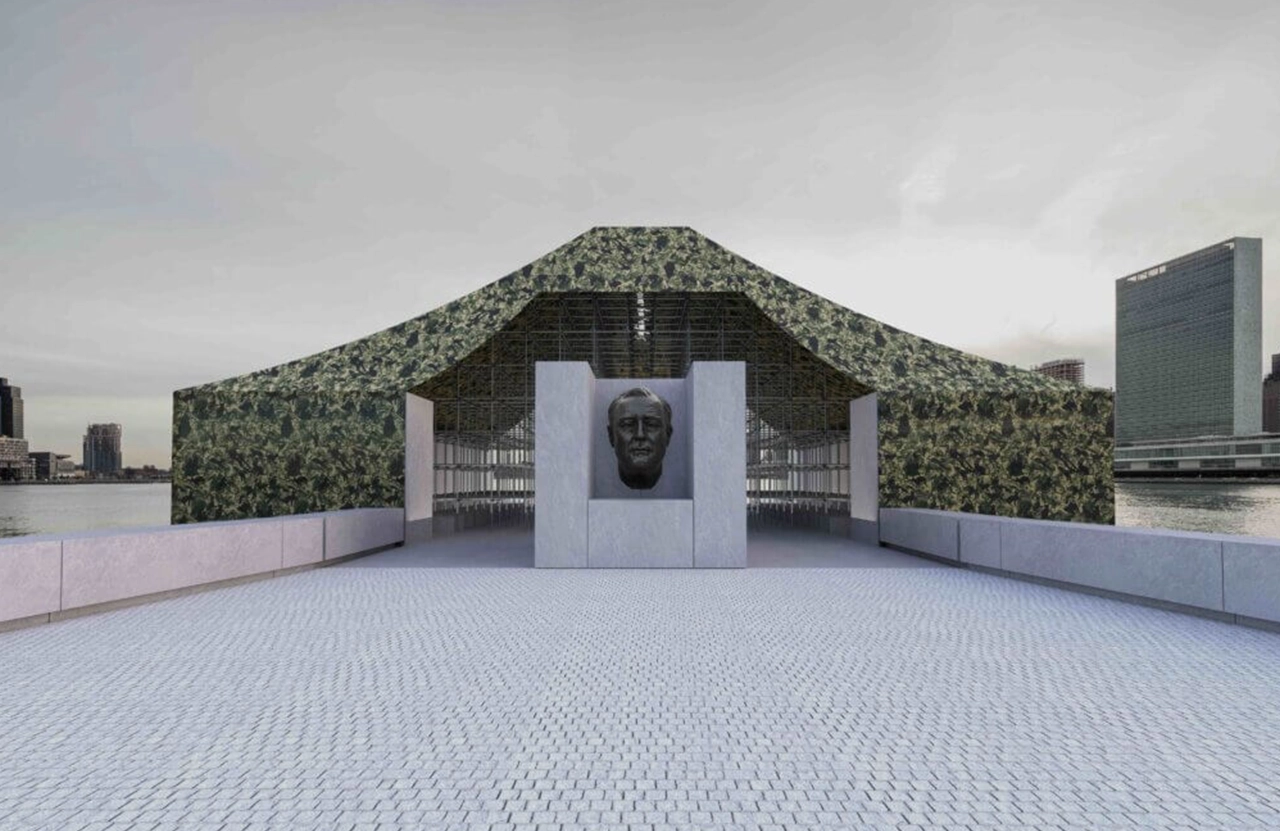
The work remakes the park’s modernist geometries in camouflage netting layers, delivering a total immersive environment that invites visitors to consider ideas of concealment, exposure, and truth. Its timing is also symbolic: the opening coincided with the 80th United Nations General Assembly session and the 80th anniversary of the Second World War (The Guardian, 2025). Located in a space consecrated to Franklin D. Roosevelt’s celebrated “Four Freedoms” speech, the installation is tuned to urgent worldwide issues: displacement, censorship, authoritarianism, and the frailty of democratic freedom.
This article examines Camouflage from multiple perspectives: the life and philosophy of Ai Weiwei, the architectural and historical context of Roosevelt Island’s Four Freedoms Park, the design and materiality of the installation, its political and social significance, and its place within Ai Weiwei’s broader oeuvre. By locating the installation in architectural and cultural contexts, this analysis attempts to decipher why Camouflage operates not just as art, but as a gesture of public dissent and spatial narrative.
Ai Weiwei: Artist, Activist, Architect
Ai Weiwei (b. 1957) is in a unique position as artist and political dissident, whose career has been defined by defiance of state authority, censorship, and exile (Obrist, 2018). Born in Beijing to China‘s most celebrated poet, Ai Qing, Ai Weiwei came of age during the Cultural Revolution, experiencing the ramifications of political repression firsthand. This experience deeply influenced his artistic lexicon, imparting a sense of vocation to truth, transparency, and human decency (Hanru, 2015).
Although Ai Weiwei is habitually situated as a conceptual artist, his practice is fundamentally architectural. His work with Herzog & de Meuron on the Beijing National Stadium (the “Bird’s Nest”) and his own architectural work, including the Fake Design studio in Beijing, illustrate his attunement to form, space, and materiality (Moffitt, 2015). Furthermore, his installations often work at the scale of architecture—reconfiguring landscapes, urban spaces, and museums into immersive political environments.
Ai Weiwei’s work consistently foregrounds the body, exile, freedom, and the politics of visibility. From Sunflower Seeds (2010) at Tate Modern, which addressed mass production and individuality, to Good Fences Make Good Neighbours (2017), which addressed migration and borders in New York, Ai Weiwei uses monumental interventions to articulate urgent global crises. Camouflage continues this trajectory, addressing the hidden and the exposed, the need for protection and the politics of concealment.
Roosevelt Island and Four Freedoms Park: The Site Context
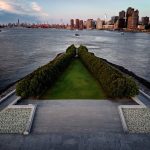
Roosevelt Island, located in the East River between Manhattan and Queens, New York, boasts a rich history. It was previously Welfare Island, where hospitals and asylums were situated before its redevelopment as a residential district in the late twentieth century. At its southern edge is Four Freedoms Park, a memorial built by architect Louis Kahn and finished posthumously in 2012 (Rybczynski, 2013).
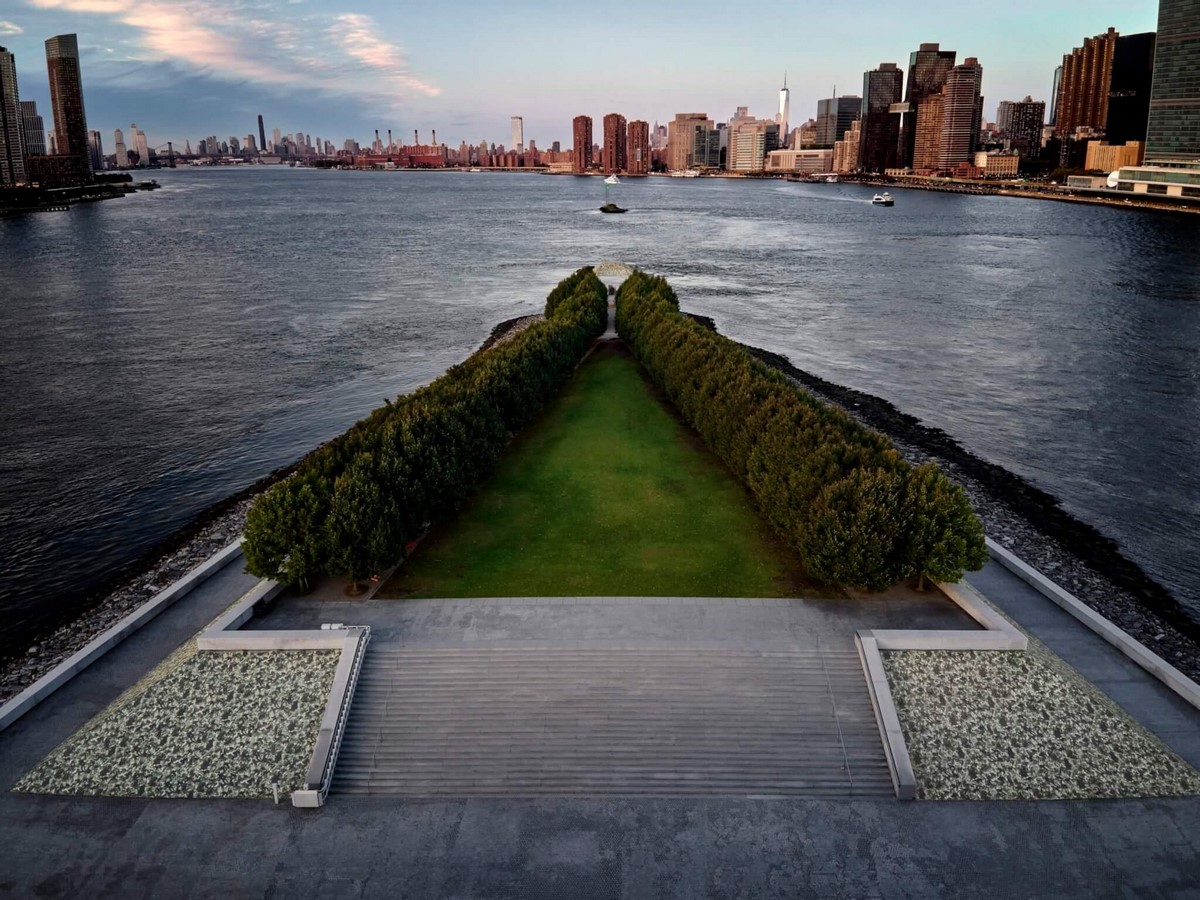
The park was designed as a sombre memorial to President Franklin D. Roosevelt’s “Four Freedoms” speech of 1941, which defined the universal freedoms of speech, worship, freedom from want, and freedom from fear (Kahn, 2012). The structure is austere, comprising a granite promenade, a triangular tree-lined allée, and a sculptural open-ended chamber containing the river and skyline. It represents Kahn’s philosophy of monumental simplicity and spatial clarity (Brownlee & De Long, 1997).
By placing Camouflage in this location, Ai Weiwei squarely confronts Kahn’s architecture and Roosevelt’s political heritage. Openness and gravitas of the park create a field for him to work on, where the camouflage netting both intrudes upon and completes the geometries already present. The location, already consecrated to universal freedoms, is turned into a battleground for reconsidering their vulnerability during the twenty-first century.
Concept and Design of Camouflage
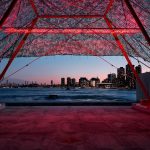
Camouflage is an architectural installation that covers big areas of camouflage netting over the structural aspects of the park, designing a space at once protective and concealing (Designboom, 2025). The use of material is powerful: camouflage netting implies military deployment, hiding, and survival, but with Ai Weiwei, it is recontextualised as a symbol for the brutality of war and for man’s drive for shelter.
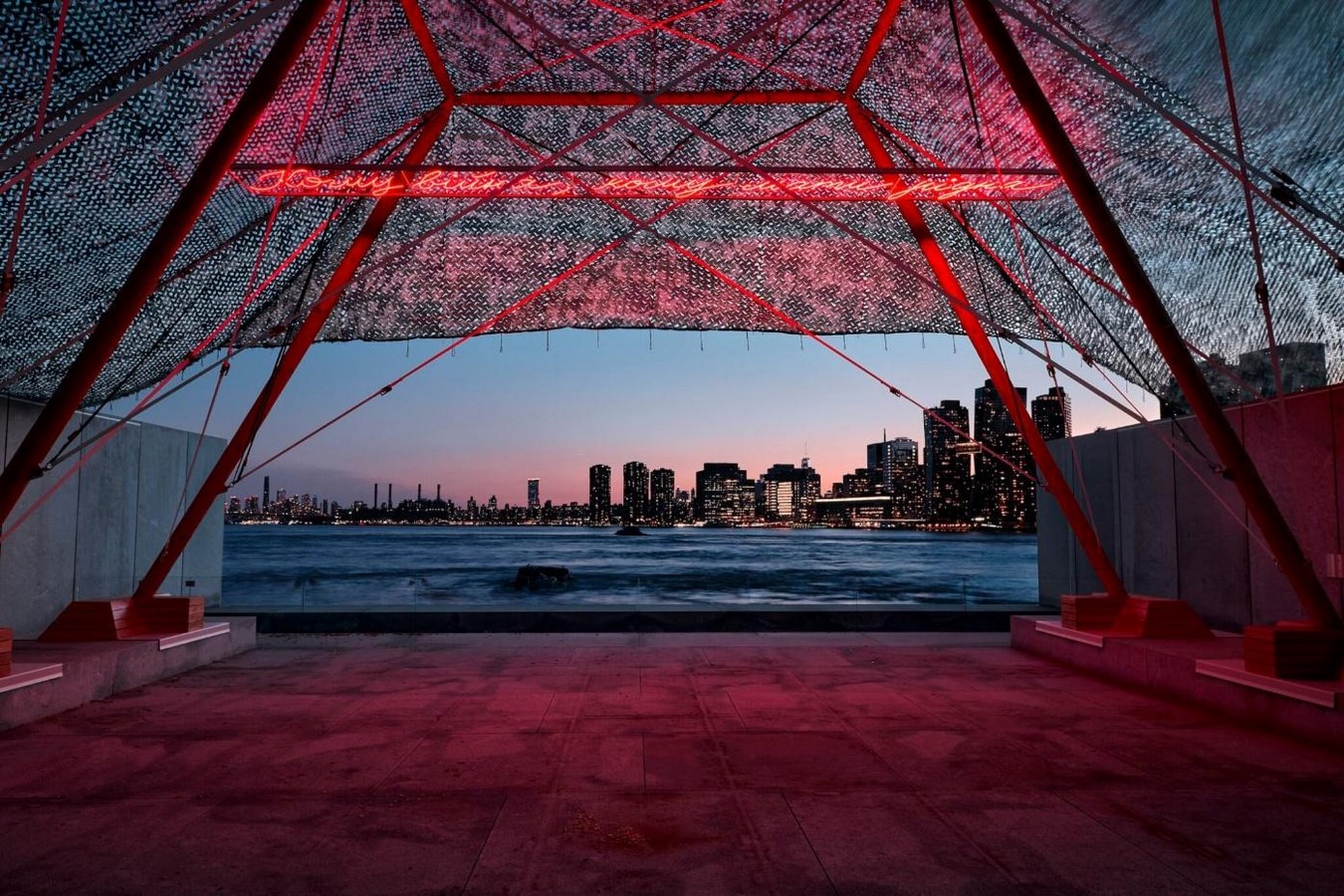
The installation creates a pavilion-like environment, changing the spatial perception of the visitor. The play of light and darkness via the mesh creates moving visual patterns, creating openness and opacity. People who pass through the site experience layers of camouflage, which symbolically evoke the suppression of truth, the invisibility of refugees, and the erasure of marginalised voices (The Guardian, 2025).
Architecturally, Camouflage is an example of site-responsive architecture. Overlaid on Kahn’s spare geometries with ephemeral, adaptive material, Ai Weiwei creates a conversation between permanence and impermanence, stability and vulnerability. The granite and concrete forms of the park are institutional permanence, while the netting is the fragility of human life under attack.
Materiality, Form, and Spatial Experience
The materiality of Camouflage is remarkably plain but theoretically complex. The camouflage netting, originally designed to keep out, is here revealed, monumentalized, and beautified. Its visibility upsets the transparency of Kahn’s design, screening the vision of the city, river, and sky. This re-framing compels visitors to engage with the strain between transparency and occlusion, liberty and limitation.
Spatially, the installation encourages movement and bodily engagement. Walking through the netted structures, visitors experience fluctuating senses of exposure and protection. This bodily negotiation echoes Ai Weiwei’s longstanding concern with the human condition under systems of control—whether authoritarian regimes, border fences, or global crises (Obrist, 2018).
Additionally, the installation makes Four Freedoms Park a stage of reflection. The camouflage is used as a veil, reminding visitors that freedom is not assured but perpetually threatened. It evokes the ferocity of war and the need for refuge, placing visitors in a state of in-between between concealment and revelation.
Political and Social Symbolism
Ai Weiwei’s Camouflage is deeply political. By employing military camouflage, he draws attention to the realities of conflict, surveillance, and displacement. Camouflage, as both material and metaphor, embodies dualities: protection and violence, invisibility and exposure, survival and erasure (Designboom, 2025).
The piece speaks forcefully in relation to Roosevelt’s Four Freedoms. While Roosevelt defined freedoms as global human rights, Ai Weiwei underscores their vulnerability today, where censorship, displacement, and authoritarianism remain. The installation questions: who is seen, and who is made invisible? Whose freedoms are secured, and whose are not?
Furthermore, the timing of the unveiling during the UN General Assembly positions the work in a universal conversation. Coinciding with an international diplomatic meeting, Camouflage serves as a reminder to political figures of their obligations toward justice, freedom, and human dignity (The Guardian, 2025).
Art X Freedom: Commissioning and Curatorial Intent
Camouflage is the Art X Freedom programme’s first commission, launched by the Four Freedoms Park Conservancy. It offers a $250,000 budget for production and an additional $25,000 artist’s award, financing annual site-specific art installations that delve into questions of justice and freedom (The Guardian, 2025).
The programme aims to transform the park into a living platform for critical engagement, moving beyond memorialisation to active dialogue. Ai Weiwei’s commission was chosen for its resonance with the park’s ethos and its ability to foreground urgent global concerns. According to the curators, the installation reaffirms the park’s role as both a monument and a space of civic engagement (Haines Gallery, 2025).
Global Context: Ai Weiwei’s Previous Works
To fully understand Camouflage, it is essential to situate it within Ai Weiwei’s broader body of work. His practice frequently employs monumental installations to address global crises.
Sunflower Seeds (2010) filled Tate Modern’s Turbine Hall with 100 million hand-painted porcelain seeds, commenting on mass production and individuality.
Good Fences Make Good Neighbours (2017), an installation across the city of New York, employed fences and cages to draw attention to the refugee crisis as well as migration controversies.
Law of the Journey (2017) in Prague featured a gigantic inflated lifeboat filled with faceless refugee bodies.
Trace (2014) at Alcatraz exhibited images of political prisoners constructed out of LEGO bricks.
Each of these pieces collides architectural scale and political urgency. Camouflage follows this path, employing site and material to challenge freedom and cover (Obrist, 2018; Hanru, 2015).
Reception and Criticism
Camouflage received widespread acclaim in its early days, with critics noted for extolling its capacity to engage the seriousness of Four Freedoms Park while speaking to current issues. The Architect’s Newspaper (2025) termed the installation an “immersive sanctuary and a call to conscience,” with Designboom (2025) pointing out its potential to redefine the landscape.
Yet monumental public works have been criticised by some as risking the aestheticisation of suffering, turning pressing crises into symbolic gestures devoured by cultural elites (Bishop, 2012). Ai Weiwei has also come under similar attack previously, with some suggesting that his international recognisability threatens to commodify dissent. But his defenders reply that his interventions put crises into the spotlight, too often shunned by mainstream politics, sustaining debate in public awareness.
The installation has also caught the attention of advocacy groups and local communities. The Wildlife Freedom Foundation, which is associated with Roosevelt Island, pointed out the similarity between camouflage in warfare and hiding endangered species, extending the relevance of the installation beyond human emergencies (Roosevelt Island Daily, 2025).
Ai Weiwei’s Camouflage at Roosevelt Island represents a powerful confluence of art, architecture, and activism. By overlaying Louis Kahn’s solemn modernist memorial with camouflage netting, Ai Weiwei recontextualises the Four Freedoms, reminding audiences of their fragility in a world of conflict, displacement, and censorship.
The installation’s strength lies in its dual nature: it is both a sanctuary and a provocation, both protective and concealing. It exemplifies Ai Weiwei’s ability to work at the scale of architecture while maintaining political urgency. As the first commission under Art X Freedom sets a precedent for future works that can transform public space into a site of critical engagement.
Finally, Camouflage is not just a piece of art but a spatial manifesto: a reminder that freedom is never absolute and must be repeatedly defended, questioned, and performed in public life.
References:
Bishop, C. (2012). Artificial hells: Participatory art and the politics of spectatorship. Verso.
Brownlee, D. B., & De Long, D. G. (1997). Louis I. Kahn: In the realm of architecture. Rizzoli.
Designboom. (2025, April 29). Ai Weiwei to wrap Roosevelt Island’s modernist park in camouflage netting. Retrieved from https://www.designboom.com/art/ai-weiwei-roosevelt-island-camouflage-installation-four-freedoms-park-new-york-04-29-2025/
Haines Gallery. (2025). New Commission: Four Freedoms State Park announces Camouflage, a monumental installation by Ai Weiwei on Roosevelt Island, New York. Retrieved from https://www.hainesgallery.com/news/178-ai-weiwei-new-commission
Hanru, H. (2015). Ai Weiwei. Phaidon Press.
Kahn, L. I. (2012). Four Freedoms Park: Louis Kahn’s last work. Yale University Press.
Moffitt, E. (2015). Ai Weiwei’s architecture: Form, politics, and poetics. Journal of Contemporary Architecture, 12(3), 45–62.
Obrist, H. U. (2018). Ai Weiwei speaks. Penguin.
Roosevelt Island Daily News. (2025, September 10). Camouflage or Catouflage? Ai Weiwei Artwork in Four Freedoms Inspired by Wildlife Freedom Foundation. Retrieved from https://rooseveltislanddaily.news/2025/09/10/camouflage-or-catouflage
Rybczynski, W. (2013). Remembering Louis Kahn’s Four Freedoms Park. Architectural Record, 201(6), 54–61.
The Architect’s Newspaper. (2025, September). Ai Weiwei installation opens on Roosevelt Island. Retrieved from https://www.archpaper.com/2025/09/ai-weiwei-installation-roosevelt-island/
The Guardian. (2025, April 24). Ai Weiwei installation to launch New York City social justice art program. Retrieved from https://www.theguardian.com/artanddesign/2025/apr/24/ai-weiwei-installation-new-york-art-x-freedom
Wikipedia. (2025). Ai Weiwei. Retrieved September 2025, from https://en.wikipedia.org/wiki/Ai_Weiwei
Amselem Ilana 2025, Neon on Net, Ai Weiwei installation opens on Roosevelt Island, The Architect’s Newspaper,https://www.archpaper.com/2025/09/ai-weiwei-installation-roosevelt-island/.