
Future design is not just about forecast aesthetics or technical innovation—it is inextricably about people, place, and involvement. As the world’s societies struggle with sophisticated, changing challenges—urban sprawl, climate uncertainty, ageing populations, and socio-economic inequality—the built environment’s notion of future design has evolved into a multi-disciplinary pursuit. It has to be participatory, sustainable, flexible, and firmly embedded in community dynamics.

It posits that the participatory process is not only an auxiliary process but a central requirement for accountable and sustainable future design. From urban planning to architecture, infrastructure, or service systems, participatory methods can support richer, more context-aware outputs.
Defining Future Design and the Role of Communities
What is Future Design?
Future design is an anticipatory, foresight-driven design process that anticipates long-term changes in society and the environment, aligning present-day decisions with favourable futures (Sawai et al., 2018). It is systems thinking, interdisciplinary, and iterative, involving innovation, value-driven decision-making, and a combination of these.
It differs from conventional design in that it is time-oriented—not just concerned with today’s needs but also considering the implications of what is done today on future generations.
Why Community Matters in Future Design
Communities are the key stakeholders of any design output—whether a street, housing development, urban plan, or digital interface. Involving them ensures that:
- Solutions mirror real needs and aspirations.
- Outcomes are contextually appropriate and culturally resonant.
- Long-term stewardship and sustainability are maximised.
As Fischer (2000) states, deliberative democracy in planning makes decisions richer both in terms of knowledge base and legitimacy. Community participation also acts as an empowerment tool, allowing marginalised voices to have a say in their surroundings.
The Evolution of Participatory Practices
Involvement by communities in design has developed from tokenistic consultation to more nuanced co-creation models.
Arnstein’s Ladder of Participation
Sherry Arnstein’s (1969) classic “Ladder of Citizen Participation” differentiates between levels of non-participation (manipulation, therapy) to levels of tokenism (informing, consultation) and finally levels of citizen power (partnership, delegated power, citizen control).
In future design, the aim is to achieve higher steps of the ladder—partnership and co-creation—wherein communities are agents of change in visioning, and not mere receivers of information.

Co-Design and Co-Production
Co-design (Sanders & Stappers, 2008) implies that users and designers collaborate at all stages of the process. It redefines the designer from being an expert creator to one who facilitates the co-creation of meaning and innovation. Likewise, co-production in planning prioritises joint governance and delivery (Bovaird & Loeffler, 2012).
These frameworks have become key templates for future design projects that will have to be inclusive, resilient, and responsive.
Case Studies: Community-Led Future Design
- Bhendi Bazaar Redevelopment, Mumbai
This ambitious urban renewal project in Mumbai involved relocating and rehabilitating over 3,200 families and 1,250 businesses from a dilapidated, high-density neighbourhood. What makes this future-facing project notable is the in-depth community consultation led by the Saifee Burhani Upliftment Trust (SBUT). Through continuous dialogue, design workshops, and community events, residents were given a voice in the housing typologies, street interface, and commercial layouts (SBUT, 2020).
The project demonstrates that future-proof, culturally responsive design is achievable through partnership with communities.
- Medellín’s Urban Transformation, Colombia
In the early 2000s, crime-ridden Medellín embarked on a series of urban interventions in design—like the Metro cable (cable car system) aerial cable car system, public libraries, and escalators—developed in partnership with local communities. Architect Alejandro Echeverri and then-Mayor Sergio Fajardo took a participatory, social urbanism approach that prioritised informal neighbourhood needs.
Community engagement guaranteed that infrastructure responded to actual mobility issues and came with social programs and ownership, making Medellín a global best practice for fair urban transformation (Brand & Dávila, 2011).
- Participatory Budgeting in Porto Alegre, Brazil
Participatory budgeting is a new model of democratic governance where citizens have direct participation in allocating parts of public budgets. The Porto Alegre experience since 1989 indicates how citizens, particularly from poor communities, can make spending priorities for infrastructure, health, and education (Wampler, 2007). The model is now being copied in more than 1,500 cities across the globe.
These models adhere to future design principles—adaptive governance, long-term value creation, and fair distribution of resources.
Methods and Tools for Community Involvement
To facilitate effective participation in future design, several ways have been developed:
- Design Charrettes
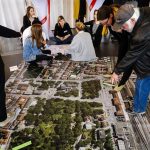
These are intense, time-limited workshops with multiple stakeholders, such as community members, to work together to come up with solutions. Charrettes prove useful in visioning exercises in master plans, public spaces, and neighbourhood renewal.
- Participatory Mapping and GIS
Community mapping enables residents to map assets, challenges, and aspirations. Participatory GIS combines local knowledge with geographical information systems to guide design. This is particularly valuable in environmental planning and disaster-hazard areas.
- Digital Engagement Platforms
In the post-pandemic era, digital platforms—from smartphone apps to virtual town halls—facilitate broader, asynchronous participation. “Consul” and “Citizen Lab” are some of the platforms utilised in smart cities to gather inputs, conduct polls, and co-create policies.
- Scenario Planning and Foresight Workshops
Future design calls for imagining several potential futures. Using scenario planning, communities can experiment with assumptions, investigate trade-offs, and co-create adaptive paths, thereby connecting today’s actions to tomorrow’s aspirations (Wilkinson et al., 2013).
Community Involvement Challenges
Even with its advantages, community participation in future design is not without challenges:
- Representation and Inclusivity
Necessarily, there are louder and more privileged voices that take over participatory processes. Representation of women, minorities, older people, informal workers, and disabled individuals needs to be ensured through conscious outreach.
- Capacity and Knowledge Gaps
Not every community has the technical literacy or assertiveness to participate in design dialogue. This necessitates capacity-building workshops, visual aids, and facilitation.
- Political and Institutional Resistance
Agencies might view participatory design as taking longer or watering down expertise. Addressing such resistance involves showing long-term value, increased trust, and lower conflict.
- Time and Resource Intensiveness
Substantive participation is resource-intensive. Long-term involvement must be reconciled with project deadlines, frequently necessitating phased or hybrid approaches.
The Indian Context: Opportunities and Innovations
India offers both vast opportunities and systemic challenges for community-driven future design.
Government Initiatives
Programs like the Atal Mission for Rejuvenation and Urban Transformation (AMRUT) and Smart Cities Mission have citizen participation provisions. Their implementation in practice, though, usually turns out to be superficial.
The Street for People Challenge and India Cycles4Change by ITDP and MoHUA, however, are examples of participatory urban design. In Indore, Pune, and Chennai, citizens collaborated with local NGOs to co-design safer streets and mobility networks.
Grassroots Innovations
From SPARC’s community toilet concepts in Mumbai slums to Ahmedabad’s self-constructed neighbourhood improvements assisted by Mahila Housing SEWA Trust (MHST), Indian cities abound with bottom-up design examples rooted in everyday life.
These examples demonstrate the potential of engaging communities not only as users but also as co-designers and custodians of built environments.
Towards a Framework for Community-Centred Future Design
To institutionalise community engagement, there needs to be a strong framework. The following principles can inform future design:
- Inclusivity: Apply culturally sensitive communication, multilingual resources, and involve marginalised groups.
- Transparency: Openly sharing data, limitations, and decision-making factors.
- Iterativity: Design as a process, not an event. Feedback loops are imperative.
- Flexibility: Leave room for changing goals according to community feedback.
- Capacity Building: Educate communities to engage meaningfully and educate professionals to listen actively.
- Ethical Engagement: Acknowledge power relationships and resist extractive participation.
As we all stare into the abyss of an uncertain but interdependent future, the power of communities to shape design cannot be overstressed. Future design has to be a communal practice of imagination, agency, and stewardship. The participation of a multiplicity of community voices is not only a democratic requirement but a design imperative—making it more relevant, resilient, and long-lasting.
Planning for the future, therefore, is a start by hearing in the here and now. Planners, designers, policy-makers, and citizens all need to collaborate in making futures that are equitable, resilient, and profoundly human.
References:
Arnstein, S. R. (1969). A ladder of citizen participation. Journal of the American Institute of Planners, 35(4), 216–224. https://doi.org/10.1080/01944366908977225
Bovaird, T., & Loeffler, E. (2012). From engagement to co-production: How users and communities contribute to public services. In V. Pestoff, T. Brandsen, & B. Verschuere (Eds.), New public governance, the third sector and co-production (pp. 35–60). Routledge.
Brand, P., & Dávila, J. D. (2011). Mobility innovation at the urban margins: Medellín’s Metrocables. City, 15(6), 647–661. https://doi.org/10.1080/13604813.2011.609007
Fischer, F. (2000). Citizens, experts, and the environment: The politics of local knowledge. Duke University Press.
Sanders, E. B.-N., & Stappers, P. J. (2008). Co-creation and the new landscapes of design. CoDesign, 4(1), 5–18. https://doi.org/10.1080/15710880701875068
SBUT. (2020). Bhendi Bazaar: A holistic urban renewal project. Saifee Burhani Upliftment Trust. https://sbut.in/
Sawai, K., Matsumoto, M., & Mizuguchi, S. (2018). Designing for future generations: Concept and practice of Future Design. Futures, 106, 27–36. https://doi.org/10.1016/j.futures.2018.01.004
Wampler, B. (2007). Participatory budgeting in Brazil: Contestation, cooperation, and accountability. Penn State Press.
Wilkinson, A., Kupers, R., & Mangalagiu, D. (2013). How plausibility-based scenario practices are grappling with complexity to appreciate and address 21st-century challenges. Technological Forecasting and Social Change, 80(4), 699–710. https://doi.org/10.1016/j.techfore.2012.10.031Introduction
Gallery of Participatory Planning: Shaping Cities through Community Engagement – 3. (n.d.). ArchDaily. https://www.archdaily.com/1009635/participatory-planning-shaping-cities-through-community-engagement/6550ff4f08e44436824270cb-participatory-planning-shaping-cities-through-community-engagement-photo