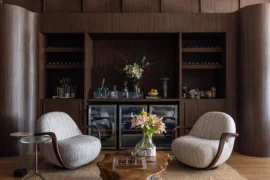
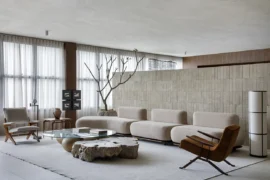
A person’s identity is crafted by their interests, their thoughts and models, the books they read and the stories they hear. Transcending through time, these become pivotal factors in shaping societies, communities and families. One such canonical story is the Ramayana, a religious tale for every Indian household and an epic for the world. The Ramayana house is a contemporary adaptation of the same.
Project Name: The Ramayana House
Studio Name: Envisage
Completion Date: 30-06-2022
Site Area (sq ft & sq m): 840 sq.m
Built-Up Area (sq ft & sq m): 700 sq.m
Photographer: Ashish Sahi & Vaibhav Bhatia

Located within a beautiful gated community called Shalimar paradise in Lucknow, the House of stories, is a fluent un-folding of the Indian epic, Ramayana. The house is not a literal, religious, or traditional recreation of the epic, but a contemporary adaptation and manifestation of the spiel itself.
The overall design scheme of the house aims to recreate the same gripping yet smooth, immersive experience that the narrative offers. The client and his three siblings grew up listening to Valmiki’s Ramayana from the family’s elders, and the home’s design celebrates these personal associations. All spaces are conceptualised to beautifully narrate the various chapters of the epic, thereby evoking memories and nostalgic happiness. By imbibing contemporary Indian design elements, in an Indian Bohemian style, the family enjoys stories and narratives, and the home takes the visitor seamlessly from one chapter to the next.

Bala Kand – A space to mark beginnings
The entry foyer symbolises the beginning of the house and depicts the Bala Kand, which marks the beginning of the Ramayana. The wall on the right has been enriched with the Ram Gayatri Mantra, an introduction to Lord Ram, as well as a warm welcome to the house. On the left is a hand-made, hand-painted console with sketches from the book Sita by Devdutt Pattanaik mounted onto the shutters. These sketches portray scenes from the Bala Kaand that beautifully encompass some pivotal scenes from the saga’s beginning. The entry wall has an artwork by Prasun Mazumdar that encompasses the entire Valmiki’s Ramayana, thus offering a summary of the story that follows as one moves through the house.

Ayodhya Kand – A Space of transition
The Ayodhya Kand in the story is marked by the transition as well as the journey from the court to the forest. Therefore, the house’s transitional spaces, such as the staircase and the passageway, are conceptualised and designed to bring out the essence of the Ayodhya Kaand. The floor of the passage is developed as a mosaic to depict the uneven textures of a forest bed and on the wall along the passage is a black and white Madhubani wall mural depicting the scenes of the forest from the epic. Since the Madhubani style of painting originates from Mithila, it is another subtle hint of its integral location in the epic.
The ceiling in the passageway is a groin vault representing the geometry of the trees in the forest with hanging lights, and the panelled doors in the passage add an earthy tone. Taking the theme forward, the risers of the staircase have been flanked with customised, hand-printed tiles, and the corner on the upper storey has a mural of a tree as well, both depicting elements of the forest. The theme of the Ayodhya Kaand extends to the powder room near the passageway. Designed with a palm leaf wallpaper from Good Earth, a green colour vanity and muted grey colour palette, the powder room is a modern recreation of the moods and colours of the forest.


Aranya Kaand – A space of communication.
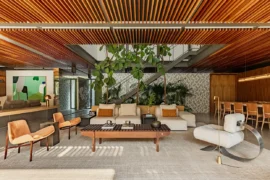
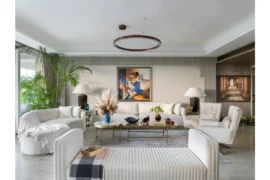
Aranya Kaand describes the settlement of the family in the forest and the fulfilling lives that they lived there. Manifested in the living area of the house, the traditional Aranya Kaand included engaging and insightful Darbaars held by Lord Ram, and their humble hut would be filled with familial warmth. In this home, the living area has been redefined from the previous layout of the house to create three key living areas, the formal living room, the informal seating area and the dining area. The formal living area is crafted as a royal, opulent space just like a King’s durbar with a vintage touch. Designed with a hand-tufted rug, camelback sofas, a wooden jhoola and a massive centre table, the living area depicts the royal lineage of the story. A bold Rama painting in the corner by Neeraj takes the opulence of the room a notch higher.

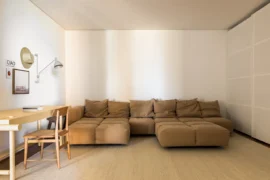
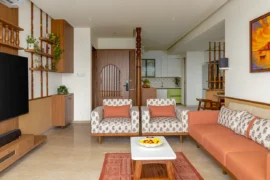
The adjacent informal seating has been designed as a baithak to bring in the same warmth and love as the hut, also a forest abode for the lord. The baithak is raised by two steps to change the volume of the space to recreate a cosy room contrasting from the grand, royal living area. The ceiling has been detailed with wooden roof rafters and a fan with a wooden finish to bring in the warmth and organic character of the wood, a key building element in the forest. The seating in the area is a slightly low L-shaped sofa seating that acts as a cosy conversation starter. The room has been adorned with two wooden shelves with brass utensils and a corner Chettinad pillar to add unique, contemporary Indian decor details to the space. Air-purifying snake plants fill the gap between the window and the sofa, bringing the lush green outdoors inside, thus blurring the physical boundaries. An ikkat border runs along the Baithak to symbolise the Laxman Rekha, a pivotal element in the story, remembered by all.