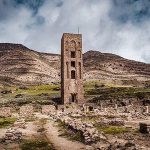
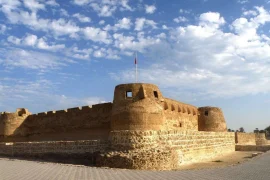
Al Qal’a of Beni Hammad was a fortified city amidst the mountains in Algeria. It houses the ruins of the first capital of the Hammadid dynasty at 1000m altitude. Most of Al Qal’a is now destroyed apart from the tall minaret of the mosque. This city is evidence of the palatial architecture of North Africa and the ruling period of the Hammad dynasty in the eleventh century. It was declared a UNESCO World Heritage Centre in 1980 (Centre, n.d.).

Recognition and Historical Context
Al Qal’a of Beni Hammad comprises several palaces for residence as well as for recreational purposes, as well as a mosque and its minarets. The city was built to embody power in 1007 and was a centre for military strength, economic opportunities and cultural richness (Centre, n.d.).However, it was soon demolished by the succeeding dynasty in less than 150 years from the time it was built. It wasn’t discovered until 1886 that a French historian identified it. The parts of the city were excavated and 150 hectares of the site were discovered and preserved (Centre, n.d.).
Very few people visit this UNESCO World Heritage site which has helped in the conservation efforts, as the remains are highly vulnerable to weathering and erosion (Archnet.org, 2017).
Palatial Architectural Features
This fortified city is a testimony to different influences like Maghrib, Andalusia and Sicily on the Arab architecture style and intricacies of Islamic architecture (Centre, n.d.). The city was not just built as a defence capital but also had dedicated recreational spaces. Qalʿat Beni Hammad comprises a total of four palaces which can be recognized by their distinct asymmetrical layouts and suggest organic expansion of the city (Archnet.org, 2017).
Qasr al Bahr – The Royal Residence
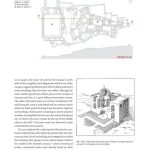
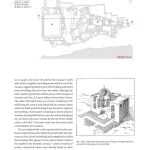
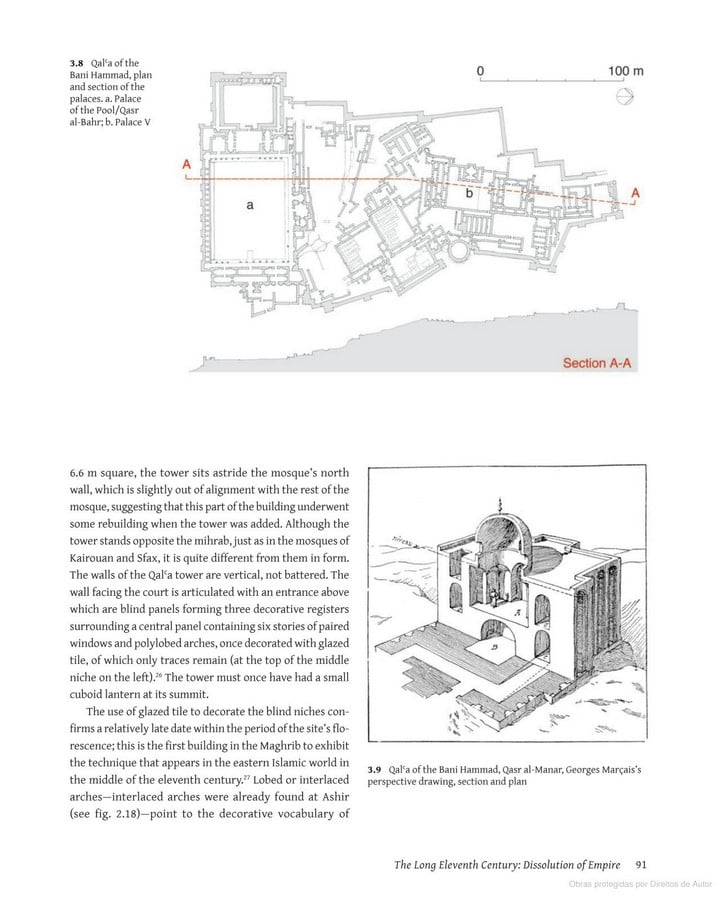
The largest palace, the Qasr al Mulk, also known as Qasr al Bahr was the primary royal residence. The name Qasr al Bahr means ‘Palace of the Sea’ which was influenced by a large bahr which is an artificial water reservoir. This water basin was also used for public events like nautical demonstrations, sporting events and theatrical performances (Archnet.org, 2017).
Image 2_Plan of the palaces a)Royal Residence and b) Palace V_© Jonathan M. Bloom, 2020
The mosque
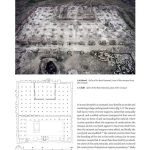
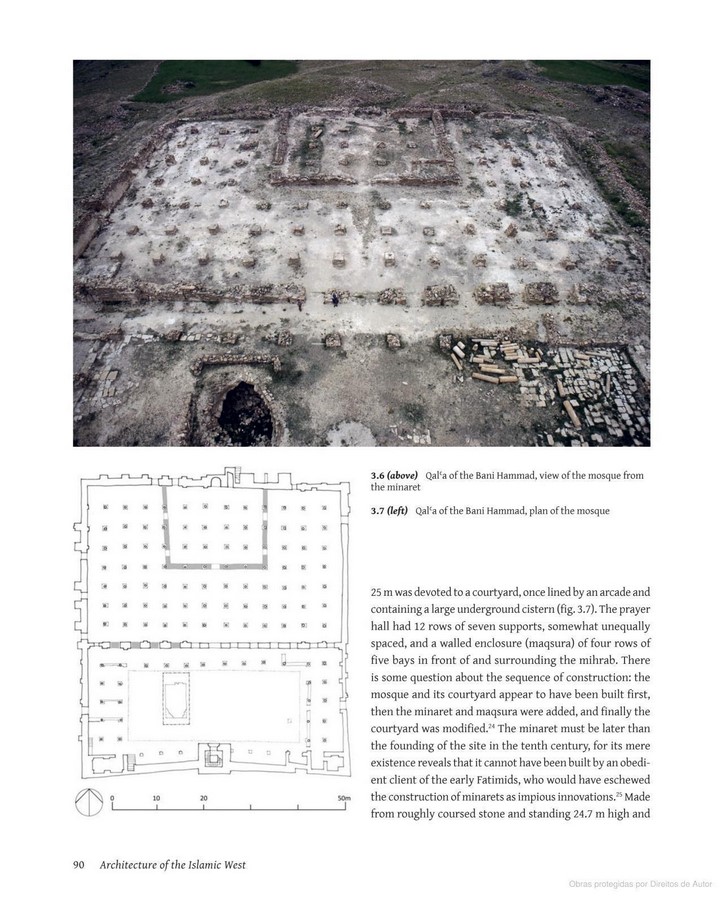
This mosque is the second largest and oldest one in Algeria. It was centrally located with proper alignment with Mecca, at the focal point of the city, perhaps to promote religious beliefs. The mosque also has a tall minaret built at the centre of its north wall; it is the only element that is still intact in its entirety (Archnet.org, 2017).
It is also suspected that the minaret was a later addition to the mosque because of the modification around it. The walls of this 25 m tall tower were built vertically instead of being battered making them look cuboidal, built according to the Western Islamic architectural style (Bloom. J.M, 2020).
The mosque has entrances in the both east and west directions directly opening to a large courtyard which is bordered by arched galleries called Sahn. Sahn was designed to accommodate gatherings before entering the prayer hall (Archnet.org, 2017). The mosque has a structural grid of columns, typical of the early Islamic mosques.
In front of the mihrab- the niche, there was a huge maqsura -an enclosed area reserved for the ruler, which was also destroyed. Its size suggests the hierarchy follows even in the religious place. Though the mosque is in ruins, its layout and foundation are visible to imagine how it was planned (Archnet.org, 2017).
Qasr al Manar – The military centre
The Qasr al Manar, also referred to as the ‘Castle of the Beacon Light’ is a fortified projection built into one of the walls in Qalʿat Beni Hammad. Apart from the minaret, this is the only structure above the ground that survived. This palace was entirely built in ashlar stone masonry. On one of its sides, there was a series of silos which could store up to two years of grains in case of siege (Archnet.org, 2017).
Apart from being the military hub, this castle was also used for diplomatic and ceremonial activities. On the uppermost level, there is a large room with no windows, with a domed ceiling which opens up to a terrace, which is used for formal meetings and possibly a watch tower as well (Archnet.org, 2017). The blind arches on the walls were decorated with glazed tiles in a technique that was found in Eastern Islamic architecture in that period, suggesting influences from Eastern regions (Bloom. J.M, 2020).
Ornamentation and Architectural Influences .
The decorative and architectural elements exhibit a wide range of artistic and cultural influences of Fatimid Egypt, Samarra (in present-day Iraq), Aghlabid Kairouan (in Tunisia) and Andalusian Spain. During the preservation, several artworks and decorative items were retrieved from the site. These include carved marble water channels, parts of frescos on the interior walls, ceramic pottery and marble sculptures. The friezes were stone carved and muqarnas were made with stone and plaster. They used multi-coloured tiles in different ways across the site.
Qalʿat Beni Hammad probably is the only structure that gives us a peek into eleventh-century western Islamic architecture. How each of the palaces was used explains the lifestyle of the rulers and the social boundaries between the common people and the royal family. Such historical cities also narrate the political ties between different regions. They could possibly be traced back to architectural influences of different regions on each other.
References:
- Centre, U.W.H. (n.d.). Al Qal’a of Beni Hammad. [online] UNESCO World Heritage Centre. Available at: https://whc.unesco.org/en/list/102/.
- Archnet.org. (2017). Archnet > Site > Qal’a Bani Hammad. [online] Available at: https://www.archnet.org/sites/4028.
- Bloom. J.M. (2020). Architecture of the Islamic West. [online] Available at: https://books.google.pt/books?id=IRHbDwAAQBAJ&dq=Architecture+of+the+Islamic+West:+North+Africa+and+the+Iberian+Peninsula [Accessed 27 Mar. 2025].