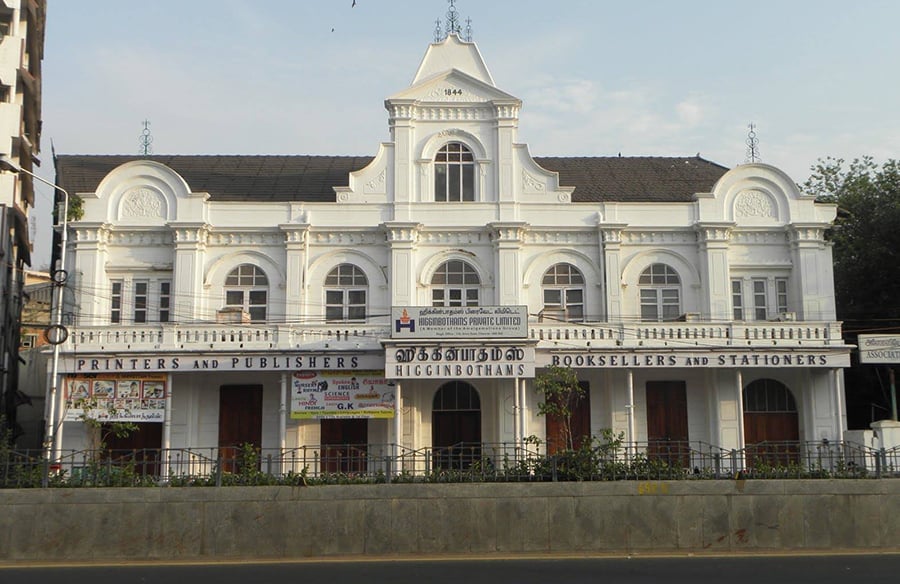
Higginbotham’s Bookstore, founded in 1844, is more than just a bookstore; it has become a cultural icon spanning history. The building is a historical monument on Anna Salai, formerly known as Mount Road, in Chennai. It is a testimony to the power of literature and the appeal of heritage architecture. The oldest surviving bookstore in India continues not only in its role as a keeper of history but as a platform for intellectual thought and, above all, a gem in architecture.
A Legacy Rooted in History

Abel Joshua Higginbotham was an English librarian who first set foot in India as a stowaway in the 1840s. He began his journey as a Bible peddler and then landed a job as a librarian in the Wesleyan Book Shop in Madras. After several years of working, he saw a prospect in the failing business and bought the bookshop in 1844, making it into the iconic bookstore that bears his name today.
Higginbotham’s developed a reputation as a bookstore with a select and thoughtfully curated range of titles for a larger audience. Abel’s sharp business instincts put the store in an upward spiral, setting the foundation in reality for its everlasting legacy. By then, the store could no longer be in its original location. In 1904, it moved into larger, purpose-built premises on Mount Road, a fitting symbol of its growing eminence.
Abel was succeeded by his son C. H. Higginbotham, who was succeeded by W.W. Ladden. The bookstore expanded its operations throughout its course. In 1949, the Amalgamations Group, a reputed conglomerate of South India, took over Higginbotham’s Bookstore. Today, there are almost twenty branches of Higginbotham’s.
Architectural Legacy of Higginbotham’s Bookstore

Designed by R.F. Chisholm, a pioneer of Indo-Saracenic architecture, Higginbotham’s reflects a seamless blend of practicality and aesthetic appeal. For the architect, designing the Higginbotham’s building meant making conditions comfortable for keeping books while inviting visitors.
Among the main architectural features are limited operable windows on the ground floor to control dust and ample fixed glass panels to provide natural light. The upper windows operate to give ventilation, and the high ceilings reduce humidity and facilitate airflow. These are all factors in book preservation.
This rectangular building has been constructed following the site for spatial efficiency in the layout. A long verandah supported by cast iron columns stretching across the front provides a semi-public space. In the interior, the mezzanine floor, connected by grand staircases, optimises vertical space inside the shop, adding to its charm.
Building Style and Relevance to its Era

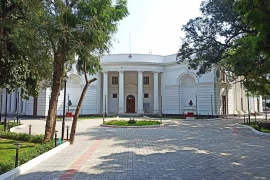
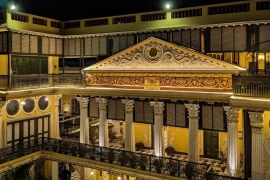
At present, Higginbotham’s stands as a testimony to the Indo-Saracenic style of architecture, a significant feature of colonial India. The white Palladian facade showcases its royalty, and its sloping Mangalore-tiled roof supported by timber rafters showcases the elegance of the building.
The intricate facade demonstrates different architectural elements. The long, narrow windows and the semicircular archway windows on the ground floor give an inviting sense of openness and elegance. Light coming through square latticed windows and the decorative stained glass above them adds more interesting charm to the interiors of buildings. The façade has a finial on the top. The frieze, horizontal bands, and pilasters emphasise symmetrical proportions. The façade shows a structural framework of harmony with double and triple windows and a one-storey porch supported by columns. The interior is characterised by colonial influence, with Italian marble flooring laid diagonally and a timber staircase leading to the mezzanine floor.

These architectural features combine utility with aesthetics, making Higginbotham’s a literary haven and a historical heritage monument. Indo-Saracenic style represents the cultural fusion of colonized India by accepting the architectural principles of Western influence in conjunction with local design sensibilities. The architecture of the Higginbotham’s Bookstore offers a glimpse into the colonial social, cultural, and political structure.
Materials and Construction
Every part of the building reflects the vision of Higginbotham’s of durability and elegance. The stained-glass windows, Italian marble, Mangalore tiles, solid timber, and cast iron play an important role in ensuring the structural strength needed for the building to stand for ages.
One of the modern changes made in the building was introducing glazed polymer film roofing to keep the floors dry. This admixture of traditional craft and modern methods has enabled Higginbotham’s to stand the test of time – still standing tall against structural and cultural marvels.
Cultural and Urban Impact of Higginbotham’s
Higginbotham’s has remained a constant feature of Chennai over the years. In colonial Madras, Higginbotham’s was a meeting place for scholars, writers, and readers from different backgrounds. The bookstore had a collection of books with an aptly inviting ambience that held them together for British elites and Indian intellects.

With time, Higginbotham’s became synonymous with Mount Road and thus enhanced the cultural stature of that locality. It has inspired many more such intellectual spaces, artistic spaces, bookstores, cafes, and handicraft emporiums lined up in the neighbourhood. Higginbotham’s has created a sense of belonging beyond its contribution to architecture and literature. Events and promos at the bookstore bring people together who foster a mutual interest in literature and culture. Its time-tested charm continues to attract tourists and readers, making it a part of the very identity of Chennai.

Challenges and Adaptations
Many challenges confront Higginbotham’s in a rapidly changing world dominated by digital media and e-commerce. When online readers and e-reading started transforming reading habits, footfalls in the traditional bookstore began to dwindle. Yet, Higginbotham’s has entered the modern world while preserving its past. By launching a mobile bookstore and expanding its collection range to contemporary genres and regional literature, it has adapted to new demands and maintained relevance. Besides, the bookstore’s commitment to preserving its architectural integrity has made it one of the most desirable destinations for heritage tourism.
A Timeless Treasure
Over almost two centuries, the bookstore has witnessed many events of historical significance – from colonial rule and independence to the digital revolution. It has served as a cultural and intellectual nexus, connecting generations through space for learning and inspiration. Today, it is an architectural and literary monument, evoking nostalgia and admiration. As Chennai evolves, this bookstore will continue to withstand the tides of change, serving as a reminder of the city’s many legacies and the enduring, vibrant spirit that defines it.
Citations:
- Prathi Jagan. (2023). The Higginbotham’s Bookstore in Chennai, Tamil Nadu. [online] Paper Planes. Available at: https://www.joinpaperplanes.com/the-Higginbotham’s-bookstore-in-chennai-tamil-nadu/ [Accessed 9 Dec. 2024].
- Homegrown. (2023). Inside Higginbotham’s: A Bookstore That’s Shaped India’s Literary Legacy Since 1844. [online] Available at: https://homegrown.co.in/homegrown-explore/inside-Higginbotham’s-a-bookstore-thats-shaped-indias-literary-legacy-since-1844 [Accessed 9 Dec. 2024].
- Roy, V. (2024). A Trip To India’s Oldest Bookstore In Chennai. [online] Outlook Traveller. Available at: https://www.outlooktraveller.com/experiences/places-of-interest/Higginbotham’s-the-heritage-bookshop [Accessed 9 Dec. 2024].
- Lavanya Gopal, Nivedita D, Ranjani T, Sindhu Swetha. Higginbotham’s Final. [online] Scribd. Available at: https://www.scribd.com/presentation/330949484/Higginbotham’s-Final [Accessed 9 Dec. 2024].