Social Architecture can be classified as projects that benefit society. The impact can be directly attributed to the project’s design, for example, the inclusion of green areas in urban projects, or it can be indirect in the form of employment. The key Principles taken into account in Social Architecture are Social Inclusivity, Long Term Sustainability, Community, and Social Identity. These principles are codependent, Social Inclusivity can only occur if the project is sustainable in the long term, and community spaces can only be successful when the cultural identity of the citizens has been taken into account.
Social Inclusivity
Spaces are designed to invite all members of society to participate. There are various ways of fostering inclusion, the main focus usually involves physical accessibility for individuals with mobility disabilities. Other forms of accessibility include the implantation of areas that provide cover from the heat, rain, or wind, these are important ways to provide a better experience for people who are vulnerable to these weather conditions. Additionally, there are methods to regulate temperatures such as water features i.e. cooling pools, or ventilation grids. Furthermore, it is necessary to take into account the various ways people inhabit spaces, some individuals might enjoy it by themselves while others are more likely to do so in groups, this leads to a variation of needs in the seating arrangements that people require. For Social Architecture to truly be socially inclusive it is important to take into account all the various conditions that co-exist within a society and how its members interact with the environment.
Long Term Sustainability

Sustainable architecture is linked to the use of vegetation, particularly local vegetation, and the use of other local resources and materials to ensure costs in resources such as water remain minimal. Furthermore, the project should aspire to emit the lowest possible Carbon Dioxide Emissions during construction. This principle is vital because Social Architecture must serve society in the long run, and the best way to do so is by protecting the environment. Urban projects such as the New York Highline successfully integrate sustainability into architecture, it addresses a multitude of civic issues: reclamation of unclaimed public space, adaptive reuse of outmoded infrastructure, and preservation as a strategy for sustainability. The park accommodates the wild, the cultivated, the intimate, and the social.’

Community
Social Architecture is constructive when it foments the formation of communities. These spaces can be designed on different scales, urban projects can provide community areas such as playgrounds for kids to play, and public parks can also be used as scenarios or places for congregation. Successful projects that incite social interactions include communal working spaces, where people can network and benefit from sharing spaces with other professionals. Other forms of architecture that specifically encourage social interactions are those that provide entertainment.
For social interaction to occur adequately it does not suffice to equip the population with public spaces, when designing on an urban scale, the safety of users must be taken into account, by limiting the number of narrow walking areas, avoiding spaces being sheltered from view, and most importantly luminosity, keeping public spaces visual helps prevent crime and makes people feel secure enough to inhabit these spaces, therefore, citizens spend more time outside socializing and creating communities. Thus, Social Architecture must be safe for social gatherings to take place.
Social Identity

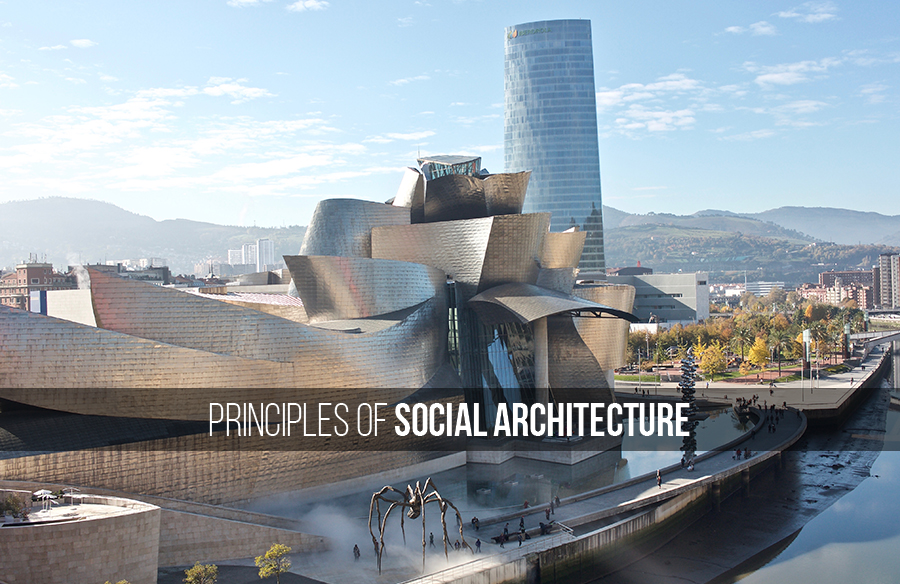
Psychologically people are more likely to engage with a space and protect it if they identify it as theirs. Cultural landmarks help generate this feeling. People need to connect with the architecture that surrounds them. A great example of Social Architecture is the Guggenheim Museum in Bilbao, designed by Frank Gehry. This building reflects the industrial and fishing tides of the Basque Country, it was inaugurated in 1997, a time when the region needed to improve its reputation due to the violent terrorist attacks committed by ETA. The iconic landmark has been instrumental in providing a new identity to Bilbao, demonstrating the vast influence architecture has over social perception, and this perception can be instrumentalized to the citizen’s benefit.
Social Architecture is a service to society, meaning all architecture should be social, regardless of its scale, this is only plausible when all the principles have been taken into account. It does not benefit society to simply fill a space with vegetation for ecological reasons if the intervention reduces the accessibility of the space. Designing a landmark won’t directly benefit society if the project doesn’t adequately value the safety of its users, the millennium bridge’s design was prioritized over the safety of its users and thus it became nicknamed ‘the wobbly bridge’. Architecture must be understood as a service to society for it to create a positive impact.
Reference:
Diller Scofidio + Renfro (2019). The high line. [online] DS+R_© https://dsrny.com/project/the-high-line.
Madrid, elDiario.es (2021). Villacís abre la puerta a que las terrazas sobre las bandas de aparcamientos se mantengan 2 o 3 años en Madrid. [online] ElDiario.es_© https://www.eldiario.es/madrid/villacis-abre-puerta-terrazas-bandas-aparcamientos-mantengan-2-3-anos-madrid_1_8267710.html [Accessed 9 Nov. 2024].
Mahmoud, Heba-Talla Hamdy. “Interior Architectural Elements That Affect Human Psychology and Behavior.” The Academic Research Community Publication, vol. 1, no. 1, 18 Sept. 2017, p. 10, pdfs.semanticscholar.org/ec72/3b10e3c57428e742a24bd34fd657d610e4f7.pdf, https://doi.org/10.21625/archive.v1i1.112.