Venice Biennale 2025
The Venice Biennale draws in artists worldwide to display creations and delve into cultural and social themes on a global scale. As one of the most prestigious artistic events, it encompasses exhibitions and festivals in art, architecture, film, dance, music and theatre every two years. Revolving around a theme that addresses global issues, the biennale provides a structure for expression and cultural exchange while exploring topics like identity and sustainability, within the Biennale space where art and architecture aim to spark ideas and visions for the future.
“Intelligens, Natural, Artificial, Collective” is decided as the theme of the 19th Venice Biennale that will be held from Saturday, May 10, to Sunday, November 23, 2025. The exhibition is titled “Intelligens” in English and Italian stressing the syllable ‘gens’ meaning people foreseeing the impact of collective intelligence, particularly AI for future advancement. Thus, extending the biennial to other disciplines such as data science, and engineering could pave the way to address the global climate crisis.
Iceland’s National Pavilion

Led by Arnhildur Pálmadóttir, the national pavilion of Iceland explores the concept of lava forming. The pavilion showcased Iceland’s design philosophy, focusing on eco-friendly building practices and geothermal energy. Iceland, a global leader in geothermal energy, has abundant resources, with over 90% of homes heated by geothermal energy and 25% of electricity generated from geothermal sources.
Basalt, a common volcanic rock in Iceland, has been used in traditional building practices for centuries due to its strength, durability, and resistance to harsh weather conditions. Today, basalt is popular in contemporary Icelandic architecture for facades, flooring, and decorative features that highlight Iceland’s geological heritage.

However, lava or volcanic rocks in their molten form can be moulded to our desired form, making them a sustainable alternative to conventional building materials and reducing carbon footprints. Taming the molten lava emitted by volcanoes also compromises the extraction energy of the material. The 2023 pavilion showcased various forms of cooled lava, such as large lava blocks and volcanic rock fragments, to illustrate how these could be integrated into buildings.
Arnhildur Pálmadóttir, an Icelandic architect, is known for her sustainable architecture, particularly her integrating geothermal and volcanic materials into building design. A founding member of SAP, she proposes unique construction methods that use Iceland’s natural resources, such as lava and volcanic rock, to reduce reliance on conventional materials like concrete and steel, significantly reducing the environmental impact of buildings.

‘The architectural profession hasn’t changed much for a long time, although we are facing various challenges, we are still working in the old systems, the old economic theories and the old material processes, which have become part of the problem. We need to imagine new worlds where we look for ways to solve our problems by telling stories of the future.’ – Arnhildur Pálmadóttir
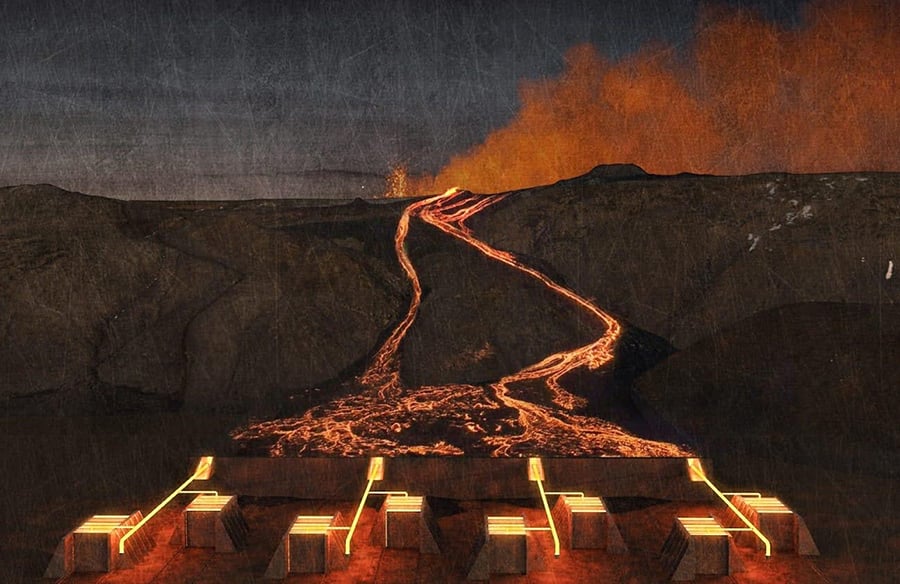
Lava Forming
Lava Forming is a concept developed by the Icelandic architect Arnhildur Pálmadóttir on harnessing the molten lava from volcanoes and using it as a natural building material. As a response to the climate crisis, Pálmadóttir saw lava as a sustainable mono material for construction as non-load-bearing and load-bearing elements depending on its different states and compositions. The process of lava forming will include creating trenches for lava to flow into when a volcano erupts or directly drilling into magma, that is before it erupts and turns into lava, thus minimising the built pressure and 3D the molten lava. The natural eruption of lava, which takes place every five years in Iceland will be redirected to the lava fields or quarries and protect the critical infrastructure of the country. Those trenches can later be used as a foundation of a city when cooled into solid rock.

“The main goal of Lava Forming is to show that architecture can be the force that rethinks and shapes a new future with sustainability, innovation, and creative thinking. A lava flow can contain enough building material for the foundations of an entire city to rise in a matter of weeks without harmful mining and non-renewable energy generation. Lava Forming is exploring a building material that has never been used before. The theme is both a proposal and a metaphor – architecture is in a paradigm shift, and many of our current methods have been deemed obsolete or harmful in the long term. In our current predicament – we need to be bold, think in new ways, look at challenges, and find the right resources.” – Arnhildur Pálmadóttir
Lava as building material
The tamed lava rock is used as a building material by taking advantage of its thermal properties, natural durability and aesthetic value. It has natural insulating properties that help maintain indoor temperature. Capable of withstanding environmental stress that includes erosion, seismic activity, and temperature fluctuations, the lava stone can be used as a structural member for columns, beams, and shear walls.

Lava stone can provide effective sound insulation, especially in urban or noisy environments. Its porous structure can absorb and dampen noise, enhancing building acoustics. With its unique texture and colour palette, lava rocks bring natural beauty into architecture making it a piece of nature’s art. Unlike cement and concrete, the lava-based construction material does not include a carbon-intensive production process, hence, making it more sustainable.
The political and environmental implications of lava forming are also significant. It raises questions about resource ownership and regulation in Iceland, as volcanic materials are both a natural asset and a potential economic resource. Furthermore, lava forming can contribute to reducing carbon emissions in the building industry, aligning with global efforts to mitigate climate change.

Through lava forming, Iceland aims to inspire global architecture by showcasing how natural, locally sourced materials can shape the future of sustainable construction. This concept also opens up other volcanic regions to explore lava as a renewable and culturally integrated building resource.
References:
- https://www.designboom.com/architecture/interview-s-ap-architects-potential-lavaforming-future-cities-venice-biennale-2025-pavilion-09-21-2024/
- https://www.fastcompany.com/90752124/lavaforming-one-architects-wild-idea-to-construct-buildings-from-molten-lava
- https://www.honnunarmidstod.is/en/honnudirogarkitektar/37-arnhildur-palmadottir-s.-ap-arkitektar