The Deccan: a Brief History
Deccan was a significant cultural and political force in South Asian history. The regions bordered by the Vindhya ranges to the north, the Western Ghats (Sahyadris) to the west, the Bay of Bengal to the east, and the Mysore Plateau to the south are collectively referred to as the Deccan (also spelled Dekkan, Dakhan). Today the Deccan comprises the plateau regions of Maharashtra, northern Karnataka, and Mysore.

The Nizams were the rulers of the princely state of Hyderabad in India, reigning from the early 18th century until 1948. The title “Nizam” is derived from the Arabic word “Nizam-ul-Mulk,” meaning “Administrator of the Realm.” They were a dynasty of Asaf Jahi rulers who established their sovereignty after the decline of the Mughal Empire, beginning with Nizam-ul-Mulk Asaf Jah I in 1724. The Asaf Jahi dynasty ruled Hyderabad for over 200 years. The Nizams maintained a semi-independent status by forming alliances with the British during the colonial period. They were allowed to govern Hyderabad internally while accepting British oversight in foreign policy matters. The Nizams were among the wealthiest rulers of their time, with one of the last Nizams, Mir Osman Ali Khan, being named the richest man in the world by Time magazine in 1937. His wealth included an extensive collection of jewels and gold. The Nizams influenced Hyderabad’s social and architectural fabric in addition to their role as political rulers and cultural benefactors.
The Nizams of Hyderabad left an indelible mark on the Deccan, not just through their political reign but through their architectural, educational, and cultural contributions. From the luxury of Purani Haveli to the academic excellence embodied by Osmania University, and the bustling commerce of Mozamjahi Market, the Nizams’ influence resonates in every corner of the city. Their vision seamlessly blended tradition with modernity, crafting a legacy that continues to shape Hyderabad’s identity. Hussain Sagar, a man-made lake built during their rule, has become a vital part of the city’s landscape, serving as a recreational hub and a symbol of their commitment to urban development.
Hussain Sagar: A Jewel of Hyderabad

India’s artificial lake, Hussain Sagar, has a long history from the sixteenth century. The fifth emperor of the Qutb Shahi dynasty, Ibrahim Quli Qutb Shah, initially built it to give water to the expanding metropolis of Hyderabad. Hussain Shah Wali, a Sufi saint buried on an island in the center of the lake, inspired the name of the lake.
Hussain Sagar has been instrumental in the growth of Secunderabad and Hyderabad throughout the years. The lake has functioned as a leisure place, a water source, and a transit center. Hyderabad and Secunderabad became twin cities after a causeway was constructed over the lake in the 19th century. The causeway is currently recognized as Necklace Road which has become a bustling commercial and residential area.
Purani Haveli: The Forgotten Gem of Nizam’s Opulence

Purani Haveli (meaning “Old Palace”) was the official residence of the Nizams for several decades. Builtin the 18th century by the second Nizam, Ali Khan Bahadur Asaf Jah II, the structure showcases a fusion of Mughal and European architectural styles. Purani Haveli is a representation of the grandeur of the Nizam era as well as a work of architectural art. Today, it also serves as the home of the Nizam’s Museum, which preserves relics and presents that various dignitaries have donated to the Nizams.


The palace is renowned for its distinctive European-inspired architecture, which includes large courtyards, tall ceilings, and exquisite woodwork. The U-shaped structure combines European, Persian, and Indian architectural ideas with a long corridor and spacious rooms on either side. Beautiful chandeliers, elaborate furnishings, and a sizable collection of artifacts that showcase the Nizams’ opulent lifestyle are all features of the palace.


Osmania University: The Nizam’s Educational Masterpiece

Osmania University was established in 1918 by the final Nizam of Hyderabad, Mir Osman Ali Khan, and is regarded as one of the Nizam era’s most important educational achievements. Osmania institution took a brave stand in conserving and advancing regional culture and language when it became the first institution in India to provide instruction in Urdu, an indigenous language. The Nizams wanted to establish a school that taught modern disciplines like science, engineering, and law with traditional Islamic and Persian knowledge.

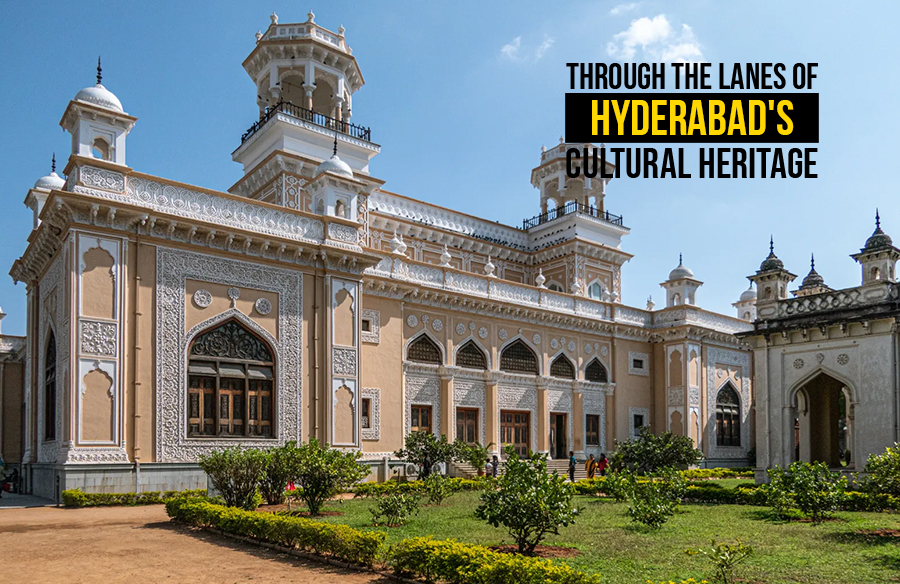
The main structure of the institution is a remarkable example of Indo-Saracenic architecture, which combines Gothic, Hindu, and Islamic architectural elements. The region’s various cultural influences are reflected in the famous central dome, which is flanked by minarets, arches, and decorative carvings. The symmetry of the building and its majestic entryway convey Nizam’s intention to build a long-lasting establishment.


One of Hyderabad’s most recognizable commercial areas is Mozamjahi Market, which was constructed in 1935 during the rule of Mir Osman Ali Khan. Originally built as a wholesale market for fruits, vegetables, and flowers, it is now recognized as a cultural icon. In addition to meeting Hyderabad’s business demands, Mozamjahi Market has evolved into a cross-cultural hub that attracts visitors from all walks of life. It’s still a bustling center of activity, well-known for its flower shops, spice shops, and vintage appeal. The market is evidence of Nizam’s commitment to promoting a robust economy and helping regional companies and craftspeople.

Their persistent contributions demonstrate the belief that “A nation’s greatness lies in its cultural heritage,” as stated by Mir Osman Ali Khan. Hyderabad is a true representation of its history because of its avant-garde dedication to education and trade, as well as its architectural fusion of Mughal, Persian, and European styles. These buildings still fulfill their original functions today, maintaining historical significance while meeting contemporary requirements.The Nizams’ influence on Hyderabad’s food scene is evident in the city’s diverse and flavorful cuisine, which incorporates Persian, Turkish, and Indian elements.
There’s a lovely selection of traditional delights available in Hyderabad, a city well-known for its rich culinary legacy. Irani tea, known for its spices and served in traditional kulhad cups, is a favorite beverage of both locals and visitors. The tea is served with Osmania cookies, which are buttery biscuits named after the Nizam of Hyderabad. Faludas are a must-try delicacy composed of vermicelli noodles, rose syrup, basil seeds, and ice cream or kulfi for a cool treat. Ice cream at Mozamjahi Market offers a broad variety of traditional, Indian, and specialty flavors ranging from Vanilla, chocolate, strawberry, and mango to traditional flavors like Kesar pista (saffron and pistachio), kulfi (thick, dense ice cream), malai kulfi (cream-based kulfi) and unique flavors like Paan (betel leaf), Chiku (sapota), gulab jamun (sweet dumplings) to suit a wide range of palates.
They created environments that continue to animate Hyderabad, demonstrating the enduring quality of true brilliance. Their contributions continue to influence the city’s social and cultural fabric even now; they are not merely a part of history.
Citations:
Saajid ,M.,Khan, S., (2021). Hyderabad Deccan Illustrated.Hyderabad:The Deccan Archive & 8Bit Rabbit Studio.
Sohoni ,Pushkar,(2018). The Architecture of a Deccan Sultanate .London : I.B.Tauris & Co. Ltd