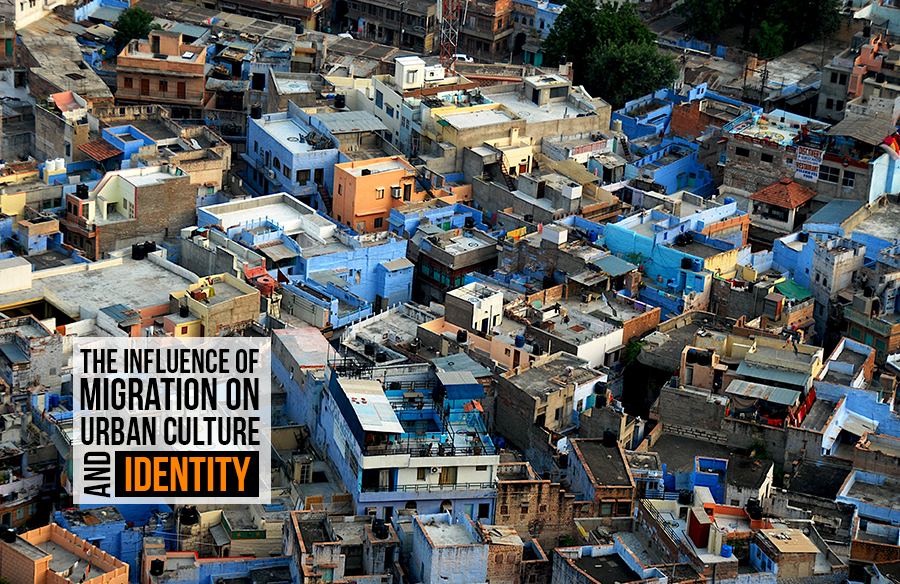
Migration, the movement of people from one place to another, has been a defining way of surviving the human race. In contemporary times, the pace and scale of migration have accelerated dramatically, reshaping urban landscapes and cultural identities worldwide. India, with its vast diversity and deep-rooted migratory traditions, provides an Exceptionally affluent context to explore the interplay between migration and urban transformation.

- Formation of Neighborhoods
Migration often leads to the formation of distinct neighborhoods. Migrants from the same region or country may cluster in specific areas, creating enclaves that preserve their cultural heritage. These neighborhoods can become vibrant hubs of social activity, offering migrants a sense of belonging and community.
For instance, in Mumbai, India, migrants from South India have formed numerous South Indian neighborhoods, such as Matunga and Dadar. These neighborhoods have become centers for South Indian cuisine, music, and cultural events.
- Cultural Transformation
The interaction between migrants and the host population can lead to significant cultural transformation. Migrants bring their traditions, customs, and beliefs to the city, enriching the local culture and creating new forms of expression. This can result in a rich tapestry of cultural influences, including new foods, music, art, and celebrations.
In New York City, for example, the influx of immigrants from Latin America has transformed the city’s culinary scene, with the proliferation of Latin American restaurants and food trucks. Similarly, the arrival of Chinese immigrants in London has led to the development of vibrant Chinatown neighborhoods, where Chinese culture is celebrated and preserved.
- Circular Migration and Its Impact on the Urban Landscape
Circular migration, where individuals migrate back and forth between their rural or urban origins and their destination, can have a significant impact on the urban landscape. Migrants may invest their earnings in their home communities, leading to the development of new infrastructure and amenities. Additionally, circular migration can contribute to the diffusion of ideas and technologies between rural and urban areas.
In India, circular migration has been a pivotal force in the advancement of rural regions. Many migrants from rural areas send remittances back home, which are used to fund education, healthcare, and infrastructure projects.
- Gender Roles and Identity in Migration
Migration can have a profound impact on gender roles and identities. Women may face divergent challenges and opportunities in their new domiciles relative to their places of origin. They may face discrimination, limited access to employment, and cultural isolation. Migration can also offer women expanded opportunities for education, employment, and personal growth.
Studies have shown that women’s roles in migration can vary significantly across cultures. In some cultures, women may be the primary decision-makers regarding migration, while in others, men may have more control over the migration process.

- Shift in the Urban Landscape, Architectural Style, and Design Approach
The influx of migrants can lead to a shift in the urban landscape, as migrants introduce new architectural styles, forms of urban planning, and public spaces. This can result in the creation of new cultural hubs and the transformation of existing neighborhoods.
In many cities, the arrival of migrants has led to the development of new housing types and commercial spaces that reflect their cultural preferences. For instance, the influx of Chinese immigrants to Toronto has resulted in the construction of numerous high-rise buildings that incorporate traditional Chinese architectural elements.
- Catalyst for Inclusive Urban Space
The increasing diversity of urban populations has led to a growing demand for more inclusive urban spaces. Cities are recognizing the importance of creating environments that are welcoming to people from all backgrounds and cultures. Such initiatives might involve promoting cultural diversity, providing language services, and ensuring accessibility for individuals with disabilities.
Many cities are also working to address issues of discrimination and inequality that may disproportionately affect migrants. This can include implementing policies to promote affordable housing, access to education and healthcare, and employment opportunities for migrants.
- Demand for an Identity-Neutral Space
While many migrants may find comfort and belonging in their cultural enclaves, there is also a growing demand for identity-neutral spaces. In these spaces, people can participate in shared activities, learn about different cultures, and form lasting friendships.
Examples of identity-neutral spaces include public parks, libraries, museums, and community centers. These spaces can be designed to promote inclusivity and diversity and to provide opportunities for people from all backgrounds to participate in cultural activities.
- Circular Urbanization
Circular urbanization is a concept that emphasizes the importance of sustainability and resilience in urban development. It involves creating cities that are more efficient, equitable, and environmentally friendly. For example, cities could implement policies to encourage public transit use, invest in waste management infrastructure, and create more parks and green spaces.
Migration can play a crucial role in promoting circular urbanization. Migrant perspectives are vital for creating resilient urban environments Additionally, migrants may be more likely to adopt sustainable practices, such as recycling and energy conservation.
Migration is a complex and multifaceted phenomenon that has a profound impact on urban culture and identity. The influx of migrants into cities can lead to the formation of new neighborhoods, cultural transformation, and changes in the urban landscape. However, migration can also pose challenges, such as discrimination and inequality.


References:
- Chen, Q. Wang, C. He, P. Cai, A. (2024). Subjective social integration and its spatially varying determinants of rural-to-urban migrants among Chinese cities. Nature, Scientific Reports (14), Available at: https://www.nature.com/articles/s41598-024-55129-y. [6/03/2024].
- Lukmaan IAS (2024). Analyze how increasing urbanization is impacting the cultural identity of rural migrants in Indian cities. [online]. (Last updated: August 22, 2024). Available at: https://blog.lukmaanias.com/2024/08/22/analyze-how-increasing-urbanization-is-impacting-the-cultural-identity-of-rural-migrants-in-indian-cities/#:~:text=Change%20in%20Dress%20and%20Lifestyle,kurta%2Dpyjamas%20with%20Western%20wear.
- Bhugra, D and Becker, M (2005). Migration, cultural bereavement, and cultural identity. National Library of Medicine. Available at: https://www.ncbi.nlm.nih.gov/pmc/articles/PMC1414713/
- Karamaras, S. (2023). Identity and Migration. It’s Complicated. Available at: https://complicated.life/blog/migration-and-identity/
- Lin, S. Wu, Fulong. Lian, Q. Li, Z. (2022). From hometown to the host city? Migrants’ identity transition in urban China. Science Direct. Volume 122. Available at: https://www.sciencedirect.com/science/article/abs/pii/S0264275122000063
- Kapoor, A. (2023). The Cultural Markers of Urbanisation. Institute for Competitiveness. Available at: https://www.competitiveness.in/the-cultural-markers-of-urbanisation/#:~:text=Due%20to%20migration%2C%20individuals%20from,provide%20urban%20identities%20with%20vibrancy.
- Wilson Center. (1999). Migration, Urbanization, and Social Adjustment. [Online]. Available at: https://www.wilsoncenter.org/publication/migration-urbanization-and-social-adjustment
- Xu, Haiping. Wu, W. Zhang, C. Xie, Y. Lv, J. Ahmad, S. & Cui, Z. (2023). The impact of social exclusion and identity on migrant workers’ willingness to return to their hometown: micro-empirical evidence from rural China. Nature. Available at: https://www.nature.com/articles/s41599-023-02345-y
- Bhide, A. (2024). Urban-ward Migration and Policy, Narratives: A Time to Retrospect. IIHS. Sage.
- Jha, R. (2024). The role of migration in India’s urban growth story. Observer Research Foundation. Available at: https://www.orfonline.org/expert-speak/the-role-of-migration-in-india-s-urban-growth-story