Social architecture is one of the central areas within the built environment discipline that is close to every architecture practitioner’s heart. However, practitioners rely on bread-and-butter projects to sustain their architectural business, and only a few have the opportunity to work on projects with societal impact. Social enterprises have mainly taken on the role of social impact. A social enterprise is a model combining business and social goals as its primary purpose. It harnesses the potential to create sustainable solutions to social challenges, and the profits generated are primarily used to fund social programs.
EPIC: Extraordinary People Impacting Communities
In Malaysia, EPIC Homes, an acronym for Extraordinary People Impacting Communities, is a beacon of hope established in 2010. Under the leadership of john-Son Oei, this social enterprise has evolved from a small one-off toilet-building and house-painting project at an Orang Asli (indigenous people) village to a transformative force. EPIC’s work, recognised through the iF Social Impact Prize 2023, is a testament to the power of social enterprise in creating positive change and inspiring hope and transformation in indigenous communities.
EPIC Homes doesn’t just provide shelter, it does so in a unique way. The organisation has developed a thoughtful process that connects local volunteers with Indigenous people in Malaysia. Importantly, recipients of a new home have agency in the building process, empowering them and fostering a sense of engagement that extends beyond the completion of the home.
Jury Statement on iF Social Impact Prize 2023
Shelter, local, indigenous people, home, agency! These keywords exemplify the purpose of EPIC Homes. EPIC Homes responded to the call for action regarding UNDP’s estimation that 34% of Orang Asli live in poverty, equivalent to one-third of their population. Owning a home is their core need. In Peninsular Malaysia, approximately 12,000 Orang Asli (OA) families live in unsafe housing. Contrasting the role of EPIC Homes to the conventional approaches of improving the quality of life of the Orang Asli, John-Son says: “Past initiatives to furnish these communities with safe housing have led to an overreliance on external assistance, leading to a decline in Orang Asli’s knowledge and skills regarding home construction, contributing to the decline of community development.”
A Home versus a House
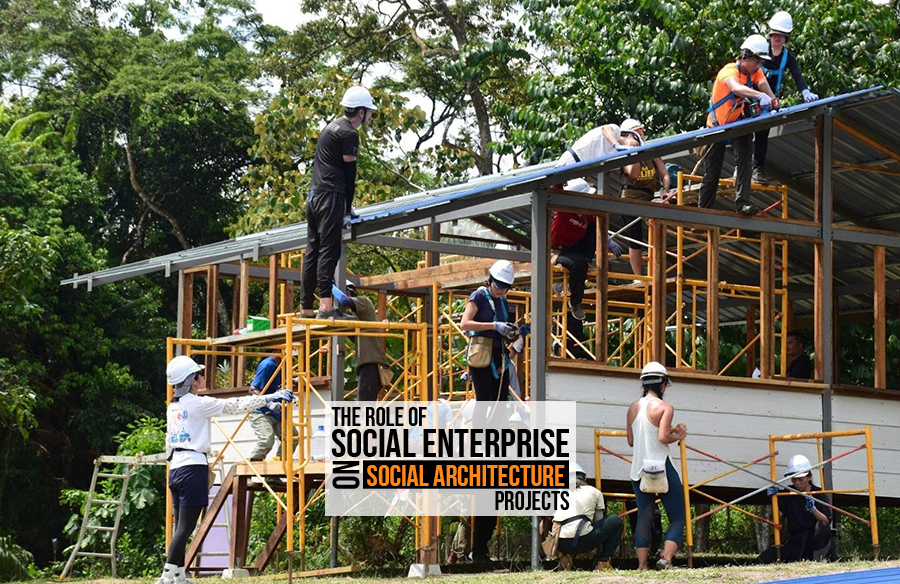
Building a home in 3 days together! Think Lego and think IKEA! Framed around the philosophy of “We believe that the presence of relationship is what truly differentiates a Home from a House”, EPIC Homes engages and mobilises urban volunteers to collaborate with Orang Asli families to build homes in just three days. Since its inception in 2010, EPIC Homes has had nearly 250 homes built, 230+ families reached, 27 communities impacted, and hosted a volunteer force of 8000+ builders whose common goal is creating sustainable and inclusive communities.

While the organisation’s core mission is to build homes for Indigenous people, its initiatives are framed around leadership, team-building programmes, and volunteerism. Branding the social enterprise around leadership, team-building programmes, and volunteerism instead of merely Corporate Social Responsibility has increased the momentum to initiate projects and engage volunteers. Since its debut in 2010, EPIC Homes has slowly gained momentum in its three-day/two-night EPIC HOMES build experience, juxtaposing relationships between team members and Indigenous people while at the same time making a powerful impact on a community in need.
The home is used as an anchor to connect to larger communities. Building a home includes the community as part of creating long-term sustainability and building relationships with the community. The ultimate measure of social impact is rooted in three areas. Firstly, the quality of life of the community’s satisfaction and current state across multiple dimensions of life. Secondly, the established web of relationships and networks and the resources shared for social mobility support the quality of life. Thirdly, the level of epic-ness is the community’s action to influence and positively impact the people around them and their readiness to create change.
Being EPIC!
In the emerging landscape of non-profit and social enterprises, the organisation’s positioning is central to optimising its focus and making a social impact.

- EPIC projects are not just about building homes; they are about building communities. They are community-led, involving close collaboration and consultation with the Orang Asli communities to derive vernacular designs suited to the cultural and environmental contexts. This approach ensures that the communities are not just recipients but active participants, fostering a sense of connection and involvement, making the audience feel part of a larger social movement.
- EPIC projects are not charities. They are in the spirit of Kickstarter and aim to initiate relationship-building within the Orang Asli community, train local champions, build capacity, and empower the communities to own their futures.
- EPIC projects use the built environment as a Kickstarter. The EPIC home projects become catalysts for long-term sustainable change, one home at a time, to change an entire community.
- EPIC Homes innovates with easy-to-build rapid construction systems. Each building is completed in 3 days, so structured rapid construction is essential to maximising the volunteer workforce in the construction process. By investing time in developing our easy-to-build rapid construction system, volunteers can participate in mass while contributing to the building of an entire home, making the experience much more effective, meaningful, and memorable. This increases the chances that volunteers will have a greater connection with the community, thus strengthening social capital and the likelihood of shared resources.
EPIC’s Project 100
In 2024, EPIC embarked on Project 100, a mission to build safe homes annually for 100 Orang Asli families, challenging its previous record of 26 homes yearly. Scaling up remains challenging, particularly for fundraising efforts, which have begun as part of Stage 1: The First 10 Homes for Project 100. Recently, the support from the MADANI Government’s 1-to-1 Home Sponsorship Matching Initiative has been encouraging. Through this program, every home funded—whether through public or corporate contributions—will be equally matched with another home, effectively doubling the impact of each donation and stretching the mileage of our donors’ generosity.

More than 40 out of 100 homes have been built in 3 out of 7 villages targeted, with more than 20 homes matched in funding by the Madani government.
An EPIC project begins from a humble start. The role of social enterprise is multifaceted, from providing a kickstart through building a home to building relationships and capacity and empowering change from within. One home at a time, a community is built.
References:
iF. (2023). Epic Homes [online]. Available at https://ifdesign.com/en/winner-ranking/project/epic-homes/591381 [Accessed 7 September 2024]
EPIC Homes. (2024). EPIC Homes [online] Available at https://epichome.org [Accessed 7 September 2024]