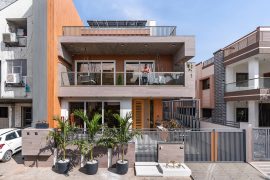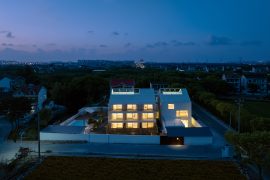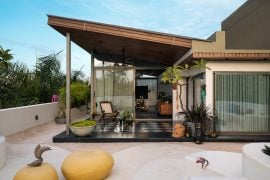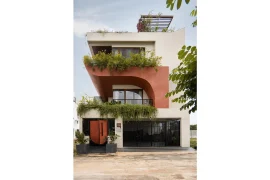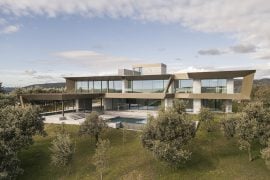

The FRN House, prominently situated overlooking the golf course at the Club Universidad de Buenos Aires within the gated community of CUBA, stands as a testament to architectural ingenuity and thoughtful design. The project was driven by a set of highly ambitious requirements.
Project Name: FRN House
Studio Name: NOA, Najmias Office for Architecture
Completion Year: 2023
Gross Built Area (m2/ ft2): 330 m2 / 3.552 sqft
Project Location: C.U.B.A. Villa de Mayo, Prov. de Buenos Aires, Argentina
Lead Architects: Oliverio Najmias
Photo Credits: Daniela Mac Adden

The clients envisioned a residence with a compact footprint—no more than 350 square meters—but it needed to accommodate a diverse array of spacious, well-appointed rooms. Ultimately, the architectural program was defined to include: a master suite with a dressing room, three en-suite bedrooms for the children, living room, dining room, kitchen, quincho (BBQ area), playroom, laundry room, storage, and a maid’s room.

The complexity of the project extended beyond just the variety of spaces; it also involved intricate spatial relationships between them. The master suite needed to be distanced from the children’s rooms, ideally on a different floor, yet closely linked to the living room. The children’s quarters required proximity to the quincho but needed sound insulation to prevent noise disturbances. Additionally, the quincho needed to be adjacent to both the playroom and kitchen. Moreover, the design called for unobstructed views of the golf course from all social areas and the master suite.

After several design iterations, which are integral to our process, we successfully integrated these diverse requirements into a cohesive architectural solution. The result is a design that marries strong architectural synthesis with efficient use of energy and natural resources, offering expansive views while maintaining the privacy of the inhabitants.

In appearance, the FRN House is deceptively simple: two offset rectangles define the plan. However, this simplicity belies a complex architecture with a spatiality that defies the ordinary. These rectangles serve distinct functions—one forms a closed, private volume that houses the bedrooms, while the other is an open, extroverted space that defines the social areas of the home. Here, the boundaries between interior and exterior blur as a floating reinforced concrete slab hovers over a travertine base, with no visible supporting structure.

Given the extensive use of glazing, special attention was devoted to optimizing energy efficiency. Overhangs and eaves are designed to block summer sun while welcoming winter light; all windows are treated for enhanced performance, and sunshades are utilized in the bedrooms. The design also emphasizes environmental sustainability, incorporating a gray water reuse system, solar collectors for hot water, and solar panels for electricity generation.