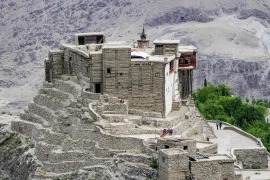
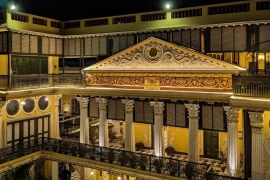
Situated in the heart of Old Nashik’s Saraf Bazaar, Sarkarwada stands as a historic monument that once served as the administrative stronghold for the Peshwas during the 18th century.

Sarkarwada: Naming Nashik’s Seat of Power
Historians are divided over the origins of Sarkarwada. One faction attributes its construction to Balaji Baji Rao, known as Nanasaheb Peshwa (8 December 1720 – 23 June 1761), who they believe built it between 1750 and 1760 in Saraf Bazaar. Others contend that it was Thorlya Madhavrao Peshwe (15 February 1745 – 18 November 1772) who oversaw its creation. A third group credits Raghunathrao Peshwe (18 August 1734 – 11 December 1783) with its establishment.
E.N. Wilton, an engineer with the British Great Indian Peninsula Railway Company, lends weight to the theory that Nanasaheb Peshwa was the builder. Wilton sketched Sarkarwada and published it in The Illustrated London News on 15 January 1859, under the title “Nanasaheb’s Wada.” His article asserted that Nanasaheb, the son of Baji Rao I, must have constructed Sarkarwada, citing Nanasaheb’s exemplary administrative and accounting skills as evidence. Wilton’s account highlights two key points: firstly, Sarkarwada was a topic of international discussion, and secondly, for the Peshwas, Nashik was a strategic base for expanding the Maratha Empire northwards.
Throughout its history, Sarkarwada has been known by various names. It was sometimes called “Odhekarcha Wada” after Sardar Rangarao Odhekar, the Peshwa chief who supervised its construction. Its proximity to Ram Setu, a bridge connecting Nashik and Panchavati over the Godavari River, earned it the name “Pulawarcha Wada,” meaning “wada built upon a bridge.” During her reign, Gopikabai Peshwe (20 December 1724 – 11 August 1778) administered the Maratha Empire from Sarkarwada, leading to its designation as “Sarkarwada” or “Sadar.”
Sarkarwada Through the Ages: A Chronicle of Continuity and Change
In 1818, following the defeat of the last Peshwa, Shrimant Peshwa Baji Rao II, by the British East India Company, Lieutenant-Colonel McDowell took control of Sarkarwada and used it to administer parts of North Maharashtra and Madhya Pradesh. Legend has it that during McDowell’s tenure, excavations at Sarkarwada unearthed jewellery worth Rs 38 lakh, which fell into British hands. Interestingly, Sarkarwada also served briefly as a prison, notably detaining Anant Kanhare and other freedom fighters involved in the Nashik Conspiracy Case of 1909.
In the 1840s, a section of the wada served as a public library. Post-independence, Sarkarwada became the location for the inaugural Collectorate office. Subsequently, it housed both the Bhadrakali Police Station and the Sarkarwada Police Station, marking a significant transition in its use over time.
Thus, Sarkarwada stands as a testament to Nashik’s rich and tumultuous history, embodying the legacy of Maratha rule, British colonial administration, and India’s struggle for independence.
Sarkarwada Redux: A Heritage Conservation Story
During the deluge of 1939, the surging waters of the Godavari River submerged eleven steps of Sarkarwada, compelling authorities to inscribe a flood line (marked in blue) on its walls. Despite the flood’s ravages, Sarkarwada’s magnificence endured. In the 1990s, through the persistent endeavours of former minister T.N. Pawar, the State Archaeological Survey of India took custodianship of this architectural treasure, ensuring its preservation. On July 20, 1993, Sarkarwada was accorded the status of a state protected monument, cementing its place as a cherished piece of history.


Building Sarkarwada
Spanning approximately 1582.70 sq. m, Sarkarwada’s original Peshwa-era structure boasted three floors, a basement, a well-constructed drainage system, two chowks (courtyards), and a fountain. The ground floor showcased intricately carved pillars, while the first floor housed the prestigious Darbar Hall. Remarkably, Sarkarwada’s construction comprised 80 to 95 percent woodwork. The columns and arches were crafted from exquisite dark processed saag (teak), adorned with elaborate designs depicting serpentine motifs, banana flowers, and peacocks—a clear influence from the architectural styles of Rajasthan, Gujarat, Kathiawad, and other regions of western India. This ornamental detailing was unique, as traditional Maharashtrian architecture of that era typically did not incorporate such intricate carvings. Additionally, the plinth of Sarkarwada was constructed using Northern Black Polish Stone (NBPS) sourced from Ramshej near Nashik city.


Sarkarwada’s Contemporary Role
Currently, Sarkarwada comprises two stories, covering an area of 1,304 sq m. It functions as the office of the state Archaeological Survey of India (ASI) and hosts a modest museum and library stocked with numerous historical reference works. The museum showcases a collection of weaponry, coins, and artefacts dating back to the eras of Chatrapathi Shivaji Maharaj and the Peshwas, along with original prints by Raja Ravi Verma. The first-floor main hall has undergone renovation to preserve the royal darbar as it was during the Peshwa era. Outside Sarkarwada lies Bohor Patti, a lane lined with hardware shops run by Bohri Muslims who migrated from Gujarat.
During World Heritage Week, the Nashik archaeology department, in collaboration with the Department of Cultural Affairs and Directorate of Archaeology and Museum, conducts a heritage walk within Sarkarwada.


Articles:
- (No date) My City My Heritage – Nashik. Available at: https://www.interglobe.com/sites/default/files/2022-11/MyCityMyHeritage-Nashik.pdf (Accessed: 21 June 2024).
- Completed (no date) NASHIK SMART CITY. Available at: https://nashiksmartcity.in/project/completed (Accessed: 22 June 2024).
- Nikale, P. (2024) Sarkar Wada: A stalwart monument in nashik reflecting historical grandeur and architectural splendor, Free Press Journal. Available at: https://www.freepressjournal.in/pune/sarkar-wada-a-stalwart-monument-in-nashik-reflecting-historical-grandeur-and-architectural-splendor (Accessed: 22 June 2024).
- TNN / TNN / Nov 18, 2019 (no date) Sarkarwada to be developed as Tourist Attraction: Nashik News – Times of India, The Times of India. Available at: https://timesofindia.indiatimes.com/city/nashik/sarkarwada-to-be-developed-as-tourist-attraction/articleshow/72090117.cms (Accessed: 22 June 2024).
- TNN / Feb 18, 2015 (no date) Monsoon target for Sarkarwada Revamp: Nashik News – Times of India, The Times of India. Available at: https://timesofindia.indiatimes.com/city/nashik/Monsoon-target-for-Sarkarwada-revamp/articleshow/46280882.cms (Accessed: 22 June 2024).