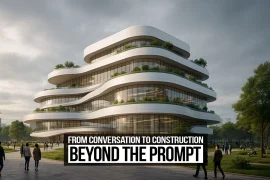
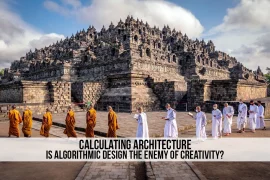
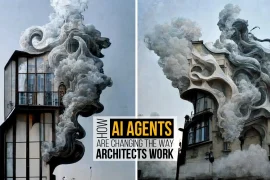
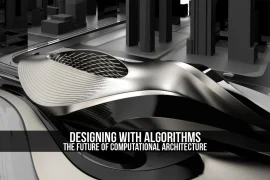
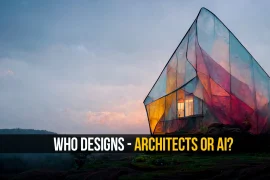
Much like the discovery of fire for humankind, architects have had to create a purpose and need for digital tools in architecture after discovering the tool itself. Today, through experimentation and innovation, we have a multitude of options that make our professions much more convenient, making the limits of Digital Architecture infinite. But, with fewer constraints on the architectural design process, it is important to ground ourselves by asking, beyond a reaction to a sudden flood of technological advancement, how did the initial ideologies of Digital Architecture come to be? What did it hope to achieve, and what did we lose on the way? And, what post-digital future might await the global architectural community?

Colin Rowe and Fred Koetter’s ‘Collage City’ – The Context of Postmodern Collage
“Collage City,” first developed as an essay in the 1970s and later expanded and published by MIT Press as a book in 1978, is a critique of modernist utopian urban ideals explored as a comparison to traditional cities.

In the aftermath of World War II, there was a widespread desire for a holistically thought-elevated new way of living. By this time, modernism had already taken its roots in human-scale architecture and had been expanding into urban-scale utopias with proposals like Le Corbusier’s heavily critiqued Plan Voisin.

In the 60s and 70s, architectural collectives like Archigram and Superstudio, in response to these modernist utopias, were emerging with unorthodox and perhaps impossible urban speculative designs. Through Superstudio’s ‘Continuous Monument,’ they created what is now referred to as ‘post-modern collages,’ where they explored the idea of ‘negative utopias.’ These collages were a response to the dull narrative of concrete and steel boxes modernism had inadvertently created.

Archigram’s high-tech utopias similarly reflect a disdain for modernism through illustrations of hypothetical projects like ‘Walking City,’ ‘Plug-In City,’ and ‘Instant City.’

Colin Rowe and Fred Koetter’s ‘Collage City’ comes into this postmodern context, where they identify how these radical new utopias gravitate towards the concept of the domination of a single, large utilitarian object, instead of a multiplicity of objects in a predominant vacuum, much like how a modernist city compares to a traditional one. To illustrate this primary argument that ultimately modern cities have become inverse versions of traditional cities, they compare the figure-ground plan of Le Corbusier‘s project for Saint-Dié with that of the city of Parma.

The comparison made in the book elaborately demonstrates how while modern cities have become ‘an accumulation of solids in a largely unmanipulated void,’ traditional cities have remained ‘an accumulation of voids in a largely unmanipulated solid.’ The manifesto doesn’t aim to only criticise the shortcomings of modernism or romanticise the historical past but also to point out the virtues of the two opposing ideals, proposing a new way of thinking about creating these utopias that don’t need to be a singular monolithic revelation that reconceptualizes existing political and social systems but instead could be a bricolage of different realities in the same urban fabric.
Unexpected Ripples into Digital Architecture
‘Collage City’ led architectural schools of thought into the fragmentation and recontextualization of postmodern collage systems. The author compares the intention in his proposal to Picasso’s ‘Bull’s Head,’ a sculpture made of two unaltered objects – the bicycle seat and the handlebar – which, when put together, resembles a bull’s head. Here, like the ‘Collage City,’ the fragments remain unchanged, giving new meaning to the composition of the elements.

Digital Architecture began as a pursuit to continue the same part-to-whole relationship but with a shift towards creating continuity between the different parts of the whole. Two architects who began experimentations in creating this continuity of fragments through digital architecture were Peter Eisenman and Frank Gehry. Their designs, like ‘The Virtual House’ (1997) in Berlin by Eisenman and the ‘Peix (Fish)’ (1989) in Olympic Village, Barcelona by Gehry, showcased the intention of creating smooth transitions between the different parts that respond variably to context, thereby creating a coherent whole.


A Post-Digital Future
From functional modernist ideals being developed during a mechanical age to postmodern bricolage utopias in a post-mechanical age and now parametric and computational designs in this digital age, it is easy to notice how our collective architectural ideologies are a direct response to the tools we learn to work with and the economic and political context of the time. ‘The Collage City’, as discussed above, was born in a transient climate between the criticisms of the lifelessness of modernism and the inadaptability of classicism. While we want to believe that the resultant digital present is a middle ground between the nostalgia of memory and prophecy, as envisioned by Colin Rowe and Fred Koetter, the truth is that our technologies, materials, and economies are much better adapted to fit modernism.
Today, as we stand over a similar historic crossroad, with the onset of artificial intelligence and the oncoming architectural renaissance, there is a need to revisit seminal texts like ‘The Collage City’ to better prescribe a future that doesn’t dismiss our past or villainize hope for utopias.
With technology capable of visualising thought experiments in seconds and equipped with the intelligence to physically realise even the most bizarre ideas, we have to wonder if we should still be unintentionally constrained by the ripples of functionalist ideals of modernism or if now more than ever, there is a necessity to subvert into more humanistic realities.
References:
Rowe, C. and Koetter, F., 1979. Collage City. Cambridge, MA: The MIT Press.
Khachatryan, T. (2021) Architectural Context Part 5: Colin Rowe & Fred Koetter, Medium. Available at: https://geometrein.medium.com/architectural-context-part-5-colin-rowe-fred-koetter-cb7952e9e87c.
Khachatryan, T. (2021) Architectural Context Part 10: Digital Context, Greg Lynn & Stan Allen, Medium. Available at: https://geometrein.medium.com/architectural-context-part-10-digital-context-greg-lynn-stan-allen-f912f524017a.
‘I Believe that Architecture is Never Finished’: In Conversation with FAR, Creator of the First Generative Project for the Metaverse (2022) ArchDaily. Available at: https://www.archdaily.com/990862/i-believe-that-architecture-is-never-finished-in-conversation-with-far-creator-of-the-first-generative-project-for-the-metaverse.
Charles P. Graves (2018). The Plan Game: The Origins of ‘Collage City’. [online] Looking@Cities. Available at: https://lookingatcities.info/2018/09/05/the-plan-game-the-origins-of-collage-city/.