

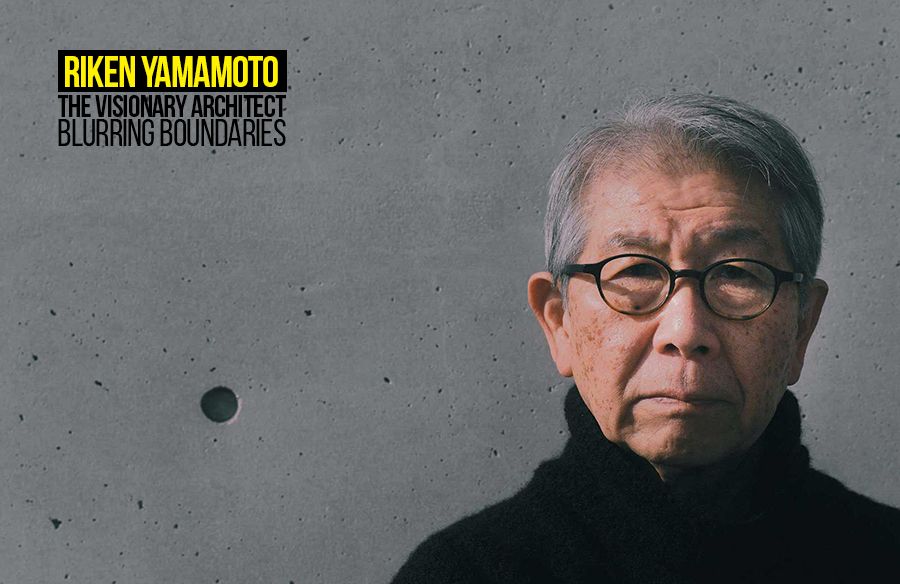
Riken Yamamoto, an eminent Japanese architect, just received the Pritzker Architecture Prize that was given to him for his excellent contribution to local community purpose-built facilities. Through the years, Yamamoto pioneered sustainable and unique designs that revolutionised the urban landscape of many Japanese and other countries.

The Pritzker Architecture Award, commonly acknowledged as architecture’s Nobel Prize, is granted yearly to an architect with distinguished accomplishments. Yamamoto has taken 53rd place among the architects on the very famous list, including the names of Frank Gehry, Zaha Hadid, and I.M. Pei.
His designs attract residents by promoting space preservation, communal interaction, and engagement while ensuring that the space is functional and visually appealing. Moreover, he has earned accolades for his artful application of environmentally friendly materials and methods, emphasising sustainable design in modern architecture.
Early Life and Education
Riken Yamamoto was born in 1945 in Beijing, and a year after the end of WWII, his family immigrated to Yokohama, Japan. This architect spent most of his childhood in a home that looked like a conventional machiya, with his mother’s pharmacy in the front and their living space towards the rear. The border was divided into two sides: one side is where the family goes, and the other is where the community lives. Yamamoto was interested in engineering, like his father, but was also drawn to architecture. When he was 17, he went to Kôfuku-ji temple, which was built in 730 and rebuilt in 1426, and was captivated by the five-story pagoda, which symbolises the five Buddhist elements of earth, water, fire, air, and space.
He finished his bachelor’s degree from the Department of Architecture, College of Science and Technology, Nihon University, in 1968. He also graduated with a master’s degree in architecture- a Japanese Master of Arts in Architecture from the Faculty of Architecture, Tokyo University of Arts in 1971. In 1973, he founded Riken Yamamoto & Field Shop.
From 2002 to 2007, he worked at Kogakuin University’s Department of Architecture as a professor. He was also a visiting professor at Yokohama National University’s Graduate School of Architecture and Nihon University. He has concurrently been the President of Nagoya Zokei University of Art and Design since 2018.
Ideology and Philosophy
Riken Yamamoto created a unique style of blending public and private spaces. The philosophy of his designs revolves around creating buildings and structural spaces that generate collective identity while disfavoring conventional isolation and seclusion.
Yamamoto also works to build societies by avoiding division into different identities, economies, politics, infrastructure, and housing. He highlights the benefits of socialised groups, through which people may help one another while the individuals’ rights are respected and privacy issues are avoided. His designs pursue the creation of spaces that are meant to sustain life through a fusion of cultures, histories, and multi-generational communities.
Among the main features of Yamamoto’s work is the frequent use of glass facades, terraces, and balconies. These elements are mostly used to convey the openness of space and evoke the feeling of communication between the building’s users and the surroundings.
His works through the years
Rather than limiting his scope just to the same type or scale of buildings, Riken Yamamoto purposely chooses to focus on a more diverse range of building types in terms of both kinds and sizes. Whether it is a private house or a public object, a museum or a fire station, instead of a monotonous or too extravagant style, he secures a community-oriented and convivial atmosphere for them all. He is committed to designing areas that promote social communication, and he has given more focus to the design of public interworking space systems. For example, at Saitama Prefectural University (1999), the whole campus area was created to bring people together and foster social communication.
Yamakawa Villa, Japan, 1977
This is the architect’s first completed project, and it was planned to embody a sense of an open-air terrace. The main living area is open to a landscape area. This enclosed space houses a bedroom, kitchen, and other functional subspaces.
In addition, he thought that rooms should be placed in the middle of the woodland and that a roof would unify the whole area. The gabled roof was the only roof form he could think of at that time.

Gazebo House, Yokohama, Japan, 1986
Yamamoto’s house is an example of forming and reinforcing connections and relationships between neighbours through terraces and flat roofs. The road widening in the same year under the Land Readjustment Act of 1954 brought about a lot of social, emotional, and architectural alterations. The houses of one-story were replaced by multi-level buildings which are residential and commercial. The architect has a higher central access road around which neighbours can walk, sharing gardens and communal space at the terraces and on the rooftops.

Hotakubo Housing, Kumamoto, Japan, 1991
In 1991, Yamamoto finished his first social housing project. The project is formed from 16 separate blocks that have a total of 110 housing units. The housing units face completely another central garden with trees, which is accessible only from the individual units. The living units are very small, but each one of them has a patio which has a view of the plaza. This encourages people to form a collective society.

Hiroshima Nishi Fire Station, Japan, 2000
The atrium of this glass building demonstrates firefighters’ operations and training, inviting the public to engage with them. The glass facade gives an illusion of transparency. This program includes fire prevention, public education, and the general public access to the exhibition lobby and fourth-floor terrace.

Ecoms House, Tosu, Japan, 2004
Yamamoto’s aim in designing the Ecoms House in Tosu was to exemplify the adaptability of aluminium as a building material and a steel replacement. The house covers a surface area of 115 square metres, and it was just a prototype that could be used for assembling prefabricated dwellings on a massive volume scale from aluminium.
While the home is erected by the use of screwed aluminium sheets. Some of them are louvred or perforated, others stick out and some have been converted to glass, thus forming a coherent mosaic.

Jian Wai SOHO, China, 2004
Yamamoto’s large residential complex is located to the east of Tiananmen Square in Beijing and was completed in 2004. The three bottom floors of the building contain 177 business spaces, while the upper floors consist of 57 residential apartments. There are shops, restaurants, and other amenities, as well as a sunken garden that provides a comfortable and relaxing environment for people to enjoy urban life. The pedestrian flow has been redirected underground for the convenience of the vehicles, creating a more seamless pedestrian experience.

Yokosuka Museum of Art, Yokosuka, Japan, 2006
Yamamoto is known for this great design, the Yokosuka Museum of Art. The museum’s unusual entryway also recreates the surrounding harbour and mountains with seemingly curving paths as it goes around. The structure is erected above the shop, which is made of glass, and several cafés and exhibition halls constitute part of it. There are exhibition rooms located underground to enhance visitor experiences by allowing uninterrupted views of nature

Fussa City Hall, Japan, 2008
Fussa City Hall is situated in the lively residential district of Tokyo. This building consists of two cubic volumes with curved corners and is made of red bricks. This way, the one high-rise structure is split into two prefab units to coexist with the neighbourhood of low-rise houses. The structure is set amongst small rises that flow with the round, brick perimeter to form a nice sitting area and space for public functions.

Koyasu Elementary School, Yokohama, Japan, 2018
Yamamoto was given the task of re-constructing Kosayu Elementary School. Since the condominium development grew, the student population at the school increased as well.
The school building is designed with a grid-like pattern, providing classrooms opening onto wide terraces. This design is made to ensure views all around and its 1000 pupils to have interactions and social platforms.

References:
- “This Week Riken Yamamoto Won the Pritzker Architecture Prize.” Dezeen, 9 Mar. 2024, www.dezeen.com/2024/03/09/riken-yamamoto-pritzker-architecture-prize-this-week/. Accessed 18 Mar. 2024.
- “5 Things You Need to Know about Riken Yamamoto—the 2024 Pritzker Architecture Laureate.” Architecture + Design, 6 Mar. 2024, www.architectureplusdesign.in/ad-exclusives/5-things-you-need-to-know-about-riken-yamamoto-the-2024-pritzker-architecture-laureate/. Accessed 18 Mar. 2024.
- “Riken Yamamoto | the Pritzker Architecture Prize.” Www.pritzkerprize.com, www.pritzkerprize.com/laureates/riken-yamamoto#laureate-page-2586. Accessed 19 Mar. 2024.
- designboom, lea zeitoun I. “Riken Yamamoto Receives the 2024 Pritzker Architecture Prize.” Designboom | Architecture & Design Magazine, 5 Mar. 2024, www.designboom.com/architecture/riken-yamamoto-receives-2024-pritzker-prize-03-05-2024/. Accessed 19 Mar. 2024.
- 10 Notable Projects of the 2024 Pritzker Architecture Prize-Winner Riken Yamamoto.” Worldarchitecture.org, worldarchitecture.org/architecture-news/fzmzh/10-notable-projects-of-the-2024-pritzker-architecture-prize-winner-riken-yamamoto.html. Accessed 21 Mar. 2024.







