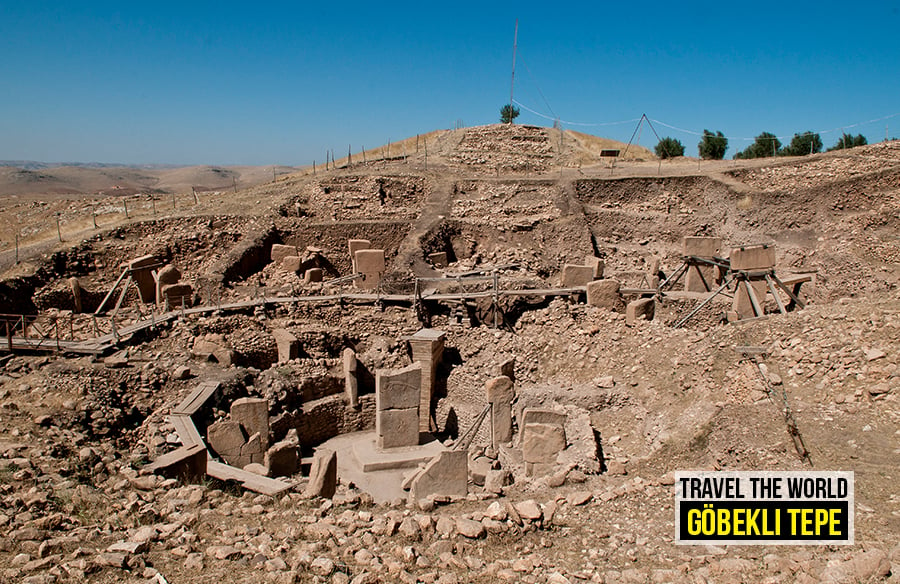
Göbekli Tepe (“Go-Beck-Lee-Tep-E”), translated as “Potbelly Hill” or “Hill of the Navel” in the Turkish language, or “Girê Mirazan” or “Xirabreşkê” in the Kurdish Language, is a Neolithic archaeological site in Turkey‘s southeastern Anatolia Region. It is the most remarkable prehistoric site ever discovered. It was first discovered in the 1960s. The UNESCO World Heritage site of Gobekli Tepe is located in south-eastern Turkey, about 13 km northeast of Sanliurfa and 2.5 km east of Orencik village.
The site consists of several large, circular structures surrounded by the world’s oldest known megaliths. According to an archaeology department study, they believe that the site was first used at the start of the Neolithic era when the oldest permanent human settlements in the world appeared. It is said that it may be one of the earliest examples of human settlement. According to German Archaeologist Klaus Schmidt, who first found the site in 1963 was the first to dig at it and claimed boldly that it was the “world’s first temple”.
It’s believed that this is one of the oldest temples in the world; the site consists of a complex of temples likely constructed by hunter-gatherer culture some 12,000 years ago. Thus, it is known as the man–made structure in the world.

Heritage, Cultural Importance: UNESCO World Heritage Site
Its UNESCO accepted site. It is one of the UNESCO World Heritage Sites. It was included in the UNESCO World Heritage list in 2018. It is believed to be the first Temple of the world. It is also believed to be a canter of faith and pilgrimage during the Neolithic period. This is the first and earliest three-dimensional depiction carved into stone found here. Gobekli Tepe discovering the world’s oldest Religious Site. This is the first human–built holy place. It is described as this is the first religious canter on Earth. Approximately 20 temples have been discovered in the region and 6 temples have been unearthed so far. It was named a UNESCO World Heritage Site in 2018 because it is “one of the first examples of human-made monumental architecture” and has “outstanding universal value.”
Architecture, Construction of Göbekli Tepe
Göbekli Tepe’s architecture is unique and monumental in features that are characterised as megalithic and monumental. The site features of Göbekli Tepe are larger, circular structures, often as a temple or ceremonial enclosures. Key Architectural features – 1. T- Shaped Columns 2. Circular Structures 3. Central Pillar Pair 4. Carvings and Reliefs 5. Alignment and Orientation 6. Burial and Filling
The construction of Göbekli Tepe was “a deviation from the hunting and gathering way of life.” The construction techniques vary but the most elaborate, striking structures in Göbekli Tepe are T-shaped monolithic columns with a pair of larger, carved T- columns at the canter up to five metres tall. More than 200 such pillars were found at the site. These not only supported a roof (for at least some of their life) but also represented abstract human figures that were part of a belief system that is not yet understood. They are sculptural as well as structural, with animal figures in relief. Gobekli Tepe is a 15m high artificial mound covering an area of about 9 ha. Excavations carried out in different areas of the site yielded megalithic architecture dated to the twelfth and eleventh millennia cal. BP (tenth and ninth millennia cal. BC: Schmidt Reference Schmidt2010).
The pillars are adorned with elaborate carvings of animals such as foxes, birds, snakes, and more. These carvings are considered to have symbolic and possibly ritualistic significance.

Göbekli Tepe was built by hunter–gatherers, apparently before the Agricultural Revolution when fully permanent settlements came into being with plant cultivation and animal herding. Rather than architecture being the product of organised societies, as has long been thought, there is new thinking that it may have been the organisation needed to build on such a scale that helped usher in agriculture and settled society. The Neolithic site, known as Göbekli Tepe, is perched atop a limestone mountain ridge in south eastern Turkey. According to a new study Hunter-gatherers might have built the world’s oldest known temple on a precise geometric plan, according to new findings.

The Triangular Relationship in Planning – Study by Researchers

The researchers studied and founded- Göbekli Tepe was built according to a very precise architectural plan. There is a triangular relationship created between three Neolithic structures which were placed according to a very precise architectural plan. If someone were to draw lines through the centre most point of three of these Neolithic structures which are called enclosures, they form a nearly perfect equilateral theoretical triangle. This suggests that these three structures were planned together in advance with some design points of view and built according to a geometric design by the researcher. Archaeologists believe that the hunter-gatherers must have excavated and moved the limestone rocks from a stone quarry nearby.

İnteresting facts about Göbekli Tepe
- The site is older than other famous Neolithic ancient sites like Stonehenge.
- Gobekli Tepe might have been a giant outdoor BBQ site for hunters–gatherers.
- It could also have been a giant brewery!
- The site may have been a temple for a strange skull cult.
- Or was the site occupied by some human sacrifice cult?
- Gobekli Tepe might have a sister site.
- Gobekli Tepe may document one of humanity’s darkest times.
- Some believe Gobekli Tepe is the inspiration for the “Garden of Eden”.
- Was Gobekli Tepe an early observatory?
These all are Archaeological survey-related studies, Researchers study related facts which are yet to be discovered in detail with evidence.
Tourism and Today’s Condition of Göbekli Tepe
Being a heritage site is an increase in tourism, whether the branded promotions come from UNESCO itself or the country’s tourism board. Being on the list also ensures survival from destruction or natural neglect. Following the President’s declaration of 2019, as the year of Göbekli Tepe, tourism in Sanliurfa has remarkably revived, and Göbekli Tepe has become a centre of tourism. Also, 2018 has been a fruitful year for Turkey tourism; the total number of tourists is expected to touch 40 million by the end of the year. From January to October, Turkey hosted 35.6 million foreign visitors, which is more than 22.9 percent, when compared to the same period last year. Turkey tourism of the Göbekli Tepe, the temple is among the most important settlements of the Neolithic age across the world, and therefore, it’s become an interesting tourist destination among local and international visitors from all over the world since it was discovered by the archaeological – researchers. As the site has gained international prominence, it’s become a bona fide tourist attraction.
According to an overall study about this topic, it can be said that it is the oldest man-made religious complex ever discovered. It is UNESCO an accepted heritage complex. So, it’s a heritage identical structural complex of Turkey. It’s a discovery work by the Archaeological- researchers department. Yet it is still to be discovered more in the subject. The architecture of the Göbekli Tepe is unique and monumental in features that are characterised as megalithic and monumental. It is the oldest heritage architectural temple complex ever discovered. Hunter-gatherers play an important role in the Göbekli Tepe history and background study, the evidence or anything related to this complex study is discovered according to hunter- gatherers’ perspectives. The site is also representative of one of the earliest examples of the establishment of an advanced social system as monuments, sacred spaces, and symbolic motifs indicate. Göbekli Tepe stands out with larger and smaller rectangular structures built by people. Historians and archaeologists believe that structures such as pillars represented ancestors or gods in the Neolithic age.
Göbekli Tepe is considered the birthplace of early civilization. There are so many facts which are yet to be discovered but still based on available discoveries about Göbekli Tepe it is said that the “World’s most exciting yet strangest ancient sites, the oldest temple of humanity”.
Image Reference Source :
Göbekli Tepe to draw more tourists on European cultural Route, Article, [Photograph], A view from Göbekli tepe, Sanliurfa, south eastern Turkey, April 28, 2022. (n.d.). Retrieved from: www.dailysahabh.com: https://www.dailysabah.com/arts/gobeklitepe-to-draw-more-tourists-on-european-cultural-route/news
Turkey’s Göbekli Tepe, Article, [Photograph], A column with a carving of a dog, (n.d.). Retrieved from: www. livescience.com: https://www.theartnewspaper.com/2018/08/03/turkeys-gobekli-tepe-is-this-the-worlds-first-architecture
The world’s oldest temple was built along a grand geometric plan, Article, [Photograph], in Göbekli Tepe, archaeologist have uncovered a handful of circular Neolithic structures such structures such as this one (Enclosure C), which consist of two T – shaped pillars surrounded by bunch of slightly smaller inward facing pillars. (Image credit: Gil Haklay/AFTAU.) (n.d.). Retrieved from: www.livescience.com:
https://www.livescience.com/gobeklitepe-built-with-geometry.html
Gobekli tepe built with geometry, Article, [Photograph], Triangular relationship between three Neolithic structures (n.d.). Retrieved from: www.livecience.com: https://www.livescience.com
2019 declared the ‘Year of Gobekli Tepe’ for Turkey Tourism, Article, [Photograph], An aerial view of the heritage site Gobekli Tepe, Turkey. (n.d.). Retrieved from: www.tourismnewslive.com:
https://www.tourismnewslive.com/2018/12/26/2019-declared-the-year-of-gobekli-tepe-for-turkey-tourism