A Long History of Urban Renewal


Urban refurbishment or urban renewal is something that has been there since the beginning of human history. Barry Kemp an Egyptian archaeologist concluded from his findings that; city creation has been a repeated occurrence of civilization. The Ancient African civilization which includes Egypt, Numidia, Ethiopia, etc. are cities with physical structures intentionally designed for their growth and survival. One of the early forms of urban renewal in Egypt was the “mud brick urban renewal”. In which the cities were raised above the Nile flood plains. Urban planning has also significantly reformed old cities. One such example can be seen in Europe, in 1853 Emperor Napoleon III designated Bar-on Georges-Eugene Haussmann to devise a plan for constructing wide streets to cut through Paris’s slums and have new parks, train stations, and aqueducts. Avenue de l’Opera designed by Haussmann. Even though Haussmann was criticised for creating division in society between the rich and the poor. He was successful in addressing the crowding and pollution, which ignited typhoid and cholera. A similar type of urban planning effort was done in Boston’s Back Bay. The details about Boston Back Bay. Because of the rise in health issues and the city’s need to satisfy the wealthier Irish immigrants, the Boston Back Bay was developed between 1857 and 1880.


Architect Arthur Gilman modelled Hausmann’s plans by creating wide streets lined with trees. This helped to increase the health, light, and good smell in the area. In 1898 the first-ever urban planning conference was held in New York. After the establishment of the urban planning school, the urban planning designs had a racial bias. For example, 20th-century New York was designed by Robert Moses.


The United States and Europe in the 20th century saw a rise and fall in urban renewal. Some of the major urban renewal in Berlin and London was because it was decimated during World War II. Urbanist Alexander von Hoffman argues that urban renewal was originally intended as a movement toward comprehensive planning instead of urban redevelopment in the 1950s. The history of urban renewal has a close connection with the history of cities. This is not a modern phenomenon and the concept of development without displacement is connected to the response against demolition as a significant plan of urban renewal.
The Middle East Enters the Refurbishment Game
This shows that urban renewal in the Western world dates to the 19th century. Whereas in the Middle East, this is not the phenomenon. They usually build up in the unbuilt areas of the desert. But due to the new projects rising, the government of this region is forced to think about the revamp. This resulted in the renewal of urban places in the United Arab Emirates, Qatar, Saudi Arabia, and elsewhere in the Middle East.
The refurbishment process in the Middle East mainly was to attract business and increase tourism revenues. In this rush, they forgot about the social effects of these plans. One of the eye-openers for the United Arab Emirates was its economic crisis in 2008. Which puts a stop to this rush of refurbishment. And gave the authorities time to see and understand the effects of their renewal plans. Later on, new rules and regulations were applied to building construction and refurbishments. This helped in reducing blind construction.

Looking for Sustainable Solutions Underground
As we confront challenges like climate alterations and resource consumption, designers and engineers are investigating innovative solutions. One such concept is building underground. This approach has the potential to be more sustainable and disaster-resistant than traditional construction.
Underground structures offer significant advantages. The constant earth temperature translates to less energy needed for heating and cooling. They’re naturally protected from extreme weather events and offer a haven during earthquakes. Additionally, underground buildings require less building material and provide natural insulation, reducing their environmental impact. They can also be quieter due to soundproofing and require less maintenance over time.
Challenges and Examples of Underground Architecture
However, there are too many challenges to consider. The introductory cost for developing an underground building can be higher than conventional methods. Another hurdle is guaranteeing appropriate lighting and ventilation to prevent feelings of confinement and dampness build-up. At last, a few individuals may encounter claustrophobia or a disconnection from nature in underground spaces.
Despite these challenges, progressions in innovation are making underground living more appealing. With careful design and planning, underground buildings can give a comfortable, energy-efficient, and economical alternative for the future.
Here are a few examples of existing underground architecture projects:
- Coober Pedy Underground Town, Australia: Home to residents who have dug their homes out of natural sandstone to escape the extreme heat.
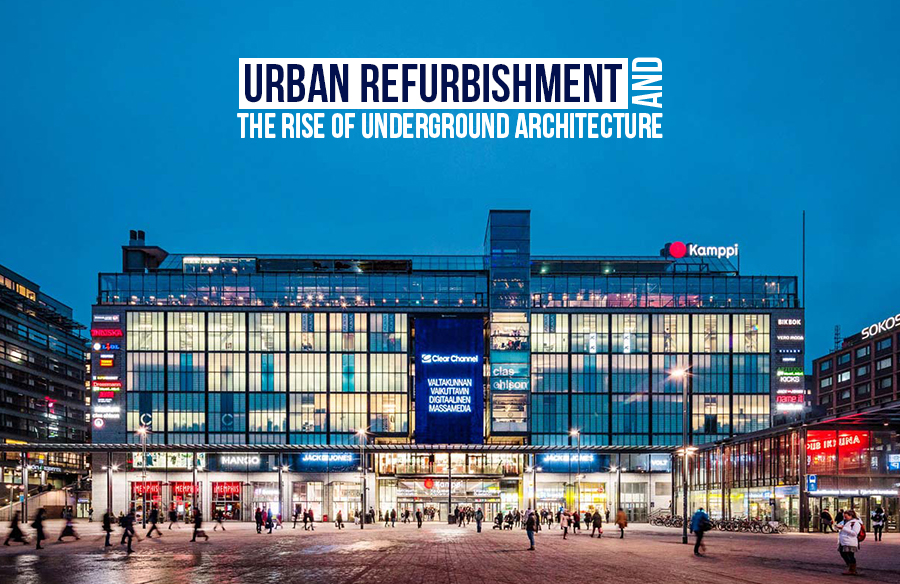
- Kamppi Center, Helsinki, Finland: A major underground expansion of a shopping centre featuring a new metro station, bus terminal, shops, and even a movie theatre.
- The New Stockholm City Center, Sweden: A massive project underway to create a new district entirely underground, including residential buildings, offices, shops, and a train station.


Timeline of Underground Architecture
The timeline begins with the earliest inhabitants of underground space, the troglodytes or cave dwellers. Human’s first few architectural endeavours were the caves. Then the journey continued, and some significant structures;
- 3600 BC: Ancient Romans and Greek times. They made tunnels to drain the marshes and aqueducts.
- 1200 BC: Derinkuyu, Cappadocia, Turkey one of the oldest underground cities in the world.
- 1300: Wieliczka Salt Mine in Krakow, Poland. The mine produced table salt till 2007. This mine contains 3000 chambers and nine floors. Out of these 3 floors are open to the public.
- 1400: Pilsen Historical Underground, Czech Republic could be a 12.5-mile-long maze of paths, cellars, and wells built underneath the city lanes. The cellars once served as storage space for food and barrels of brew and, a few say, as an elude route in case of an attack.
- 1788: Edinburgh Vaults was in Edinburgh, United Kingdom. It’s a series of chambers. This is to house taverns, cobblers, etc.
- 1860: Metropolitan Railway, London was known as the first underground construction.
- 1903: Delancey Underground aka, The Low Line, this area was initially a trolley terminal that became vacant in 1948. In 2021 the area is converted into the world’s first underground park.
- 1940: Shanghai Tunnels in Portland, United States. This was a passage that linked the old town of Portland (Chinatown) to the central Downtown. Previously the basements of bars and hotels in the area were linked to the Willamette River waterfront by this. Then 1962, Reso in Montreal, Canada. This is a maze that runs under Montreal’s streets.
- 1970: Dixie Cheng’s Underground City, Beijing, was built to serve as a shelter during the war, invasion, bombings, and nuclear attacks.
- 2007: Madrid –Rio Project in Spain was a recreational pedestrian zone.
- 2008: Pionen White Mountains was a Stockholm nuclear bunker in Sweden. Is built beneath the granite bedrock which is transformed into a sleek data centre.
- 2012: The Path Mall in Toronto, Canada became the largest mall in the world and It has 12 levels.


Combining Refurbishment and Underground Spaces
Regarding urban planning and refurbishment, it is said that modern megalopolises cannot be developed without efficient usage of underground spaces. Further, in regions susceptible to extreme weather, underground architecture is safer and more dependable than flat-surface architecture. Earth is a great natural insulator, it can maintain a warm temperature during winter and cool during the summer, therefore diminishing the energy consumption of underground architecture. Moreover, the urban environment has been struggling with a growing population. There have been efforts by planners to make a sustainable urban environment. So urban development can be a solution to these problems.
Reference List:
Ahlfeldt, G.M., Maennig, W. and Richter, F. (2013). Urban Renewal after the Berlin Wall. SSRN Electronic Journal. doi:https://doi.org/10.2139/ssrn.2973293.
Anon, (2022). Subterranean Architecture: Interesting Approach To Design And Construction | The Design Gesture. [online] Available at: https://thedesigngesture.com/subterranean-architecture/.
Ashrafian, T., Moazzen, N. and Haghlesan, M. (2011). Human Comfort in Underground Buildings. 5thSASTech 2011.
Back Bay Houses. (2015). Overview: Development of the Back Bay. [online] Available at: https://backbayhouses.org/overview-development-of-the-back-bay/.
Belfanti, S. (n.d.). » Old and New Cities: The Long History of Urban RenewalThe West End Museum. [online] Available at: https://thewestendmuseum.org/article/old-and-new-cities-the-long-history-of-urban-renewal/.
Burchea, o (2019). Top 9 secret underground cities in the world – momomdo Discover. [online] Discover. Available at: https://www.momondo.com/discover/secret-underground-cities-in-the-world.
Kasyanov, V. and Oksana, C. (2019). Use of Underground Space in Large Cities. IOP Conference Series: Materials Science and Engineering, 471, p.112052. doi:https://doi.org/10.1088/1757-899x/471/11/112052.
Schwartz, A. (n.d.). This 7-story-deep underground mall is the future of retail. [online] Business Insider. Available at: https://www.businessinsider.com/mexico-citys-underground-mall-2016-1.