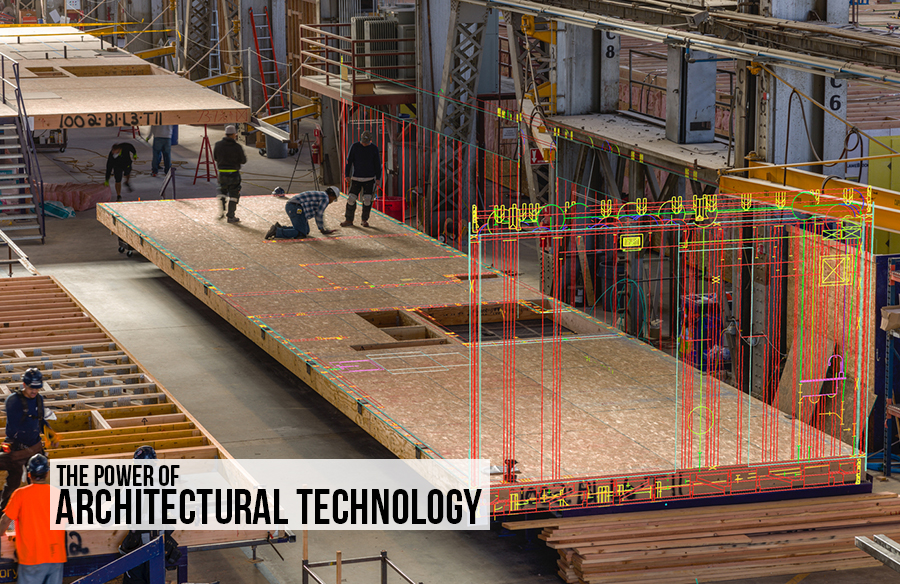
Architecture must evolve to keep pace with changing needs. Technological advancements are essential for designers to meet the increasingly complex requirements of the field. From the early days of ancient civilizations building with stone, technological innovations have been pivotal for architects. Today, smart technology, capable of processing data rapidly, underscores this truth more than ever. In today’s digital era, the importance of leveraging technology is undeniable, leading to the rise of architectural technology as a distinct field of study. This emerging discipline explores the interplay between technology and design, focusing on the structure, creation, and functionality of buildings.

Technology in Architecture

Technology has helped facilitate both the architecture industry and the architect’s role. While earlier, architecture emphasised great detailing in aspects like design and drafting, the introduction of technology has helped in expanding focus in areas such as building performance, production, and processes. Architectural technologists bring specialised knowledge essential to the building design process, covering both the methodology and the final outcome.
With ongoing technological advancements, our creative potential expands, enabling us to transform ideas from imagination into digital formats or 3D-printed models. Here are some benefits:
Effective Communication of Vision: Whether presenting to your team, impressing clients, or engaging with real estate experts, lifelike visualisations make it easier to convey your ideas. Clients can don a virtual reality headset to experience unfolding building plans or examine a 3D-printed model of their future home. This interactive approach creates a deeper connection to the final product.
Lower Project Costs: Technologies like virtual reality and 3D printing allow clients to identify desired changes before construction begins. Early detection of these changes simplifies the process and reduces costs for everyone involved.
Enhanced Collaboration: Innovations like Building Information Modeling (BIM) ensure that all project participants are aligned at every stage. Engineers, designers, and architects can use BIM to synchronise their plans, preventing discrepancies before any physical work begins.
Technology as a Stepping Stone in Architecture

Technology has significantly influenced architecture, notably through enhanced design and visualisation technologies. Computer-aided design (CAD) software has transformed the design process, allowing architects to create detailed and complicated buildings with great precision. These tools also enable the simulation of different lighting conditions, materials, and settings, resulting in more informed design decisions.
Additionally, 3D modelling software has transformed how architects present their ideas to clients and stakeholders. By generating realistic renderings and virtual walkthroughs, architects can present clients with a detailed image of the final outcome, boosting their comprehension and involvement with the design.
Technology has also made important contributions to architectural sustainability and energy efficiency. BIM software enables architects to create precise 3D models of buildings that simulate energy use and performance. This skill enables architects to identify design modifications, such as insulation or ventilation, in order to reduce energy use and promote sustainability.
Architectural Technologies in Today’s Market
1. Building Information Modeling (BIM)

BIM is a key tool in modern architecture, enabling architects to create detailed 3D plans and collaborate efficiently with engineers. Programs like Autodesk BIM 360 and Autodesk Build facilitate real-world simulations and scenario testing, enhancing design accuracy and coordination.
2. Big Data and Digital Twins

Digital twins take BIM further by creating dynamic digital replicas of buildings using big data and sensor inputs. This technology allows architects to test various scenarios, optimise energy use, and improve building designs, supporting smart city initiatives.
3. Artificial Intelligence

AI and machine learning have revolutionised architecture by providing answers to complex design questions. These technologies analyse large datasets to find efficient solutions, optimise building designs, and streamline construction processes, from material selection to site evaluation.
4. AR, VR, and XR

Augmented reality (AR) overlays digital elements on real-world views, aiding in construction and training. Virtual reality (VR) offers immersive design presentations, while extended reality (XR) facilitates remote collaboration, enhancing project visualisation and communication.
5. Generative Design

Generative design mimics evolutionary processes, allowing architects to input constraints and goals to generate numerous design solutions rapidly. This approach accelerates innovation, optimises forms, and pushes engineering boundaries, exemplified by projects like Zaha Hadid Architects’ Heydar Aliyev Center.
6. 3D Printing

3D printing revolutionises construction by enabling the creation of complex shapes and structures. This technology reduces material costs, minimises waste, and speeds up building processes, making it possible to construct entire buildings, even in challenging environments.
7. Internet of Things (IoT)
Smart building devices, part of the IoT, transform building operations with sensors and control systems that enhance energy efficiency and sustainability. These tools provide data for optimising space usage, improving collaboration, and designing better buildings.
8. Cloud Computing

Cloud computing transforms data storage and access for architects. It allows for the sharing of designs, digital twins, and simulations among teams, facilitating rapid development, real-time collaboration, and adaptive workflows.
9. Robotics

Construction robots bring precision and efficiency to building tasks, using laser scanners and GPS for accuracy. They can perform repetitive tasks faster than humans and operate in hazardous environments, advancing construction capabilities.
Future Implications

As technology progresses, its influence on architecture grows. Augmented reality (AR) and virtual reality (VR) are poised to transform the industry by allowing architects to build immersive experiences and clients to virtually examine concepts. Furthermore, evaluating building data with artificial intelligence (AI) has the potential to optimise energy usage and sustainability. AI can also produce design options based on budget or site conditions, allowing architects to efficiently explore more ideas. Overall, technology has greatly influenced architecture, from design and construction to presentation and sustainability. Future breakthroughs in AR, VR, and AI are anticipated to significantly alter the architectural landscape.
In conclusion, further developments in technology will have a significant impact on the future of architecture. With the availability of advanced instruments and techniques, architects will be able to create innovative and sustainable structures. As a result, constructions of the future will probably be more effective, convenient, and aesthetically pleasing than what we’ve already seen.
References:
- Autodesk (2024) New Architecture Technologies for Advanced Building Design, Autodesk. Available at: https://www.autodesk.com/design-make/articles/technology-architecture
- Fidanci, E.A. (2023) The role of technology in Architecture, illustrarch. Available at: https://illustrarch.com/articles/15449-the-role-of-technology-in-architecture.html
- Armstrong, G. and Allwinkle, S. (2017) (PDF) Architectural Technology: The Technology of Architecture, Researchgate Publication. Available at: https://www.researchgate.net/publication/321514227_Architectural_Technology_the_technology_of_architecture.
- Team, D. (2024) 8 tech advancements changing architecture, Designblendz. Available at: https://www.designblendz.com/blog/the-power-of-technology-in-architecture-today
- Danneskjöld, R. (2022) The dawn of ai architecture, Constructing Architect. Available at: https://www.constructingarchitect.com/the-dawn-of-ai-architecture/
- A deep dive into Digital Twins for Architecture (no date) Autodesk University. Available at: https://www.autodesk.com/autodesk-university/article/A-Deep-Dive-into-Digital-Twins-for-Architecture