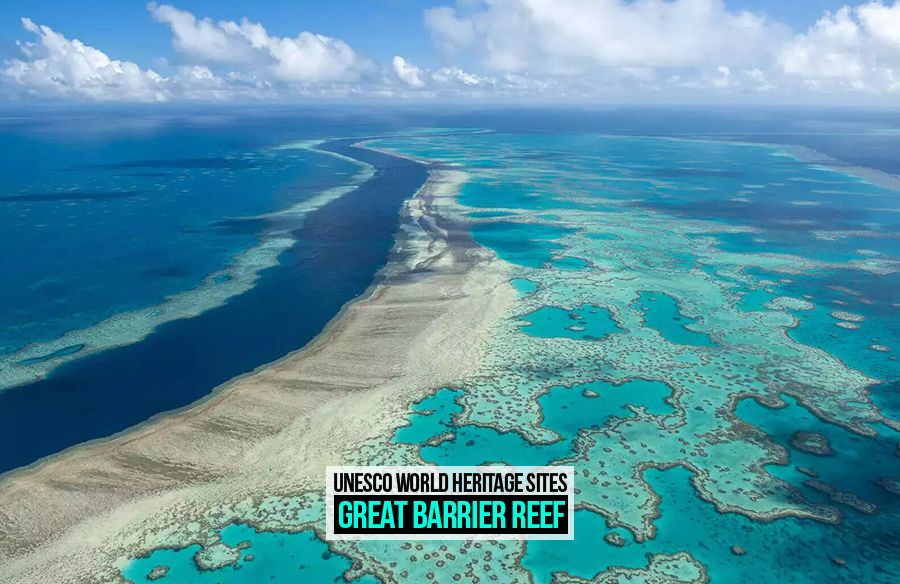
Reefs are where much of the world’s ocean life begins its journey. Nurturing a diverse and extensive marine habitat, these rainforests of the ocean play a crucial role in feeding small and big fish alike. The greatest of them all, holding up to the name it declares, is The Great Barrier Reef. Home to the famously lost Nemo (from Pixar’s 2003 animated film ‘Finding Nemo’), this reef is a remarkably stunning natural wonder on the north-east coast of Australia. With one of the richest and most complex ecosystems on earth, it hosts over 400 species of coral reefs, 1500 species of fish, 4000 species of molluscs, 240 species of birds and a great diversity of sponges, crustaceans and marine worms all interconnected and dependent on each other. The entire ecosystem of the Great Barrier Reef, an area of around 348,000 sq. km was declared a World Heritage Site by UNESCO in 1981. Generally, for sites to be included on the World Heritage List, they must be of outstanding universal value and meet at least one out of ten selection criteria.

Outstanding Universal Value
The Outstanding Universal Value, as defined by UNESCO, refers to a cultural and natural importance that is so exceptional that it goes beyond national boundaries and is of common importance for the present and future generations of all humanity. The Great Barrier Reef, being the largest coral ecosystem in the world and possessing extraordinary biodiversity and ecological significance, draws attention from all over the world. The reef is home to a diverse range of marine life, providing vital habitats for many threatened and endangered species such as the Hawksbill Sea Turtle and the Grey-headed Albatross, making it significantly important to the scientific community. In ideal temperatures not exceeding 21°C, this ecosystem has formed over millions of years from the skeletons of a multitude of living organisms, surviving apocalypses and mass extinctions.

Criteria
Besides being of Outstanding Universal Value, the Great Barrier Reef also satisfies four of UNESCO’s criteria to become a World Heritage Site.
Criteria (vii) – Being of exceptional natural beauty
The Great Barrier Reef is recognized as an area of exceptional natural beauty and aesthetic importance. From the intricate mosaic patterns on coral reefs themselves to the undulating transience of seascapes and landscapes across the northeastern coast, even the thousands of sea creatures the reef attracts like the migrating whales or the nesting turtles or the swarms of fishes in different colours, shapes and sizes, these azure waters host a marvel that cannot be seen anywhere else in the world.
Criteria (viii) – Representing record of life
The Great Barrier Reef is a prime example of an ecosystem that has developed over thousands of years. The reefs began forming on the continental shelf as early as the Miocene Epoch (23 million to 5 million years ago). When glaciers formed, sea levels dropped, revealing the reefs as flat-topped hills of eroded limestone. Large rivers wound through these hills, and the coastline extended further east. When the ice melted and sea levels rose during warmer periods, continental islands, coral cays, and new phases of coral growth began. Aeons of environmental history can be read from these formations making it of importance to us and generations to come.

Criteria (ix) – Representing significant ongoing geomorphic and biological processes
Besides the unique biological diversity of species found here, the site also reflects ongoing geomorphic, oceanographic and environmental processes. The different island morphologies, the complex cross-shelf connectivity and the erosion and accretion of coral reefs are some examples visible to us, influenced by a large number of unexplainable interconnected ecological processes that work together to maintain a delicate balance.

Criteria (x) – Requiring conservation of biodiversity
Being the world’s most complex coral reef system, the Great Barrier Reef houses tens of thousands of marine and terrestrial species and is of global conservation significance. The shallower marine areas of the reef support half the world’s diversity of mangroves and many seagrass species. The waters also provide major feeding grounds for one of the world’s largest populations of the threatened dugong. At least 30 species of whales and dolphins and seven species of marine turtles occur here.
A Threatened Future
Over the last 30 years, half of the world’s coral reefs have been lost to climate change, and unfortunately, the Great Barrier Reef too is no exception. Corals require adequate temperature for the food-producing algae on the coral to survive. In waters with high temperatures, the corals expel the algae living in their tissues causing the coral to turn completely white – this is called coral bleaching. When coral bleaches, it’s not completely dead, if the temperature drops and conditions return to normal, there is a chance for bleached corals to recover. But when this fails to happen and the coral completely dies, it is not just a coral organism that is lost. A coral is a fundamental part of a huge ecosystem, if corals go extinct we are not looking at species or even genus-level ripples but entire classes of organisms to be affected.

According to the projections of ocean temperature rise, unfortunately, we might be the last generation to see the Great Barrier Reef. Climate change has become unstoppable and inevitable, the only hope is to delay the effects of it long enough, and hope that it gives the natural world enough time to adapt to its rapidly changing environment. The good news is that organisations like the Australian Institute of Marine Science have already begun efforts towards this objective. In 2023, they monitored that hard coral cover across the Great Barrier Reef remained at similar levels to that recorded in 2022, with only small decreases in the Northern, Central and Southern regions. Preserving the Great Barrier Reef is crucial not only for maintaining marine biodiversity but also for ensuring the health of our planet’s oceans. By supporting conservation efforts and raising awareness about the impacts of climate change, we can contribute to the survival of this extraordinary natural wonder for future generations.

References:
UNESCO, 2024. The Criteria for Selection. [online] Available at: https://whc.unesco.org/en/criteria/ [Accessed 7 July 2024].
UNESCO World Heritage Centre, 2024. Great Barrier Reef. [online] Available at: https://whc.unesco.org/en/list/154 [Accessed 7 July 2024].
Woods Hole Oceanographic Institution, 2024. Is the Great Barrier Reef making a comeback? [online] Available at: https://www.whoi.edu/know-your-ocean/ocean-topics/ocean-life/coral-reefs/is-the-great-barrier-reef-making-a-comeback [Accessed 7 July 2024].
Great Barrier Reef Foundation, 2024. Great Barrier Reef Foundation. [online] Available at: https://www.barrierreef.org [Accessed 7 July 2024].