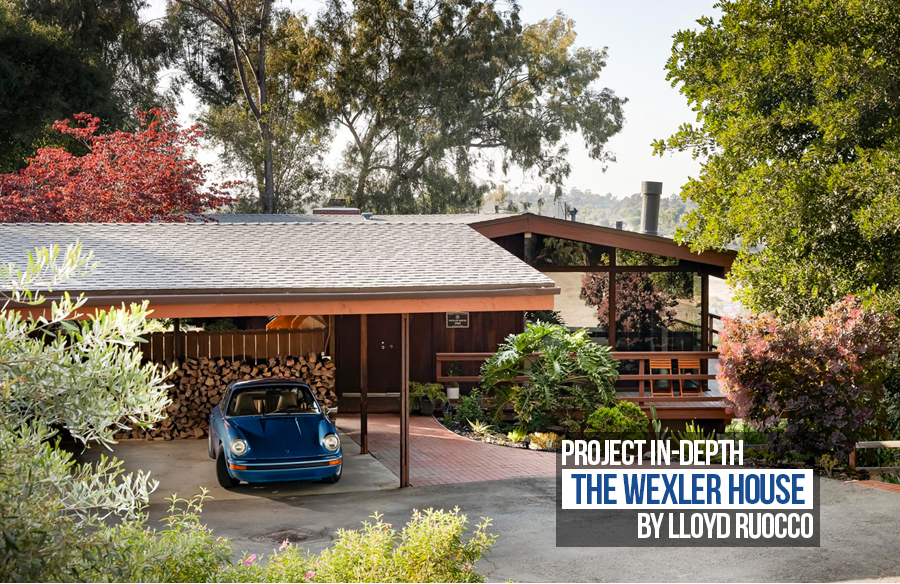
The Wexler House Architect: Lloyd Ruocco

Born Lloyd Pietrantonio Ruocco, popularly known as Lloyd Ruocco was an architect known for his modernist approach to design. His designs were known for their emphasis on simplicity, functionality, and integration with nature. Lloyd was born in Maine before having relocated to Santee in the early 1920s. As a young boy, Ruocco participated in a home design competition for Kensington Heights and soon after—whilst still attending high school—began working in the office of architect Richard Requa. Shortly after his employment, he started taking drafting lessons from Lillian Rice and was later convinced by Rice and Requa to transfer from San Diego State to Berkeley and major in architecture.
Following his graduation from UC Berkeley, he returned to San Diego and worked within the offices of Requa and William Templeton Jackson. Under the supervision of his high school drafting teacher, Lillian Rice, he worked on the master plan for the community of Rancho Santa Fe and also assisted in the 1953 Panama Exposition, County Administration Building.
In the thirties, rehashed revival styles were prevalent, and Ruocco, heavily dissatisfied with the movement, set out to open his own offices with the hopes of bringing a more modern style of architecture to San Diego.
Ruocco’s Impact on Mid-Century Modern Architecture
Ruocco’s impact, especially concerning San Diego’s architectural context, is nothing short of esoteric. His architectural style which he called “San Diego Regional Modernism” integrated modernist principles with the nuances of the local environment and climate. In a bid to emphasise the harmonious relationships between buildings and their immediate environs, he incorporated natural elements in his designs; and designed structures that blurred the lines between indoors and outdoors.
Ruocco was not only an architect, he was a facilitator of inspiration as captured by Bill Mosher, “He was the person whom you turned for inspiration. He was a modernist.” His influence led to several architectural commissions. His ultimate goal in life was to better the life of the people of San Diego through art and design so he and Ilse (his wife, an interior designer and artist) created and led organisations that catered to the design and architecture community.
The Wexler House
Commissioned in the early 1950s, The Wexler House was originally designed for Sidney and Henrietta Wexler. The Wexler House embodies the Carlifoinian Modernist movement championed by Ruocco and equally showcases his innovative design philosophy.
Architectural Features

Design Philosophy
Like every Modernist architect, Ruocco’s work in The Wexler House emphasised simplicity and functionality; by stripping away any unnecessary ornamentation to create a clean, uncluttered, and minimalistic space. The house highlights an open floor plan that permits the fluidity of movement between spaces and creates a sense of continuity.

Integration with the Environment
One of Ruccuo’s foremost design principles is a harmonious blend of nature and the building. His extensive use of glass creates unobstructed views of the surrounding landscape thereby generating a visual relationship with the natural elements. As a sustainable design disciple, Ruocco maximises natural light in the interior spaces, ergo reducing the need for mechanical lighting in creating a warm and cosy aura. The design and the orientation of the house also promote natural ventilation and lighting and therefore ensure a comfortable living space whilst reducing energy consumption.

Material and Technique
Ruocco made use of natural materials like redwood and stone to further enhance the house’s connection with its surroundings. His post and beam construction techniques eliminated the need for load-bearing interior walls. The warm and natural look of the interior of the living area was enhanced by his installation of a tongue-and-groove ceiling and exposed redwood beams.
Spatial Organisation
Ruocco designed the living areas to maximise comfort and functionality by emphasising open plans and little to no use of partitions. The transition between indoor and outdoor spaces is achieved with the use of sliding glass doors and a wrap-around deck.
Cultural Impact
At this point, it is safe to say that The Wexler House is a cultural icon because if it were not, you, dearest reader, would not be reading about it 60 years after it was finally constructed. Much like Ruocco, The Wexler House inspired countless design practitioners. The Wexler House and other of Ruocco’s works played a major role in making modernist principles mainstream in the design of residential buildings.
Present-day Wexler House
The current owners of The Wexler House are architects who have made some renovations such as remodelling the kitchen and the creation of a separate guest suite (downstairs) with an adjacent office/studio. They have stated that every renovation that has been done matches the original aesthetics and intended design of the home.
The Wexler House with its incredible mountain views stands as a monumental achievement in the domain of mid-century architecture. It is an encapsulation of Ruocco’s architectural philosophy: innovative designs and thoughtful integration with nature.
References:
Sievers, E., et al. (2024) ‘Lloyd Pietrantonio Ruocco’, Modern San Diego. Available at: https://modernsandiego.com/people/lloyd-ruocco (Accessed: 4 August 2024).
Walker, J. (2024) ‘Mid-Century Modern (Keller II House) by Lloyd Ruocco in Mission Hills, San Diego’, Agents of Architecture, 14 May. Available at: https://www.agentsofarch.com/home/mid-century-modern-by-lloyd-ruocco-mission-hills-san-diego (Accessed: 4 August 2024).
Walker, J. (2024) ‘The Wexler House by Lloyd Ruocco (31 Photos)’, Dwell Magazine. Available at: https://www.dwell.com/home/the-wexler-house-by-lloyd-ruocco-9f1ffc50 (Accessed: 4 August 2024).
Walker, J. (2024) ‘The Wexler Residence by Lloyd Ruocco in San Diego’s Mount Helix Neighborhood’, Agents of Architecture, 20 May. Available at: https://www.agentsofarch.com/home/mid-century-modern-the-wexler-house-lloyd-ruocco-mount-helix-san-diego (Accessed: 4 August 2024).