The world’s great universities are not just academic institutions; they are vibrant urban fabrics, rich in history and culture, seamlessly integrated into their surroundings. They offer the perfect blend of normality within a unique and memorable urban structure, creating an environment where day-to-day activities unfold in a tapestry of serendipitous interactions and complex patterns of use. This holistic approach ensures that the sum of these universities’ parts is greater than the whole, making them ideal places for study and innovation.

The proposal for the University of Nalanda epitomises this concept, aiming to create a campus that is both practical and memorable. Practicality is achieved through straightforward planning, flexible use, and simple construction of buildings. The memorability, however, does not stem from the architecture alone but from the intriguing and rewarding spaces between the buildings. This network of spaces reflects the organic plan of a town, offering a comfortable series of interlinked areas with a relaxed permeability and clear hierarchy.
Site and Masterplan
The approach to designing the Nalanda University campus starts with a profound understanding of the site, both physically and culturally. Nestled against the backdrop of the Rajgir Hills to the south, the campus layout is decisively oriented to acknowledge this natural feature. This orientation not only counterbalances the site’s flatness but also provides a constant visual reference, grounding the campus in its unique geographical context

The site, historically used for cultivation, has an open field feel with few scattered trees, enclosed by a concrete compound wall. Beyond these walls lie small villages, exemplifying the traditional, spontaneous settlements of the area. The proximity to the city of Rajgir and the train line to Patna further integrates the campus with its surroundings, enhancing its accessibility and connection to the broader region.
Crossroads and Gates
The genesis of cities often lies at the crossroads of trade routes, evolving into central gathering points surrounded by key buildings. Similarly,the design for Nalanda University incorporates a system of connections through two main routes: an East-West pedestrian spine and a North-South vehicular route. These routes organise movement through the campus and are anchored by symbolic gates, reminiscent of historical city walls that marked the transition from the outside world to the protected inner sanctum.
The Asymmetry of the Place
The asymmetrical nature of the site, accentuated by the Rajgir Hills, plays a crucial role in the campus layout. The northern edge, treated as a ‘back,’ features a continuous line of houses and court gardens, creating a buffer between the residential area and the compound wall. In contrast, the southern edge incorporates a series of reservoirs to manage monsoon runoff, leading to green corridors that offer expansive views of the mountains. This thoughtful organisation of space frames these views, creating a sense of openness and connection to the natural landscape.

Simple Buildings, Complex Spaces
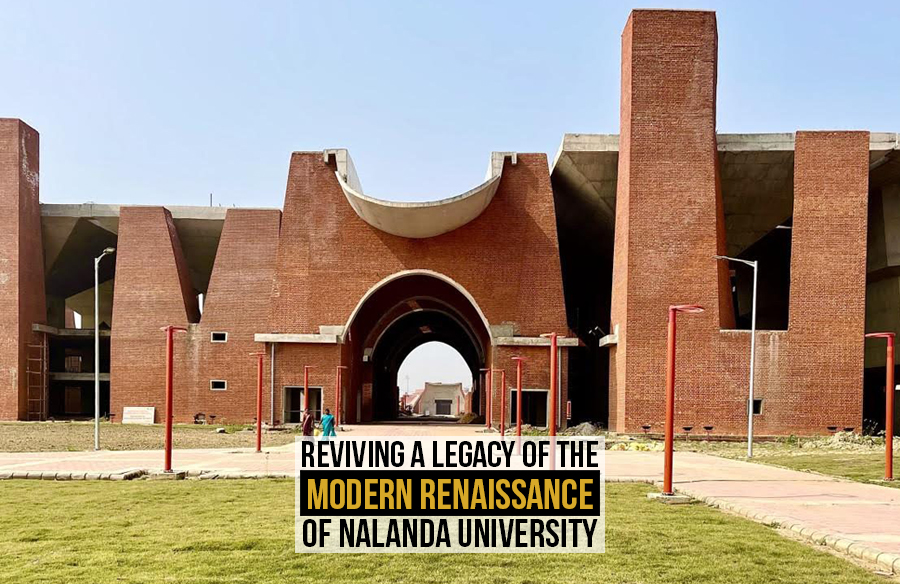
Indian cities are known for their relaxed informality, where buildings are placed in seemingly casual arrangements, creating dynamic and engaging urban spaces. The proposal for Nalanda University seeks to capture this informality through the strategic placement of simple, rectangular buildings that define complex public spaces. These spaces, rich and varied in form, balance the rationality required for a large-scale project with the relaxed character essential for creating a vibrant campus environment.

Density for Place Making

The character and intensity of traditional Indian cities are largely due to their density, where closely spaced buildings create recognizable urban spaces teeming with life. The design for Nalanda University embraces this density, organising the campus around a compact footprint that encourages walking and reduces the need for motor transport. This compactness not only enhances sustainability but also fosters a sense of community, with buildings close enough to create shaded alleys and open spaces, promoting natural ventilation and cooling.
Two Interlinked Open Spaces
At the heart of the Nalanda University campus are two main open spaces, structured around significant buildings that serve as central gathering points. The first space, located at the crossroads of the main routes, features the library, food court, campus inn, international centre, and administrative building. These buildings create a civic centre that serves as the heart of the university. The second space, located along the main pedestrian spine, acts as a counterpoint, featuring the museum, auditorium, and temple, alongside academic buildings. These spaces, built during the initial phase of construction, provide the campus with recognizable centres from its inception.

A Cohesive Family of Buildings
Successful urban spaces often display a degree of cohesion, with buildings that work together harmoniously. The proposal for Nalanda University incorporates a controlled number of building types, creating a cohesive composition that maintains individual identity. Inspired by the still life compositions of Giorgio Morandi, the design achieves a dynamic interplay between related yet distinct building forms, emphasising the importance of the spaces between them.
All buildings in the campus share key features: courtyards that enhance spatial quality and natural ventilation, and shading devices such as screens, slab projections, and recessed windows. These elements contribute to a consistent architectural language that defines the character of the campus.

The Nalanda University campus design is a testament to the power of thoughtful planning and respect for context. It harmonises the practical needs of a modern educational institution with the cultural and geographical significance of its site. By creating a series of interconnected spaces that reflect the organic growth of a town, the design fosters an environment where efficient study and research can thrive within a memorable and inspiring setting. The result is a campus that is not only functional but also a vibrant and integral part of its wider community, embodying the essence of great campus architecture..
References:
Sangath – Vāstu Shilpā Consultants. (n.d.). https://www.sangath.org/projects/nalanda-university-bihar/
About Nalanda – Nalanda University. (2024, April 26). Nalanda University. https://nalandauniv.edu.in/about-nalanda/
Photo Gallery – Nalanda University. (2024, January 19). Nalanda University. https://nalandauniv.edu.in/photo-gallery/
Shilpa, R. K. V., & Shilpa, R. K. V. (2022, August 4). Nalanda University, Rajgir, by Rajeev Kathpalia, Partner at Vastu Shilpa Consultants – ArchiSHOTS -. ArchitectureLive! – Art, Architecture and Urbanism From Around the World. https://architecture.live/nalanda-university-rajgir-by-vastu-shilpa-consultants/