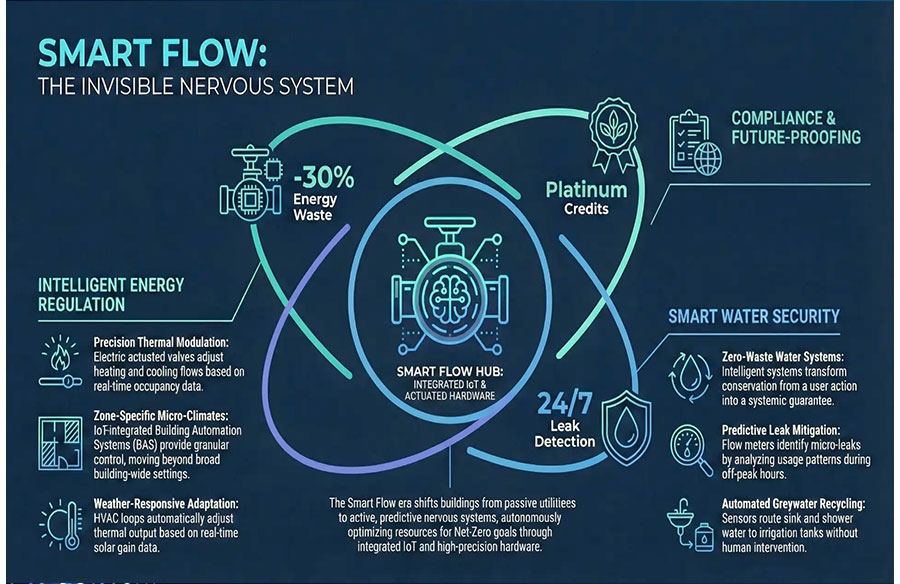
Architecture is frequently judged by its façade—the sweeping glass curves, the greenery-clad balconies, and the imposing skylines. However, the true “heartbeat” of any modern structure lies deep within its walls: the fluid management system.
For decades, plumbing and HVAC were treated as static necessities—pipes were laid, valves were manual, and systems ran on fixed schedules. Today, this passive approach is obsolete. To meet the rigorous demands of LEED Platinum certifications and Net-Zero energy goals, true sustainability must be achieved where it is least visible: in the intelligent regulation of water and thermal flows.
This is the era of Smart Flow, where invisible infrastructure becomes the primary driver of visible sustainability results.
Redefining Fluid Dynamics in Modern Architecture
The shift from “passive plumbing” to “active flow management” represents a fundamental change in how architects and engineers approach building utility. Traditionally, a building’s circulatory system was reactive—responding only when a tap was turned or a thermostat was adjusted manually.
Smart Flow redefines this by introducing systems that are predictive and adaptive. Modern fluid dynamics in architecture are no longer about simple transportation of water or air; they are about intelligent distribution.
- Occupancy-Based Modulation: Systems that reduce flow pressure in unoccupied zones.
- Weather-Responsive Adaptation: HVAC loops that adjust thermal output based on real-time solar gain data.
- Predictive Maintenance: Sensors that detect flow irregularities before they become leaks or system failures.
By integrating these active systems, designers are not just installing pipes; they are installing a nervous system that enables the building to “breathe” efficiently.
The Intersection of IoT and HVAC Efficiency
For Sustainable Design Consultants and MEP Engineers, the challenge is often reconciling ambitious aesthetic goals with strict energy codes. The solution lies at the intersection of the Internet of Things (IoT) and high-performance HVAC infrastructure.
When a building’s Building Automation System (BAS) is fully integrated with its fluid control components, the potential for energy savings is exponential. This integration allows for granular control over energy consumption, moving away from broad “building-wide” settings to precise “zone-specific” micro-climates.
Automated Control for Optimal Thermal Comfort
The theoretical brain of a smart building is its software, but the muscle is its hardware. To achieve optimal thermal comfort without energy waste, sensors and actuators must work in perfect unison.
Consider a modern commercial high-rise: thousands of data points regarding temperature, humidity, and CO2 levels are processed every second. To translate digital data into physical efficiency, the underlying hardware must be equally advanced. Building Automation Systems (BAS) rely on precision components to execute commands instantly. This is where specialized hardware becomes critical; Vincer Valve, for example, engineers high-response electric actuated ball valves that ensure heating and cooling flows are modulated with exact precision based on real-time data. This seamless synchronization between software and hardware is what ultimately drives the energy performance of a smart building, allowing the system to throttle energy usage down to the exact kilowatt needed—and no more.
Water Conservation via Intelligent Systems
While energy efficiency often grabs the headlines, water scarcity is an equally pressing concern for global urban development. Designing buildings that waste “zero water” is no longer an aspirational goal; in many regions, it is a regulatory requirement.
Intelligent systems transform water conservation from a user-dependent action (e.g., remembering to turn off a tap) into a systemic guarantee.
Mitigating Risks in High-Rise Structures
In vertical architecture, managing hydraulic pressure is a complex engineering feat. High-rise structures face the dual challenge of delivering adequate pressure to upper floors while preventing over-pressurization which causes leaks and pipe fatigue.
Automated pressure management systems are the answer. By utilizing smart pressure reducing valves (PRVs) linked to central monitoring, buildings can dynamically adjust pressure based on demand.
- Leak Detection: Flow meters can identify micro-leaks by analyzing usage patterns during off-peak hours (e.g., 3:00 AM).
- Automatic Shut-off: In the event of a catastrophic pipe burst, intelligent valves can isolate the specific zone immediately, preventing water damage and massive waste.
- Greywater Recycling: Automated diversion systems can route greywater from sinks and showers to treatment tanks for irrigation, entirely managed by flow sensors without human intervention.
Future-Proofing: Standards and Longevity
A truly sustainable building is one that stands the test of time. “Future-proofing” in architecture means designing structures that will remain compliant and efficient for 50 years or more. This requires selecting infrastructure that is not just up to code today, but adaptable to the stricter standards of tomorrow.
The Role of Certification and Compliance
The push for smarter infrastructure is not just a trend; it is a regulatory necessity. Major frameworks, such as the UN Sustainable Development Goals, explicitly highlight the urgent need for efficient water management and resilient infrastructure in urban planning. By adopting intelligent flow technologies today, architects align their projects with these global mandates, ensuring relevance and compliance for the future.
Furthermore, specifying high-standard, intelligent components directly contributes to scoring credits in certification schemes like LEED (Leadership in Energy and Environmental Design) and BREEAM. Specifically, credits are awarded for:
- Water Efficiency: Advanced metering and sub-metering.
- Energy & Atmosphere: Optimize energy performance via automated controls.
- Innovation: Using novel technologies for significant measurable environmental benefits.
Key Takeaways
| Area | Key Takeaway | Impact/Data |
| Strategy | Shift to active, predictive flow management | Vital for Net-Zero targets |
| Energy | Integrate IoT for zone-specific modulation | Eliminates wasted kilowatts |
| Hardware | Install high-response electric actuated valves | Enables real-time software execution |
| Risk | Deploy automated pressure & leak detection | Prevents catastrophic high-rise bursts |
| Compliance | Aligns with UN Goals and global codes | Secures LEED & BREEAM credits |
Conclusion
The “invisible” systems of a building are no longer silent partners in design; they are active participants in the building’s performance. For architects and engineers, embracing “Smart Flow” technologies offers a pathway to reconcile design freedom with environmental responsibility.
By integrating intelligent actuation, IoT connectivity, and robust fluid management strategies, we can create buildings that do more than just house occupants—they actively preserve resources. The future of sustainable architecture flows through the pipes, valves, and sensors that keep our buildings alive.