Modern architecture often focuses on the visible spectrum of sustainability: photovoltaic glass, living green walls, and passive solar orientation. While these façade-level interventions are critical, a building’s true carbon footprint is frequently determined by its “lungs”—the mechanical ventilation systems buried deep within the core.
For architects and sustainability consultants, the challenge is no longer just about reducing thermal bridging; it is about optimizing active systems. True net-zero status cannot be achieved if the mechanical components driving airflow are operating on outdated, energy-intensive principles. The shift from passive design to active component precision is the new frontier in green building standards.
The Evolution of Ventilation Technology
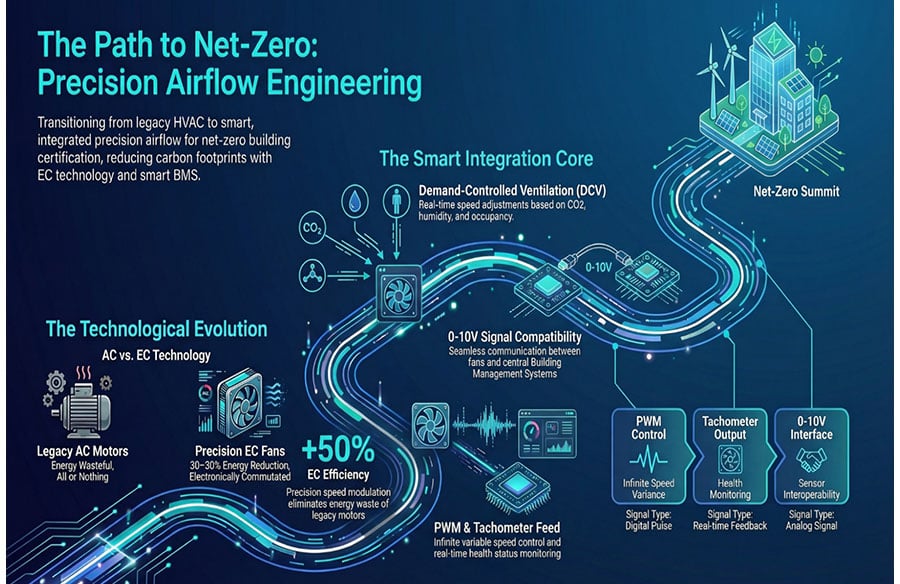
Historically, commercial buildings relied on AC (Alternating Current) induction motors. While robust, these units are notorious for their “all-or-nothing” energy consumption profile. They often run at full capacity regardless of actual demand, leading to significant wasted energy in the form of heat and noise.
The industry is rapidly shifting toward EC (Electronically Commutated) technology, which combines AC and DC voltages to bring the best of both worlds: the convenience of AC power supply with the efficiency of DC motors. Technical data from specialized component manufacturers like ACDCFAN indicates that EC fans can reduce energy usage by up to 30–50% compared to legacy systems. This efficiency gain is largely due to their ability to modulate speed precisely based on real-time environmental demand, rather than cycling on and off inefficiently.
This transition is not merely an operational upgrade; it is a fundamental design requirement for buildings aiming for LEED Platinum or BREEAM Outstanding certifications.
Integrating Smart Components with BMS
Efficiency is useless without control. The defining characteristic of a “smart building” is the interoperability of its components. High-performance airflow components are now expected to speak the language of the Building Management System (BMS).
To achieve true Demand-Controlled Ventilation (DCV), specifiers must look for components featuring:
- PWM (Pulse Width Modulation) Control: Allows for infinite variable speed adjustments.
- Tachometer Output: Provides real-time feedback on fan speed and health status to the central controller.
- 0-10V Signal Compatibility: Ensures seamless integration with standard environmental sensors (CO2, humidity, temperature).
When a meeting room fills up, CO2 sensors should trigger the ventilation system to ramp up specifically for that zone. Conversely, when the room empties, the system should idle. This granular control is impossible with traditional, dumb components.
Thermal Management in High-Density Spaces
While general ventilation focuses on air quality, specific zones within commercial structures face acute thermal challenges. Server rooms, elevator machine rooms, and telecommunication closets generate immense heat loads per square meter.
In these high-density applications, airflow is a matter of asset protection. Overheating leads to equipment failure and downtime. The architectural solution involves specifying cooling components that offer high static pressure capabilities to push air through dense filters and restricted ductwork without losing efficiency.
Key considerations for high-density zones:
- Redundancy: N+1 fan configurations to ensure continuity.
- Targeted Cooling: Directing airflow exactly where heat is generated rather than cooling the entire volume of space.
- Acoustic Profile: Ensuring high-RPM cooling does not bleed noise into occupied office areas.
Future-Proofing: Global Standards and Compliance
The selection of mechanical components is increasingly dictated by regulatory frameworks rather than just engineering preference. Governments are moving from voluntary guidelines to mandatory efficiency thresholds.
Regulatory bodies worldwide are tightening standards for HVAC efficiency to meet aggressive climate goals. According to the International Energy Agency (IEA), the International Energy Agency warns that without efficiency improvements, energy demand from space cooling will more than triple by 2050. This regulatory pressure means that specifying high-efficiency components is no longer optional—it is a compliance necessity for any project intended to remain viable over the next decade.
Key Takeaways
| Area | Key Takeaway | Impact/Data |
| Tech Upgrade | Replace AC with EC motors | Cuts energy use by 30–50% |
| Smart Control | Require PWM & sensor integration | Enables granular Demand-Controlled Ventilation |
| Asset Safety | Deploy high static pressure & redundancy | Prevents critical failure in server rooms |
| Compliance | Anticipate mandatory efficiency thresholds | Mitigates risk as cooling demand triples |
Conclusion
For the modern architect, the Bill of Materials (BOM) is as potent a tool as the CAD drawing. By prioritizing high-efficiency EC components and smart integration capabilities, design teams can ensure their buildings perform as beautifully as they look. The path to net-zero is paved with precision engineering, one fan rotation at a time.