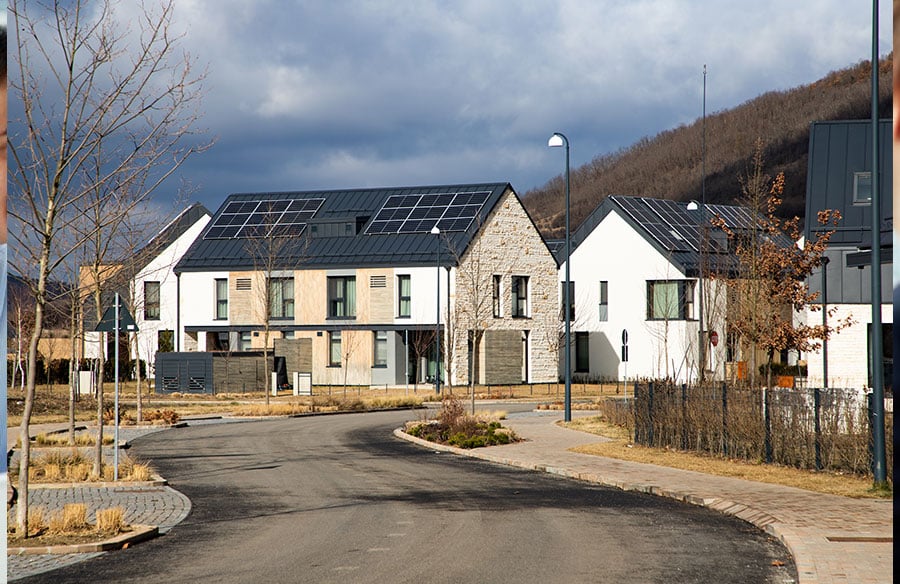
In a significant move towards sustainable urban development, Galway City Council has announced that all new social housing projects will incorporate solar energy technology as standard. This progressive initiative positions the western Irish city at the forefront of environmentally conscious housing policy, demonstrating how local authorities can lead the charge in combating climate change whilst simultaneously addressing housing needs and fuel poverty. The decision reflects a growing recognition across Europe that social housing developments present a unique opportunity to embed renewable energy infrastructure from the ground up, creating long-term benefits for residents and the environment alike.
The Context: Ireland’s Housing and Climate Challenges
Ireland faces a dual challenge that has become increasingly urgent in recent years. On one hand, the country grapples with a persistent housing crisis, particularly acute in urban centres like Galway, where demand far outstrips supply and housing costs have spiralled upwards. On the other hand, Ireland must meet ambitious climate targets set both domestically and through its commitments to the European Union’s Green Deal, which aims for climate neutrality by 2050.
The residential sector accounts for approximately 30% of Ireland’s total energy consumption, making it a critical area for intervention if the nation is to achieve its climate objectives. Social housing, which represents a substantial portion of new residential construction undertaken by local authorities, offers a particularly promising avenue for implementing sustainable solutions. Unlike private developments where market forces and individual decisions predominate, social housing allows for strategic, consistent implementation of environmental standards that might otherwise be considered optional or cost-prohibitive.
Galway City Council’s decision to mandate solar installations across all new social housing reflects this understanding. By treating renewable energy as infrastructure rather than luxury, the authority is ensuring that some of the most vulnerable members of society – those dependent on social housing – can benefit from reduced energy costs and improved living standards whilst contributing to national climate goals.
The Solar Strategy: What It Entails
The council’s solar incorporation strategy involves the installation of photovoltaic (PV) panels on the roofs of new social housing units, whether individual dwellings or multi-unit developments. These systems are designed to generate electricity that residents can use directly within their homes, reducing reliance on grid-supplied power and lowering electricity bills substantially.
According to GoKonnect Solar Galway, the specific capacity of solar installations varies depending on the property type and available roof space, but typical installations on social housing units range from 2 to 4 kilowatts of peak power generation capacity. For a standard three-bedroom semi-detached house, a 3kW system would be considered appropriate, capable of generating approximately 2,400 to 2,700 kilowatt-hours of electricity annually under Irish weather conditions.
Importantly, the solar panels are being integrated into new builds from the design stage rather than retrofitted afterwards. This approach allows architects and engineers to optimise roof orientation, pitch, and structural support to maximise solar gain. South-facing roofs with appropriate angles can be prioritised, and electrical systems can be designed with solar integration in mind from the outset, creating more efficient and cost-effective installations.
The council has also indicated that installations will be accompanied by monitoring systems that allow residents to track their energy generation and consumption. This transparency not only helps residents understand and optimise their energy use but also provides valuable data to the council for assessing the programme’s effectiveness and making evidence-based improvements to future projects.
Financial Benefits for Residents
Perhaps the most immediately tangible benefit of solar panel installation is the reduction in electricity costs for social housing tenants. Energy poverty – the inability to adequately heat or power one’s home due to financial constraints – affects a significant proportion of Irish households, with those in social housing particularly vulnerable due to lower average incomes.
Solar panels address this issue directly by reducing the amount of electricity residents need to purchase from utility companies. Estimates suggest that a typical 3kW solar installation could reduce a household’s electricity bills by between 30% and 50%, depending on usage patterns and how well energy consumption aligns with solar generation periods. For a family spending €1,500 annually on electricity, this could represent savings of €450 to €750 per year – a substantial sum for households operating on tight budgets.
Beyond direct generation, the solar installations also connect residents to various support schemes. In Ireland, the Microgeneration Support Scheme allows households with solar panels to receive payment for excess electricity exported back to the grid. Whilst social housing tenants may not own their properties, the council can arrange for any feed-in tariff payments to reduce residents’ rent or energy costs, ensuring the full financial benefit flows to those living in the homes.
These financial advantages compound over time. Whilst energy prices fluctuate and generally trend upwards over the long term, solar panels provide a hedge against such increases. Residents with solar installations are partially insulated from future price rises, providing greater financial stability and predictability in household budgeting.
Environmental Impact and Climate Goals
The environmental rationale for Galway City Council’s solar initiative is equally compelling. Each kilowatt-hour of electricity generated by solar panels represents electricity that need not be produced by fossil fuel power stations. In Ireland’s current energy mix, which still relies substantially on natural gas and other fossil fuels despite growing renewable capacity, solar-generated electricity provides genuine carbon emissions reductions.
A typical 3kW solar installation on an Irish social housing unit might generate 2,500 kWh annually. Given Ireland’s current electricity grid carbon intensity of approximately 0.3 kg CO2 per kWh, this translates to roughly 750 kg of CO2 emissions avoided per household per year. Across a development of 100 homes, this would amount to 75 tonnes of CO2 avoided annually – equivalent to taking approximately 16 average cars off the road.
When multiplied across all new social housing developments in Galway over coming years, the cumulative impact becomes substantial. If the council delivers 500 new social housing units over a five-year period, all equipped with solar panels, the total annual carbon dioxide reduction would reach approximately 375 tonnes once all developments are operational.
These reductions contribute directly to Ireland’s climate commitments. The Climate Action Plan 2021 sets out a pathway to reduce greenhouse gas emissions by 51% by 2030 compared to 2018 levels, with specific targets for the electricity generation and residential sectors. Every tonne of CO2 avoided through initiatives like Galway’s solar housing programme helps bridge the gap between current emissions and these ambitious targets.
Broader Implications for Housing Policy
Galway City Council’s initiative has implications that extend well beyond the immediate environmental and financial benefits. It represents a philosophical shift in how social housing is conceived and constructed, moving towards a model where environmental sustainability is considered fundamental rather than optional.
This approach challenges the persistent misconception that sustainable building practices are luxuries affordable only in premium private developments. By incorporating solar technology as standard in social housing, Galway demonstrates that renewable energy can and should be accessible to all socioeconomic groups. This democratisation of sustainable technology is essential if Ireland is to achieve an equitable transition to a low-carbon economy.
The initiative also sets a precedent that other local authorities across Ireland and beyond may follow. Social housing construction represents a significant proportion of public capital expenditure, and the approach taken by councils influences building standards more broadly. When local authorities demonstrate that solar integration is feasible, cost-effective, and beneficial, it encourages both policy makers and private developers to adopt similar standards.
Furthermore, the programme provides valuable learning opportunities regarding the real-world performance of solar installations in social housing contexts. Data gathered from these developments will inform future policy decisions, helping to refine installation standards, identify best practices, and demonstrate return on investment in ways that support expansion of renewable energy initiatives.
Challenges and Considerations
Despite its many benefits, Galway’s solar housing initiative is not without challenges. The upfront costs of solar installations represent a significant capital expenditure for a council already facing budgetary pressures. Whilst solar panels deliver long-term savings, the initial investment must be funded, potentially competing with other pressing social housing needs.
Maintenance and replacement considerations also require planning. Solar panels typically carry warranties of 25 years and can function beyond this, but inverters and other components may require replacement after 10-15 years. The council must ensure adequate long-term budgets exist for maintenance and eventual system renewal to sustain the benefits over time.
There are also questions about how benefits will be managed if residents move or if properties eventually transfer into different ownership arrangements. Clear policies must govern these scenarios to ensure continuity and prevent disputes.
Galway City Council’s decision to incorporate solar panels into all new social housing projects represents forward-thinking policy at its best – addressing immediate needs whilst building resilience for the future. By reducing energy costs for vulnerable households, cutting carbon emissions, and demonstrating leadership in sustainable development, the initiative delivers multiple benefits simultaneously.
As climate change intensifies and energy security becomes increasingly important, such initiatives will transition from progressive to essential. Galway’s approach shows that social housing need not be merely functional but can exemplify the highest standards of environmental design. In doing so, the council ensures that those most in need of housing support are also beneficiaries of the renewable energy transition, rather than being left behind as society shifts towards sustainability. This is social housing policy fit for the challenges of the 21st century, and it deserves recognition and emulation across Ireland and beyond.