In a design world dominated by sterile minimalism on one end and overdone maximalist warmth on the other, a new aesthetic has emerged as a middle ground, one that finds beauty in juxtaposition. Eco Brutalism blends the honesty of industrial design with the comforting touch of natural materials. It’s an unlikely love story between the solidity of concrete and the vibrancy of greenery, between hard structures and soft textures, permanence and life.
The term Eco Brutalism is at first glance a paradox; what can be both “brutal” and environmentally friendly? The contradiction is precisely what’s so intriguing. It’s more than just a look, though. It’s a mentality – one that champions honest materials and craftsmanship, that equally celebrates form and function, and one that seeks to erase the line between the man-made and natural.
In this piece, we’re going to dig into how Eco Brutalism has gone from an architectural revolution to an interior design muse, and why concrete is this movement’s modern cornerstone.
Concrete as the Foundation of Eco Brutalism
Concrete has been the material most strongly associated with Brutalist design. Characteristically, it’s utilitarian, unapologetically honest, and quietly monumental. And now, these same qualities are finding their way into today’s interiors in softer and more sustainable forms. A concrete pedestal basin, for instance, reimagines a traditionally structural material into something sculptural, layered with purpose, and curiously warm.
The transition is one of the keynotes of Eco Brutalism: the right balance between permanence and presence. Concrete isn’t the star of the show — it frames and textures light and life instead. Juxtaposed with timber, greenery, and organic materials, it’s modern but not cold.
What Defines Eco Brutalism?
Eco Brutalism is inspired by the buildings that came before it. Raw, pared back and unapologetically truthful. Mid-century Brutalists weren’t seeking beauty in the ornamental. Brutalism was a love letter to sincerity. Buildings with honest surfaces and exposed walls that proudly showed how they were made. Brutalism was imperfect, distinctly human.
Echoes of this movement can now be heard within the home. Concrete floors and frames remain, but they are less dominant. Neutral tones of timber, linen, stone and plants add warmth and soften the hard lines. Industrial elements intermingle with natural materials and textures.
Eco Brutalism is less of a juxtaposition than a return to earth. Grounding the raw power of the industrial movement and creating living spaces that feel both timeless and vibrant.
Designing an Eco Brutalist Interior
Bringing Eco Brutalism home is all about balance. It’s the line between the honest rawness of materials and the effortless feel of nature. It’s not a style to slap on the wall; it’s one to cultivate with intention and a certain sense of restraint.
To show you how that balance can look, we want to focus on the details that really make it stand out: the building blocks of materials that ground the space, the colour and light that eases it, and the functional furniture pieces that give it purpose.
Key Materials and Textures
Embracing raw materials and using them in their most natural state is the central tenet of Eco Brutalism. Concrete, wood, stone and metal are left exposed, rather than being covered up or finished to within an inch of their lives. A tactile, tonal quality is what you’ll notice here first. Uneven surfaces, and a palette of natural materials that are recognisably what they are.
In the living room, concrete can act as a grounding element. Light bounces off smooth cast surfaces or pool in the dips and creases of more roughly finished materials. Introducing timber joinery or linen upholstery to soften it, concrete suddenly feels cosier and more homely than you’d expect.
To layer your space, mix hard surfaces with softer finishes: a concrete floor softened with a wool rug; a rendered wall contrasting with textured fabrics. Contrast is key in this style, but it’s not about softening the concrete. Work with each texture, whether natural or man-made, to complement and enhance each other.
Colour, Light, and Organic Contrast
Materials ground Eco Brutalism, but colour and light make it sing. Expect muted, calming hues of soft grey, warm taupe, and other earthy/mineral tones that feel like concrete and stone. These colours don’t shout. They work with texture and form to provide a soothing setting for the details to do their thing.
Lighting, specifically natural light, is a key player. In an Eco Brutalist space, you won’t find even lighting that washes every surface in the same way. Instead, uneven pools of light create more drama, casting highlights and shadows on surfaces, catching the lip of an arch, or calling attention to an exposed brick wall. It’s a quiet, subtle interplay of light and shadow, with a dash of reflection.
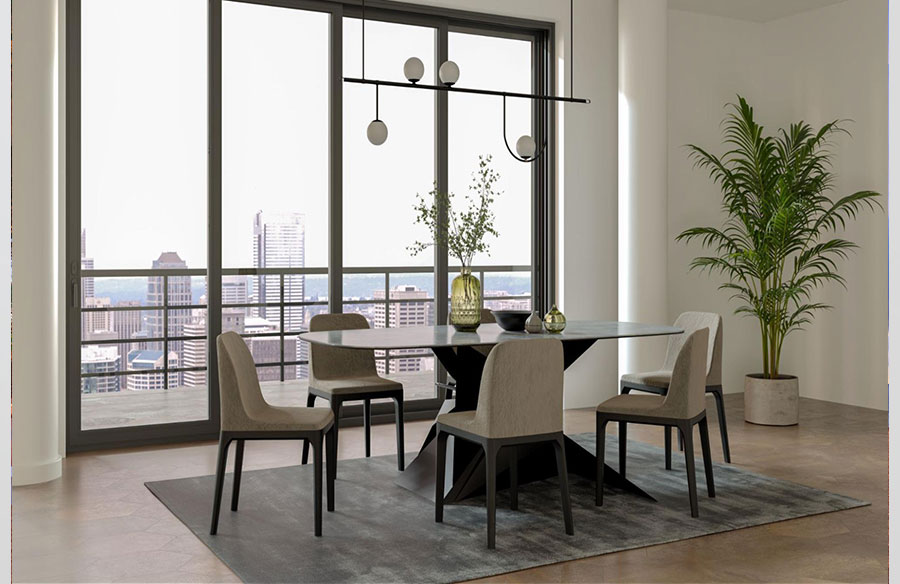
To prevent a room from feeling too cold or sparse, nature provides the yin to stone and concrete’s yang. Timber, greenery, and woven textures help soften the edges, adding warmth with tone and texture as much as colour. A lone indoor tree or a grouping of leafy plants can also go a long way in changing the energy of a room.
Integrating Functional Design Pieces
When it comes to Eco Brutalism, furniture and fittings should be considered extensions of the interior. This means no unconsidered details. Everything should have a purpose, and every shape must justify its presence. Never be obscure about function, but find another way to display it, such as through shape, proportion, and material.
Consider, for example, using sculptural forms to create a lasting impact. A pedestal basin, a single monolithic dining table or a cast-concrete plinth are all reminiscent of the wider aesthetic in the space, and ground the space with their minimalism and solidity. This means you can use them as key architectural elements, a rare and wonderful occurrence where functionality and sculpture can meet.
Use these heavier pieces as anchor points within your Eco Brutalist interior, both literally and figuratively. These pieces should be the things you use to ground a space, whilst allowing simpler and softer details to exist around them. In this way, your interiors won’t feel cluttered, but rather purposeful and well-crafted.
Why Eco Brutalism Resonates Today
Eco Brutalism is about more than just an aesthetic. It’s also about the increasing demand for permanence in a world where things seem to become outdated in the blink of an eye. The raw, unpolished materials and intentional craftsmanship that define Eco Brutalism promise longevity.
Concrete, timber, stone and other materials typically used in Eco Brutalism aren’t just visually impactful, they’re often chosen for their durability. The fewer the instances of repainting, remodelling, or replacing materials, the more sustainable the architecture is. As a result, this design style aligns closely with sustainable architecture.
In addition to its environmentally-friendly edge, Eco Brutalism has had such a strong impact because it feels genuine. There’s an authenticity to exposed surfaces, unembellished forms, and functionality over frills. Spaces designed this way exude integrity and temperance, offering calm, resolute and grounded interiors.
Redefining Raw Beauty for a Sustainable Future
There is an understated elegance to spaces that don’t shout for attention. Eco Brutalism is a testament to this. There is beauty in the honesty of materials and the simplicity of lines, in things that are designed to last. It’s in the interplay of textures: the cool, smooth surface of concrete against the warmth of timber. It’s in the details: a rugged facade softened by a green wall, or a sculptural light fixture that is both functional and a statement piece.
It’s about celebrating the unplanned within the confines of the planned – a corner where a potted plant spills over a raw brick wall, or a geometric shelf that doubles as a conversation piece. It’s also a mentality. It’s choosing durable materials, working with the existing landscape, considering how a space will weather over time.
It’s what makes a space feel lived-in rather than curated, and that’s really what sustainable design is all about: making conscious, meaningful choices.