

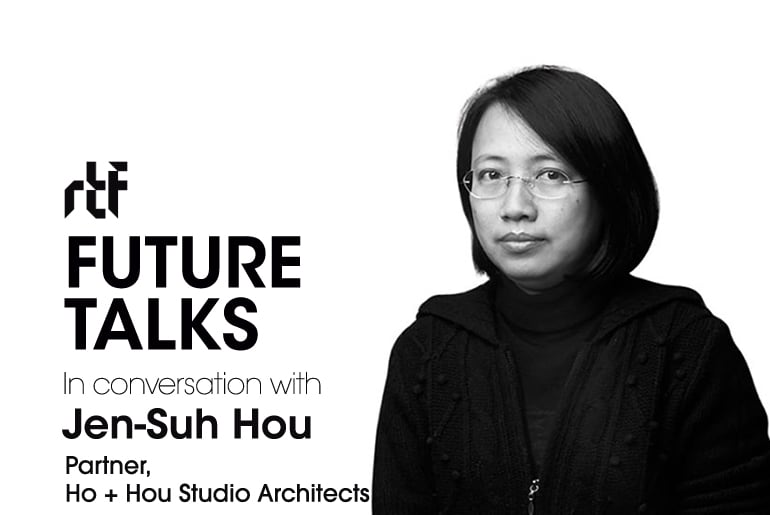
Ladies and gentlemen, enthusiasts of innovative design, and seekers of creative inspiration, welcome to Future Talks by RTF. In our ongoing quest to explore the limitless boundaries of design and architecture, we have the privilege of engaging in a captivating conversation with the extraordinary minds that shape the world of design.
Today, we have the honor of introducing a remarkable individual whose journey through the realms of academia and practice has shaped a unique perspective on the world of design, Jen-Suh Hou. Hailing from vibrant Taiwan, our guest embarked on an educational odyssey that took them from the lush landscapes of The National Taiwan University to the prestigious halls of Harvard’s Graduate School of Design (GSD).
This journey began with a Bachelor’s Degree in geography, reflecting a deep-rooted curiosity about the world and its ever-evolving tapestry. However, a fervent love for design coursed through their veins, pushing them to delve deeper into the realms of creativity. This pivotal moment led they to enroll in the Master’s program in landscape architecture at Harvard’s GSD, a decision that would serve as a transformative chapter in life.
It was this relentless pursuit of excellence that drove them to pursue a second Master’s degree, this time in Architecture, from the esteemed Columbia University. The knowledge and insights they acquired from these diverse academic experiences laid the foundation for a career that would redefine the contours of architecture and design.
After their academic journey, our guest ventured into the bustling cityscape of New York, working with some of the industry’s most renowned firms, including Perkins & Will, Rafael Vinoly Architects, and Kohn, Patterson & Fox. These experiences were crucibles of creativity, refining his skills and expanding his horizons.
In 1998, he made a significant decision, one that would bring them back to the roots in Taiwan. Teaming up with their partner, Albert Ho, they founded Ho + Hou Studio Architects in 1997. This marked the beginning of a remarkable journey into design innovation and storytelling, where their architectural creations would blend the global perspectives gained in New York with the rich cultural heritage of Taiwan.
Join us as we delve into the incredible life and career of our distinguished guest, exploring the influences and experiences that have shaped his visionary approach to architecture and design.
RTF: Hi Jen-Suh Hou , We are glad to have you as a guest on Future Talks by RTF. Thanks for joining us. What is your design language and what shaped it?
Jen-Suh Hou: Our designs are minimal and modern. They are inspired both by the heroic moderns, Corbu, Mies, Aalto…etc and the modern revisionists, James Sterling, John Hejduk, Aldo Rossi… Perhaps more importantly are the influences of sculptors and painters, Richard Serra, Agnes Martin…etc They provide a wide spectrum of design vocabularies and tendencies.
RTF: What is your process of developing the initial thoughts about a project? How do you start?
Jen-Suh Hou: There is no one set process. The client and the site are providers of information on how to proceed.
RTF: What kind of attention do you give to the ‘community’ in conceptualising a project? How do pragmatism and subjectivity go hand-in-hand in it?
Jen-Suh Hou: We always strive to understand a set of ‘objective’ program requirements through ‘subjective’ interpretation. We see it as our task to reinterpret programmatic requirements, usually expressed through numerical values into a set of qualities. These qualities may not necessarily be spatial at the outset, but may be textural, visual, or sensual qualities.
RTF: What is the process of establishing a common ground when dealing with a client’s demands and your own ideas? How important do you consider ‘The Art of Persuasion’ for architects?
Jen-Suh Hou: The design process is not viewed as a tug of war between our ‘ideas’ and our clients’ wishes. We begin by reinterpreting our client’s demands into ‘qualities’ or priorities as mentioned above. And we would explain as succinctly as possible through visual tools how these qualities align with the client’s demands or desires. In other words, our ‘ideas’ are in fact interpretations of our clients’ desires.
RTF: How do you look at the work beyond designing for young architects, such as involvement in publishing, handling media and building an online presence?
Jen-Suh Hou: We are a very ‘old school’ design studio. We do not have a social media platform on Facebook, Instagram..etc. We prefer to present our work through ‘traditional’ media, working with journalists either online or physical media.
RTF: What do you think of building a social media presence for architects? How important is it and what does it demand from the architects who choose to do it all on their own?
Jen-Suh Hou: Obviously, having a social media presence in any profession is a ‘must’ nowadays. The demands of regular ‘in-house’ maintenance of the platforms, to me, is almost a full-time job.
RTF: How important do you consider the need for super ‘receptive’ heads in the team to establish a progressive mindset?
Jen-Suh Hou: I believe one of the most important requirements for architects is the ability to listen, to be receptive to others’ ideas, not only from our clients. The need to be receptive should be present in all strata of the design team, not just at the top.
RTF: Who has been your inspiration throughout your architectural journey?
Jen-Suh Hou: Some of the living architects who have inspired are Alvaro Siza, Billie Tseng and Tod Williams, Caruso St. John Architects, Shim-Sutcliffe Architects, and Glen Murcutt. Artists from the post-war period also inspire, Jackson Pollock especially. Finally the art critic and curator Kirk Vernedoe was an inspiration for his interpretation of modern art.
RTF: Where do you find global architecture a decade from now?
Jen-Suh Hou: I hope to find an architecture more engaged with the local, rather than the global.
RTF: Where does one find you when you’re not working?
Jen-Suh Hou: I tend to be in a home basement studio working on woodwork of pottery.


