

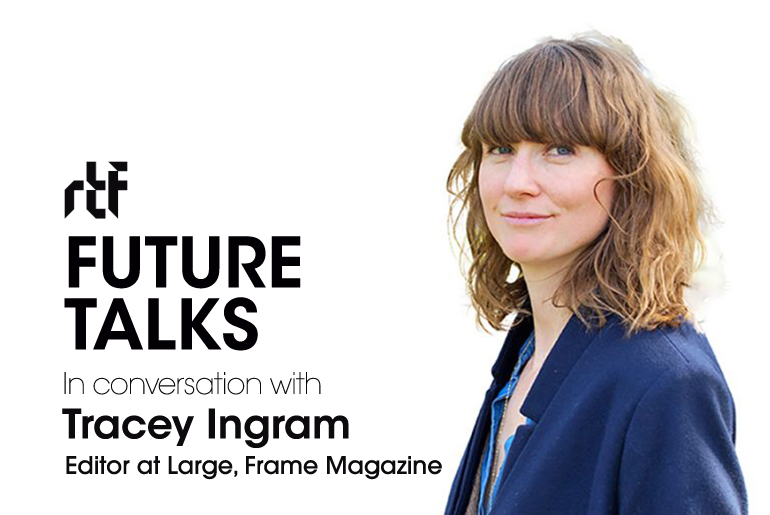
Ladies and gentlemen, get ready to embark on a captivating journey into the world of design as we present to you Future Talks by RTF. In this exciting series, we have the privilege of engaging in conversations with the true pioneers who breathe life into design stories, unveiling the intricacies of their craft and vision.
At the helm of these illuminating dialogues is none other than Tracey Ingram, a distinguished figure in the realm of design journalism. As Frame’s former managing editor and current editor at large, she brings a wealth of expertise and a profound passion for spatial design and products.
Residing in the vibrant city of Amsterdam, Tracey’s journey into the design world began in her native New Zealand. She honed her craft and earned her stripes, obtaining a Bachelor of Design with Honors, with a specialization in Interior Design from Massey University in Wellington. Her keen eye for detail and unwavering dedication to design have led her to contribute to publications around the globe. Beyond the written word, she has lent her creativity and vision to numerous design studios and brands, helping them bring their stories to life.
As we delve into the intricacies of design and innovation, let us be inspired by the remarkable talents and insights shared by Tracey Ingram and the visionary designers she converses with. Future Talks promises to be a source of inspiration, a fountain of knowledge, and a window into the limitless world of design, where imagination knows no bounds.
RTF: Hi Tracey, We are glad to have you as a guest on Future Talks by RTF. Thanks for joining us. You started your career as an Interior designer and then treaded on a path of editing. How has the trajectory of your career been?
Tracey: My high school English teacher couldn’t believe I wasn’t going to study writing after I graduated. I wanted to be a designer, but once I got to design school I realised I liked the research and conceptual side of design projects more than actualising them. I tried out a few different things after graduating from design school – working in events, then for a lighting design company – before moving from New Zealand to Amsterdam. My timing was tricky: it was in 2008, the middle of The Great Recession. I worked for a small design studio but they eventually had to let me go – I was the only one on the payroll who wasn’t a founder. I started to reassess everything, even whether I wanted to remain in Europe. I’m glad I did though, as I started at FRAME in 2010 and immediately felt at home. This was the kind of work I wanted to be doing – combining my passion for design with my passion for writing.
RTF: What would you suggest to young architects and designers who wish to get their features published in the top publications? What are some challenges in doing so?
Tracey: Invest in good photography. It might be different for local publications, but as an international magazine, FRAME unfortunately can’t personally visit each project we publish. We have to rely on images, and it’s sad but true that even a decent project with terrible images probably won’t make the cut. That said, a well-photographed, well-designed project might also not get selected. It pays to look at the editorial agenda of the publication. For this year at FRAME, for instance, we pulled out some key themes we feel are shaping the future of spatial design: Sustainability, Wellbeing, Agility, Experience and Community. We’ve been looking for new ideas that tackle these issues.
RTF: What are some challenges that general exchanges with architects and designers present?
Tracey: I wish we had the time to reply to every submission individually, because I understand that designers go to the trouble of sending us their projects and are often waiting eagerly to hear if they’ll be published. People often think that we’re a huge team of editors, but there’s only a handful of us. If we replied to everyone individually, that’s all we’d do!
RTF: What is the striking factor in the chunk of content that comes your way, how do you look at the content and decide on working towards that? What is the process like?
Tracey: As I mentioned, we have key themes we’re working with at the moment: Sustainability, Wellbeing, Agility, Experience and Community. Next year we’ll also have a special Multiverse issue. We work with these themes both online and in print, so if we see an interesting project we ask ourselves if it aligns with our editorial direction, and if it’s new, innovative and inspiring. We do receive submissions, but we do a lot of research ourselves, either online or by visiting design events and so on. Our own research has become a lot more important as we’ve sharpened our themes over the years. We’ve also moved somewhat away from publishing solo ‘hero’ feature projects towards publishing themes and tendencies. We group projects and talk about the phenomenon surrounding them. One of our more recent additions to the print publication is our Mood Board, which covers inspiring projects outside the spatial design realm that can inspire interior designers, things like fashion, food, art. For that it’s about having a good mix of projects that look good together on a spread.
RTF: We would like to get your idea of a good pitch and how you differentiate between a ‘positive’ and a ‘negative’ approach from the writers, designers and architects.
Tracey: It’s a fine balance to pitch well. You need to say enough without including fluff. There are many angles to tell about a project, so again I think it’s about aligning with the publication’s editorial agenda. One publication might be solely interested in the aesthetics, while another might appreciate that you worked with sustainable materials, for example. Ideally you would tweak your pitch to fit different publications, but I understand that takes time, and designers and writers tend to be busy people. As a sort of in-between, I’ve received pitches suggesting, say, three different angles that relate to the project. In the end, the editors will know what they’re looking for and what they can extract out of a pitch. The writers and designers just have to make sure they know what ingredients to put in there.
RTF: What does it take for writers and editors to constantly be on the bandwagon? And how crucial it is?
Tracey: I’ll say what my former managing editor told me on my first visit to Milan Design Week many years ago: ‘You simply can’t see everything.’ In today’s content-saturated era, that’s even more true. Being part of an editorial team gives you the advantage of knowledge-sharing. I might say, ‘Hey, I’m thinking of doing a piece on xxx’, and a teammate might tell me about a project they’ve seen that fits that theme. For our Insights pieces, which focus on future-oriented themes in spatial design, we often work with our contributing editors, who all have one area of focus: workplaces, hospitality and so on. It’s much easier to stay on top of what’s happening in one field than across the board. Our in-house editorial team doesn’t have specialities, so we do try to keep abreast of the biggest shifts in the wider industry. Everyone has their own way of doing so, usually by checking in with trusted online resources, talking to people, asking the right questions, keeping our eyes and ears open.
RTF: How has your job influenced you creatively?
Tracey: It’s interesting to be so surrounded by design yet not design anything myself anymore. I don’t really miss designing, and I think writing satisfies my desire to create. I’ve been lucky enough to meet and interview some of the world’s best designers, and I love hearing how they think. Just as I preferred the research and conceptual side of design school, I’m stimulated creatively by hearing about the research and conceptual side of their projects.
RTF: What are the other paths you stroll on when not working?
Tracey: I’m a yoga teacher, which is a nice balance as it gets me away from my desk and computer. And I’m currently working on my first novel (my English teacher would be proud!). It’s a long and challenging process, very different to writing about design. I’m no longer writing about what’s happened or what someone else believes will happen. I have to make things happen myself, through my words.
I also love to travel, which I sometimes do for work but more often for pleasure. I’m trying to take fewer flights, so I’ve been on some incredible long train journeys lately. As a New Zealander in Europe, it’s amazing to have such varied cultural experiences on my doorstep.


