

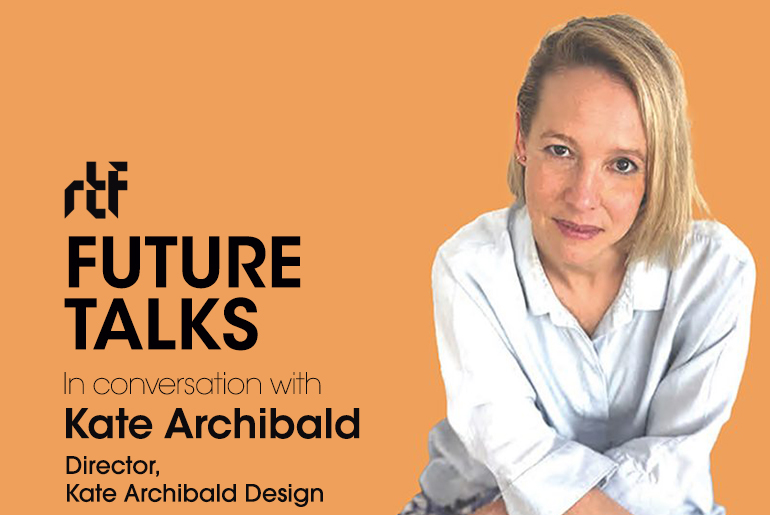
Ladies and gentlemen, enthusiasts of innovative design, and seekers of creative inspiration, welcome to “Future Talks” by RTF – Rethinking the Future. In our ongoing quest to explore the limitless boundaries of design and architecture, we have the privilege of engaging in a captivating conversation with the extraordinary minds that shape the world of design.
Today, we are thrilled to introduce you to a true luminary in the field – Kate Archibald. As a multi-disciplinary designer and the driving force behind Kate Archibald Design, Kate’s talents and creativity know no bounds. With a unique ability to seamlessly traverse between interior design, built form, lighting, furniture, and jewelry design, Kate Archibald is a true visionary.
Currently dividing her time between the vibrant cities of Brisbane and Perth in Australia, Kate Archibald’s designs reflect the diverse influences and inspirations she draws from her surroundings. Her journey is one of constant exploration, evolution, and the pursuit of excellence in design.
Join us as we delve into the fascinating world of Kate Archibald, where she will share her insights, experiences, and the future of design as she envisions it. Prepare to be captivated by her innovative ideas, boundless creativity, and her extraordinary ability to reimagine the future of design.
RTF: Hi Kate, we are so glad to have you as a guest on Future Talks 2.0. Thanks for joining us. So, what led you to pursue a career in architecture and design?
Kate: I’ve always had a deep interest in architecture and design. Since I was a young child, my parents (although both scientists), were incredibly nurturing and encouraged my exploration in the arts. I always loved art and lego as a child, and as I moved through life these two loves made me decide to complete a degree in fine arts majoring in jewellery design, and then an honours degree of interior design/interior architecture at RMIT.
RTF: How would you describe your overall design philosophy or approach to architecture and design?
Kate: I feel as an interior designer/ interior architect my key role is balancing the functional needs and requirements for the space, while overlaying a language of texture, materiality and to the space. I am also incredibly aware, from a sustainability point of view, how wasteful our industry is, I’m always trying to pose to myself and others how can we do more with less? Can we re-use? How can we engage with local? Can we create a smaller space, but maximise how it functions? How to find the balance between creating really good results aesthetically whilst still being conscious about the decisions we are making in regards to materiality.
RTF: Do you have a singular design process that you follow or does the approach vary and change based on every project?
Kate: I take a very personal approach to each project and client. I would say that I have a basic skeletal framework for my design process that I utilise for the start of the process, but as I learn more about the client and project I tailor my approach to the client based on how they communicate their design needs, and how each client understands design ideas. I am constantly striving to improve my design process with each project; learning or gaining insight into how I can do things better.
RTF: How do you approach getting your projects featured in publications? Do you manage the communications and PR in-house or have this task outsourced to a PR & communications agency? Which approach do you think is better and why?
Kate: All of my PR is done in house. So far I have been incredibly lucky that the photographer I use, the amazing Jack Lovel, has reached out to his contacts with photographs of my projects and they’ve wanted to publish them. It’s been a fluid process. My design practice is just me, and I only take on a limited number of projects. My approach to PR as a small firm works, however if you were looking to grow and expand, or you were a larger established firm, I can see the benefits of outsourcing and utilising PR and communication companies, who are able to help you reach new audiences.
RTF: Can you share any challenges you’ve encountered in the process of getting your work published and how you overcame them? Are there any lessons you’ve learned over the years that have significantly improved your success in this area?
Kate: I haven’t had any challenges, but I have found that engaging with active and quality photographers within the industry is key. There is nothing more valuable than being able to effectively communicate your design and its key elements; this is best achieved by engaging really good photographer. They know as soon as they walk into the space where the key shots are; they are amazing at seeing a narrative; a story of photographs that effectively and beautifully explain the space.
RTF: How do you measure the impact of having your work featured in publications, both professionally and personally?
Kate: It is a real pleasure to see my work published and to share ideas/designs, not only in local publications within Australia but also elsewhere – I’ve been lucky to see my work published in countries like China and Russia. Whilst it’s incredibly rewarding, these publications have not translated into new work. Being acknowledged by these magazines/ online publications is thrilling; it’s very rewarding that my work is a part of the current design dialogue.
RTF: What advice would you give emerging architects looking to increase their chances of publishing their work? Are there any specific resources or platforms that you would recommend for architects seeking publication opportunities?
Kate: As mentioned before, definitely align yourself with a quality architectural photographer. Their involvement just completely elevates the communication of your project. Also don’t be afraid to reach out, as many magazines/ online publications have submission pages.
RTF: Which project of yours has been the most rewarding for you in terms of learning and/or exposure?
Kate: La Condesa, a Mexican restaurant based in Subiaco in Western Australia, was a great project. It was different and attracted a lot of traction within the media and was published both nationally and internationally.
RTF: In your opinion, what are the most critical skills and knowledge areas that architectural education should emphasize?
Kate: I feel our industry is moving into a period of real change and development. Artificial AI is becoming more capable in “image creating”, and being able to assist in creating designs from a brief. I think one of the most important areas that architectural education should engage with is concept development. I would love to see AI platforms being able to streamline our design process, particularly in areas like documentation; I could see this being incredibly beneficial. However, the concepts that are brought together in the initial stages of the project really weave in the intricacies and nuances of a design; they create a personality for the project. The 10% that transforms a good space into a beautiful space.
RTF: Share a piece of advice for young architects wanting to start their own practice.
Kate: Be open, and be okay to share your weaknesses as well as strengths. Engage and ask questions to all of the contractors you come into contact with. There is an abundant wealth of knowledge in every carpenter, structural engineer, electrician, etc. Let them know you’re interested in what they know about their area of expertise and work out how it can help you do your work better. Most people love to share their knowledge with you, and in my experience listening and engaging with contractors makes you a much better and more experienced designer.
RTF: How will architecture and design transform in the coming years?
Kate: As mentioned above, I think AI is going to create incredibly huge change and disruption to our industry. In addition to this, I think the environmental pressures we are now beginning to experience are going to demand exponential change. Basic building materials are already making construction incredibly expensive and I feel we will see an incredible need for new building materials – ones that are not only sustainable from an environmental point of view, but are also affordable and durable.
RTF: What’s your take on the integration of AI and architecture/design?
Kate: I have seen some incredible renders from an AI program that were produced from a designer giving the program a brief (a series of images that had the look and feel they were seeking in the design). Although impressive that an AI program created these renders, for me they lacked a sense of personality. I think the integration of AI within the architecture design world is definitely going to put pressure on Architects and Designers. Jobs for humans in this area will definitely reduce and more and more people will feel they can engage with these programs and create effective designs DIY. However, I still believe there will be a space for quality architects and designers… true craftsman that bring individualism and personality to spaces that an AI can’t easily replicate. Already, there is a feeling within Australia that it is elitist to engage an architect or designer. This sentiment may grow as mass generated designs and documentation become more accessible through AI.


