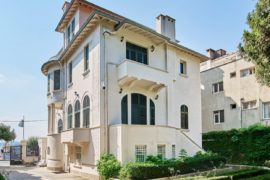
Criminal Justice: A Family Matter is a courtroom drama in which it is not only the individuals but the spaces themselves that define the drama. Architecture in this series is not a silent backdrop; it plays an important role. Architectural details and setups in the show are used smartly to highlight power, generate tension, and communicate the emotional depth of characters. From the courtroom to the living room, from the police station to transitional corridors, the constructed architectural environment on the show becomes a reflection of how justice and a gauge of human susceptibility are perceived.

Emotional Choreography of Space
The courtroom in the show is a working environment. Its design on the show is hierarchically organized: the raised judge’s bench dominating the room, the witness box set apart, and the public gallery seated at a distance. These architectural details and setups all tell a story about hierarchy, remoteness, and power.
The way the series processes the space and reveals the emotional depth of the choreography provides increased context for the audience. Aspects of the interior, such as a heavy sense of symmetry, imply that the institutional order of courtrooms is about emotional well-being, but for every good turn forward together, there are countless memories of the institutional burden of judicial rigidity. Therefore, architecture participates in the judicial spectacle while resonating with the emotional significance of the moment.
If the courtroom is the public stage of the script, the house is where the private drama takes place. The architectural features, like cramped corridors, closed doors, etc., make visible the emotional cage in which the characters are trapped. Architecture does not only enclose our bodies; it encages our hearts.
Whereas at home in the show, moments are linked to feelings like vulnerability, whereas the police station has a consistent, harsh utilitarian design, i.e., bare walls, iron bars, and dim fluorescents. It offers a blank space, void of particularity. These are not spaces made for ease, but for management and monitoring.
The claustrophobic layout of cells, no natural light, and horrible acoustics permeate the atmosphere. The visual dreariness of these sites makes our time there inhuman, a testimony to how architectural details have a big impact and also contain order.
The transitional spaces, like the waiting rooms, the hallways, are transitional spaces, the corridors of in-betweenness, the moments when characters anxiously pace, eavesdropping on bits of conversations, or just standing in pensive pause in the performance.
Corridors throughout the courthouse are so pedestrian, consistent doors and sterile lighting allude to the endless bureaucracy of the system. The waiting rooms become a space of nonverbal tension. These transitional spaces have little architectural merit, but they are loaded with dramatic subtext, of the uncertainty of being fanatical enough to believe they are either ‘innocent’ or ‘guilty’, ‘hope’ or ‘despair’.
What is bubbling under this whole experience is the way space articulates psychology. The shut-up rooms, slight framing, and narrow hallways induce claustrophobia, and this is how the character’s feeling trapped is conveyed. While symmetry is promised by courtroom architecture and orderly intent, it merely processes emotional chaos. The ‘disconnect’ between the warmth of home and the coldness of the lockups illustrates the gap.
Light is an important architectural feature in set design. The darkened shadows of the lock-up, the neutralizing glare of courtrooms, and the ambient warmth of the home all generate transitional atmospheres. The show exploits this dynamic to imply that spaces are not fixed, but they have emotional charge, influencing and being influenced by human experience.

Architecture is Never Neutral
It’s worth mentioning that the architectural details and setups in Criminal Justice: A Family Matter are not just design decisions. It is an implicit narrator that orchestrates the story. Each space, such as the courtroom, concerns power, the house pertains to fragility, the lock-up addresses alienation, and the corridor applies uncertainty; all serve to create mood and generate visual commentary for the story, alongside the dialogue and performances.
Where legal dramas can risk becoming exercises in navel-gazing debates on morality and evidence here, the physical landscape provides firm ground. Where justice is conveyed as less than a debate, justice is enacted physically, lived, felt, and experienced.
Ultimately, Criminal Justice: A Family Matter is one such instance where spaces narrate. The architectural details and setups in the series are not inactive but are active participants in enactment, stimulating action, emotions, and reflecting the power structures and dynamics in society. The courtroom acts as a stage of judgment, the house a testing-ground for exposure, the police station a control body, and the corridor a cathartic waiting ground.
By this subtle harnessing of the built environment, the series takes us to its most basic truth: that justice is not abstract. It is experienced in spaces, as spaces of confinement, of segregation, of silence. By illustrating this for us, Criminal Justice: A Family Matter reminds us that architecture is never apolitical, never unemotional, and outside of the human condition.