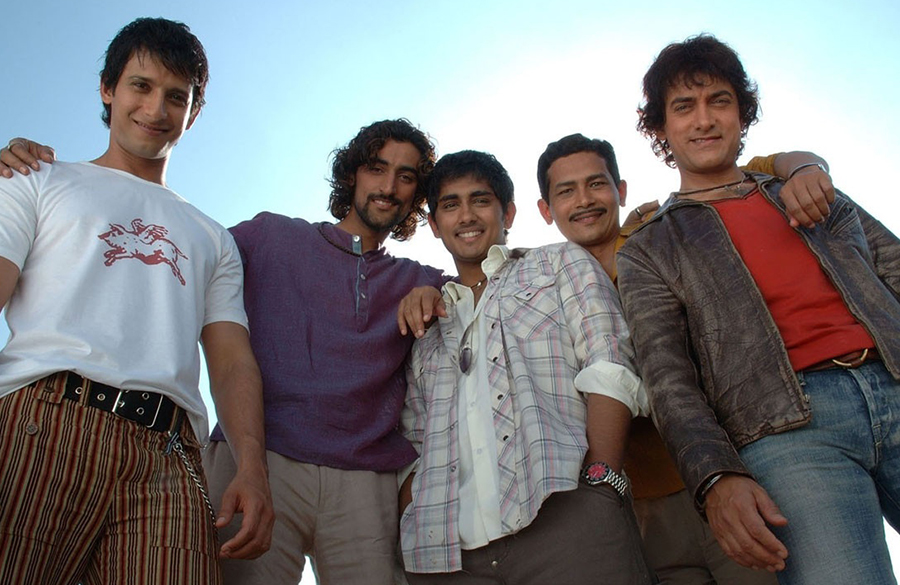
While the Hindi film industry is often associated with larger-than-life drama and crowd-pleasing masala, beneath the surface lies a wealth of cinematic brilliance- bold, innovative, and brave films that push the boundaries of storytelling. Among these, some movies stand out, challenging conventions and leaving a lasting impact. One such film was Rang De Basanti, directed by Rakeysh Omprakash Mehra. With its powerful narrative and the unforgettable music of A.R. Rahman, the film not only told a compelling story but also resonated deeply, its soundtrack becoming the soul of the film’s emotional and rebellious energy.

Story
A critically acclaimed film that was released in 2006, Rang De Basanti tells the story of a group of disillusioned, carefree college friends who are drawn into the political turmoil of modern India. The film is centred around Sue, a British filmmaker who arrives in India to make a documentary on the Indian freedom fighters who were hanged during the British Raj, based on the memoirs of her grandfather.

Sue (played by Alice Patten) casts a group of young Indians- DJ, Karan, Aslam, Sukhi, and Sonia (played by Aamir Khan, Siddharth, Kunal Kapoor, Sharman Joshi, and Soha Ali Khan respectively), to portray these historical figures. Initially indifferent to patriotism and the struggle for freedom, the friends see the past as irrelevant to their lives. However, as they immerse themselves in the roles, they begin to draw parallels between the British colonial rule and the corrupt political system of contemporary India.

A tragic event- the death of a close friend, Flight Lt. Ajay Rathod (played by R. Madhavan) in a MiG fighter crash, attributed to government corruption- shocks them into activism. Inspired by the revolutionaries they portrayed, the group decides to take matters into their own hands, leading them on a dangerous and violent path toward seeking justice.
The film intertwines the historical narrative of Indian revolutionaries like Bhagat Singh and Chandra Shekhar Azad with the contemporary struggles of the youth, making a powerful statement about patriotism, sacrifice, and the importance of taking action against injustice. Rang De Basanti explores the themes of political corruption, national identity, and the cyclical nature of revolution in Indian history.

Architectural Elements
Rang De Basanti masterfully utilizes a range of architectural settings. The movie begins with Sue arriving in New Delhi, India to work on her documentary about Indian freedom fighters, joined by her friend Sonia. This journey starts at an audition in one of the amphitheatres of the India Habitat Centre, an architectural landmark in New Delhi designed by Joseph Allen Stein with B.V. Doshi as consulting architect. This setting serves as an ideal backdrop, capturing the essence of modern Indian architecture. The choice of this location reflects the film’s patriotic core, as Sue’s documentary seeks to remind India- and the world- of the hard-won sacrifices that enable today’s generation to thrive in a free, creative, and progressive India.


Sue’s introduction to the group of friends takes place at the step-well of Nahargarh Fort, where they are shown drinking, jumping into the water, and enjoying a campfire together. It is in this lively setting that the song “Paathshala” unfolds, capturing the carefree spirit of the group against the fort’s stunning backdrop. While this location is portrayed as a regular hangout spot for the friends, Nahargarh Fort is actually located in Jaipur, Rajasthan, perched on the Aravalli hills overlooking the city. Built in 1734 by Maharaja Sawai Jai Singh II, the founder of Jaipur, Nahargarh Fort served both as a royal retreat and a defensive fortification. Along with Amer and Jaigarh Forts, it formed a protective ring around Jaipur, safeguarding the city from potential invasions. Its unique blend of Indo-European architecture and strategic hilltop location make it one of Jaipur’s most iconic landmarks.


The Mughal Sarai at Doraha, Ludhiana, a historic caravanserai from the Mughal era, serves as another memorable location in the film. This inn, featuring a central courtyard designed for travellers in desert regions, is portrayed as a gathering spot where the group of friends often hang out. Iconic songs from the movie, like “Tu Bin Bataye” and “Roobaroo,” were shot here, capturing the essence of this expansive, offbeat space. The vast, secluded setting becomes a fitting metaphor for the friends’ carefree spirit, a place where they can freely roam, make plans, reflect on life, and simply enjoy each other’s company in unrestrained happiness.


India Gate, one of India’s most iconic landmarks, appears frequently in the film. Originally commissioned by the Imperial War Graves Commission, this war memorial commemorates 82,000 Indian soldiers who died during World War I and the Third Anglo-Afghan War. Designed by Sir Edwin Lutyens, the structure draws from the style of ancient Roman triumphal arches. Beneath its arch lies the Amar Jawan Jyoti, an eternal flame honouring India’s unknown soldiers, installed in 1972. It serves as a focal point for Republic Day tributes, civil protests, and is a popular tourist destination.

India Gate becomes the focal point in the film when citizens gather to honour Flight Lt. Ajay Rathod, who dies in a plane crash while saving civilians. The defence minister is initially blamed for supplying faulty jets, allegedly causing the decorated pilot’s death. However, he deflects responsibility by claiming the accident was due to pilot error and inadequate training, sparking public outrage. In response, citizens organize a candlelight vigil at India Gate, a poignant act that later leads to a forceful police crackdown. This scene underscores the film’s powerful themes of civil resistance and the fight against injustice.
The final, unforgettable scene of Rang De Basanti unfolds in the halls of Modern School, Barakhamba Road, New Delhi, which is transformed into the All India Radio office in the film. Here, in the grand circular lobby with four corridors branching out- a striking setting for their last stand- the five friends gather, bound by their convictions and their unbreakable bond. It is here that Karan, with fierce resolve, takes to the radio, confessing to the killing of the defence minister in a bid to expose the corruption that led to their friend’s death. This brave admission sets off a chain of explosive events, culminating in the tragic end where each friend is gunned down by India’s Black Cat commandos.

Conclusion
Rang De Basanti offers several significant takeaways, with one of the most striking being its paradoxical reflection on reality: it is Sue, a British filmmaker, who seeks to ignite a sense of unity and purpose among young Indians by exposing the brutalities committed by her British ancestors. Through her efforts to highlight the pain and sacrifices endured by India’s freedom fighters in their struggle against British rule, she becomes a catalyst for a modern awakening, urging the next generation to recognize and honour their legacy. This irony- that a British woman reawakens the spirit of Indian resistance- adds depth to the film’s message, challenging viewers to examine both historical and personal accountability.
In one powerful scene, the group clashes with Laxman Pandey (played by Atul Kulkarni) over their contrasting ideals and Sue’s decision to cast him as Ramprasad Bismil. Frustrated by the group’s infighting, Sue erupts, exclaiming, “I am so stupid to come to a place where people are just looking for an excuse to kill each other!” This line resonates deeply, capturing her disillusionment and the painful truth of India’s divisions- a sentiment that remains strikingly relevant today, reflecting a nation often divided by ideology yet united in its potential for change.

In the final climactic scene, when Karan takes to the radio to confess their actions, he engages with civilians who pose challenging questions. When one person demands that he kill all corrupt politicians, Karan responds, questioning who should be targeted, noting that such a list would be endless. He emphasizes that these politicians are not foreign adversaries; they are our kin- people we elected. Rather than resorting to violence, he asserts that the real power lies in self-transformation: by making better choices and setting positive examples, individuals can enact meaningful change. Ultimately, he underscores that progress begins with personal accountability, as the future of the country hinges on the collective effort to change ourselves. From this powerful climax, we must take away a profound lesson: true change does not come from violence or blame, but from a commitment to self-improvement and civic responsibility. Rang De Basanti urges us to reflect on our roles within society and inspires us to be proactive agents of change, reminding us that the fight for a better future starts within each of us.

Architecture, in Rang De Basanti, transcends mere backdrop; it is intricately woven into the very fabric of the story, grounding the characters in spaces that echo India’s complex identity. Each location- from the timeless resilience of Delhi’s monuments to the serene, historic grounds of Rajasthan- mirrors the film’s themes of memory, protest, and patriotism. As the characters confront their reality, these structures stand silently, bearing witness to their transformation and sacrifice. Through its powerful narrative and carefully chosen settings, Rang De Basanti not only honours the past but calls upon viewers to reflect on their role in shaping the future, making it an enduring masterpiece in Indian cinema.
References:
- Ayushi (2022) Stepwells in Jaipur: An insight into the ancient structures rooted in time, Jaipur Stuff. Available at: https://www.jaipurstuff.com/stepwells-in-jaipur-an-insight-into-the-ancient-structures-rooted-in-time/ (Accessed: 28 October 2024).
- Rang De Basanti (2013) YouTube. Available at: https://www.youtube.com/watch?v=Ocu35D_h1EE&ab_channel=YouTubeMovies (Accessed: 28 October 2024).
- ‘Rang De Basanti’ – rakeysh omprakash mehra (2006) ‘Rang De Basanti’ – Rakeysh Omprakash Mehra (2006). Available at: http://www.filmsufi.com/2019/12/rang-de-basanti-rakeysh-omprakash-mehra.html (Accessed: 28 October 2024).
- Tulsiani, K. (2016) 10 years of ‘Rang De Basanti’: 8 interesting facts about the film that you may have not known, News18. Available at: https://www.news18.com/news/movies/10-years-of-rang-de-basanti-8-interesting-facts-about-the-film-that-you-might-have-missed-1195137.html (Accessed: 28 October 2024).