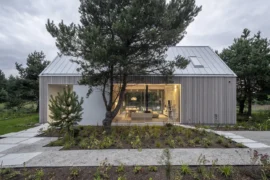
When a Delhi family decided to make Goa their permanent home, they were not looking for a holiday house by the sea. They were looking for a place to belong. That distinction shaped everything we did at Casa Joy.
Project Name: Casa Joy
Studio Name: Bricolage Bombay
Location: Morjim, Goa
Year completed: 2026
Status: Completed

As the founders and architects of Bricolage Bombay, Vinit Nikumbh and Ankita Mathapati Nikumbh, we have never believed a house begins with a plan. It begins with a conversation — about daily rituals, family histories, favourite objects, and the small, specific ways each person imagines living. A short walk from the coastline, on a long and linear site, Casa Joy was drawn out of those conversations rather than imposed upon them.

From the street, the house wears a bright yellow that belongs unmistakably to Goa — an immediate gesture of familiarity within its neighbourhood. Beyond that recognisable skin, terracotta-tiled roofs, carved timber eaves and wrought-iron balconies continue the vernacular conversation. But the real life of the house turns inward, around a series of courtyards that pull light, landscape and weather into the centre of everyday life. These are not decorative voids; they are active rooms without ceilings, where the family pauses, gathers and watches the day change.
We designed the house around its inhabitants’ routines. For one family member, a winding path that loops through the site became essential — a place for solitary morning walks. For another, a quiet study was carved out for reading and writing. Upstairs, a bridge links the private rooms, turning the simple act of moving between bedrooms into a small daily journey, and making the idea of connection literal.

Memory is built into the fabric. Cherished objects and materials carrying emotional weight were reinterpreted and folded into the architecture, so the interiors read as a continuation of the family’s story rather than a break from it. Materially, the house is warm and restrained — timber, stone, soft colour, handcrafted joinery, patterned tile underfoot — an atmosphere that feels lived-in rather than staged.

The vernacular is worn lightly but consistently. Pitched roofs in terracotta tile sit on carved timber rafters; deep eaves are trimmed with the scalloped white fascia of the old Goan-Portuguese house; wrought-iron balconies and reeded-glass shutters filter the coastal light. Underfoot, patterned tiles in ochre and soft blue draw geometry across the floor, and at dusk the yellow walls glow against the green of the garden. The house is recognisably of its place, yet unmistakably the family’s own.

Casa Joy is, finally, a house about transition: a move from one city to another, one chapter to the next. It responds not merely to a site, but to a life.