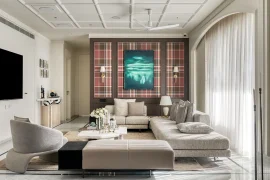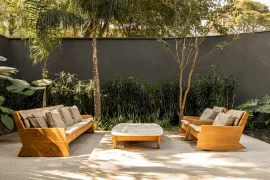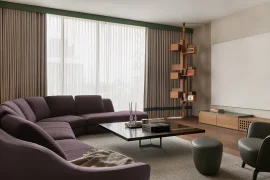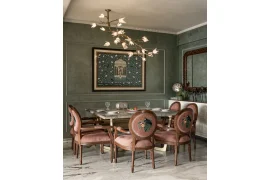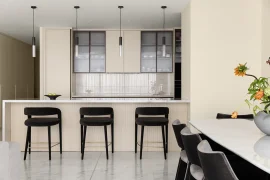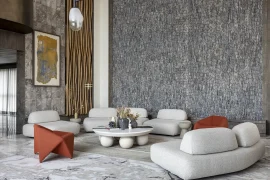
The minimalist art movement, which emerged after World War II, has evolved beyond painting to encompass various fields, including architecture, sculpture, installation, and lifestyle. Postmodernism, which incorporates minimalism, begins with spatial design, aiming to simplify visual information and alleviate cognitive overload. By focusing on the essence of objects, the expression shifts to a more spiritual level, employing abstract language to convey rich internal images.
Project Name: 338㎡ Postmodern Monologue Home
Studio Name: Giant Design
Project Location: Foshan, Guangdong, China
Project Area: 338㎡
Chief Designers: Jack Lee, Zhiqiang Hu
Design Service: Interior Design, Construction, Purchasing
Completion Date: February 2024
Wooden Customization: MULl
Five Constant Systems: Shangsheng Five Constant Systems, Chuanyu Comfort Technology
Lighting Design: CDN Light
Sintered Stone Customization: Ultra Ceramic
Painting Customization: TASSANI
Main Furniture Brands: Minotti、Poliform, X+Q Art, SORAYAMA、Bearbrick、Tom Dixon、Occhio
Photographer: Yun Ouyang

This project, situated in Foshan, belongs to a Canadian returnee whose years abroad have nurtured a passion for a relaxed and free lifestyle. Their love for the arts and unique perspectives on life make this project a vibrant celebration of culture and beauty. In a world filled with uncertainty, we have designed a sanctuary of peace, freedom, and balance for the client, emphasizing functionality—such as customized intelligent storage—alongside meaningful personal items that reflect their aesthetic.

In reconstructing the spatial atmosphere, the designers approached the project with a careful and relaxed mindset, employing natural and postmodern techniques to alleviate the heaviness inherent in the original layout. By removing two existing balconies, the indoor space was expanded, gathering public areas around the dining room and extending private spaces towards the back. This architectural planning maintains an overall balance in density, with each functional area presenting a stable relationship between centripetal and centrifugal forces around the home’s landscape. The living room, positioned between the kitchen and guest rooms, balances service and serviced spaces, creating a rhythmic spatial sequence that achieves stability while managing spatial tension.
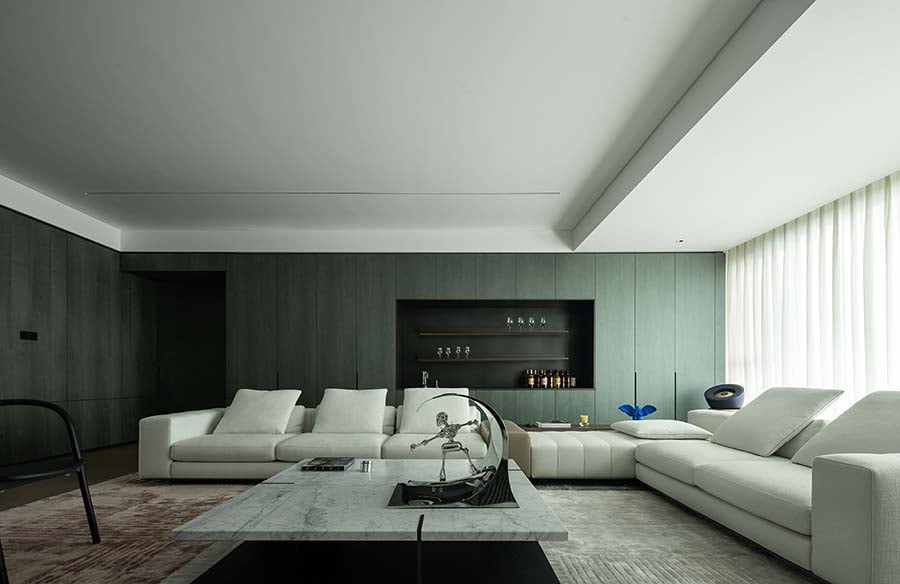
Large French windows maximize the connection to nature. The previously existing “wall of thought” has been dismantled, allowing rhythm to flow through the space, where light and shadow shift as one moves left to right. The open layout, combined with flowing patterns and geometric lines, dissolves the boundaries between the dining and living areas, fostering a social scene filled with comfort and joy, highlighting the beauty that evolves over time, both unified and diverse.

Function Shapes Space
The architectural style of postmodernism aligns with the homeowner’s international experiences. The residence designed by Giant Design prioritizes practicality and comfort, seeking a balance between aesthetics and sustainability. By carefully managing space and scale, the design responds to the current needs of its occupants.
The male homeowner enjoys social gatherings and wine tasting, leading to the public areas—living room and kitchen—being positioned nearest to the entrance. A concealed storage design showcases the homeowner’s passion for wine, while the hostess’s influence, shaped by years abroad, reflects the functional flow of their lifestyle.

The designer reconstructs spatial logic to harmonize the preferences of the homeowner, their spouse, and children. Materials, textures, lighting, and structure are thoughtfully arranged. The original two-bedroom layout has been transformed into four suites plus a communal activity area, better accommodating multigenerational living. The design emphasizes functionality while also embracing aesthetics, creating a comfortable environment that evokes past memories and nurtures new stories for the homeowner.
Each object holds a silent narrative, with rich details enhancing the interplay of different elements. This clear expression of a peaceful lifestyle highlights life’s essence, echoing aesthetics in the space and fostering an artistic ambiance.
The Essence of Home
“Our project aims solely to transform a building into a home.”
—Giant Design丨Jack Lee
These sentiments are often articulated, felt, or sensed, yet the significance of the word “home” often goes unrecognized: the meaning a space embodies, the responsibilities it carries, and the emotions it evokes.

Here, multicultural influences, personal experiences, and individual tastes converge, finding common ground. The residential design aligns with the shared aspirations of the owner and their family, offering a range of possibilities for future living arrangements while addressing essential functional needs. The master bedroom suite prioritizes comfort and privacy, with the children’s independent suites and dressing areas designed for autonomy, while the senior suite features its own bathroom. These renovated private spaces are distinct yet interconnected, embodying a lifestyle of trust and respect. This thoughtful layout captures the essence of family life in clean lines—silent yet filled with warmth.