If you know an architect, you will certainly have noticed that they interact with their surroundings differently. Architects can be recognized by their casual comments which include pointing out that a staircase ‘doesn’t meet the required inclination to be considered accessible’, or their disgust for a building that was ‘much better before the renovation’. However, inside the mind of an architect, there is much more than snarky comments. After looking at floor plans for many years, aside from myopia architects develop a greater understanding of their surroundings. Architects can perceive the potential fire hazards in a building faster than most people, they are also more likely to be able to figure out where the North is at any given time. These faculties appear insignificant, but they can also be life-saving in certain circumstances.
How is an Architect’s perception different?
Architects can imagine an improved version of what surrounds them. To improve things one must first ask the right questions. Most people walk down the street and complain about how warm it is, an architect is thinking ‘Why are there no trees in this street? We need shading here! To be able to perceive the potential of a space is how you make a difference. If one wants to make the world a better place, first one must be able to imagine it. Creativity and the desire for constant improvement are the essence of architecture. This is why the greatest question that can navigate an architect’s mind is: ‘If I could do anything… what would I do with this space?’
Nobody ever changed the world by thinking the same way as everyone else.
A great architect does not conform to reality, a great architect imagines, and later they decipher a method to transform their potential creation into physical form. Learning that mindset is the greatest challenge an architecture student might face. Sometimes people’s brains are wired to be practical and realistic above anything else, and to be able to change the perception of an adult mind is not always possible. This doesn’t mean that those who can’t won’t be successful architects, it just means they won’t be grand. If previous architects had stopped their work because what they were designing was considered unrealistic, we wouldn’t have the iconic landmarks we have today. The Sydney Opera House is probably the most iconic scene from the city and yet the truth is when construction began, they hadn’t deciphered a way to build the whole structure. Today the Sydney Opera House is the symbol of Sydney.

Architecture, like any other form of art, has a message.
However, unlike a piece of art in a museum, architecture doesn’t have a poster by its side. When an architect or architecture student looks at a building, they should have the ability to perceive the decisions that were made through the production process, and the message behind the architecture. For example, architects recognize monuments as tools to shape public perception of the ruling government. The messages behind architecture are sometimes obvious, and other times you can find them not only in what is constructed but in the absence of it. A good example of this is the lack of decoration in protestant churches compared to the catholic churches, this indicates an intention of the protestants to appear more humble to give the impression of being more in touch with the common folk compared to their catholic counterparts. Once an architect learns that everything is carefully crafted and measured, they learn to perceive the intent behind the architecture that surrounds them.


Architects shape our perception.
Architecture always tells a story, and among all buildings the best storytellers are museums. Unlike other buildings, museums are designated spaces for the transmission of memory. Architects who have the privilege to design these spaces, directly influence how society will gather the memories behind these walls. The stories that we learn and how we learn them shape society. The influence that our understanding of our history has on us is unmeasurable, and thus the responsibility of an architect to shape and define the way we perceive history is probably the greatest task any architect can face.

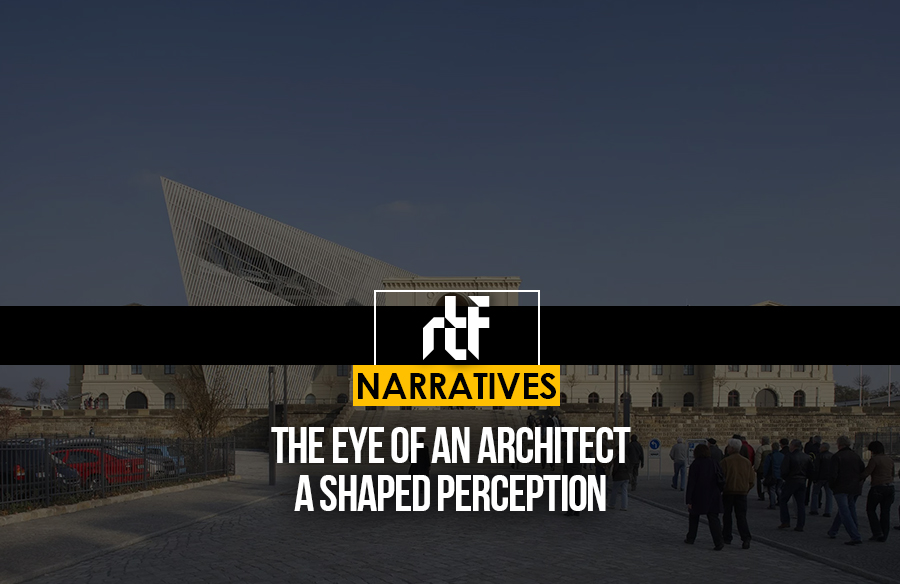
The Military Museum in Dresden Germany by Daniel Libeskind is famous for its non-conventional intervention. Many may find the structure that invades the building disruptive. However, this was precisely the intention of the architect, Libeskind’s aim was none other than to materialise the destruction that took place during the Second World War. Behind the walls of this museum is the history of Germany’s military, and when you reach the period 1940-1945 you encounter the disturbance. People are forced to perceive this interruption as a physical manifestation of the rupture that transformed the nation. Libeskind took this intervention as an opportunity to teach a lesson on violence, the wedge moves towards the point from which Dresden was bombed, showcasing how every detail is carefully considered. In the interior you get to experience the fragmented natural light that invades the structure, signalling how this period brought in a new light that would change the way people would perceive its history.