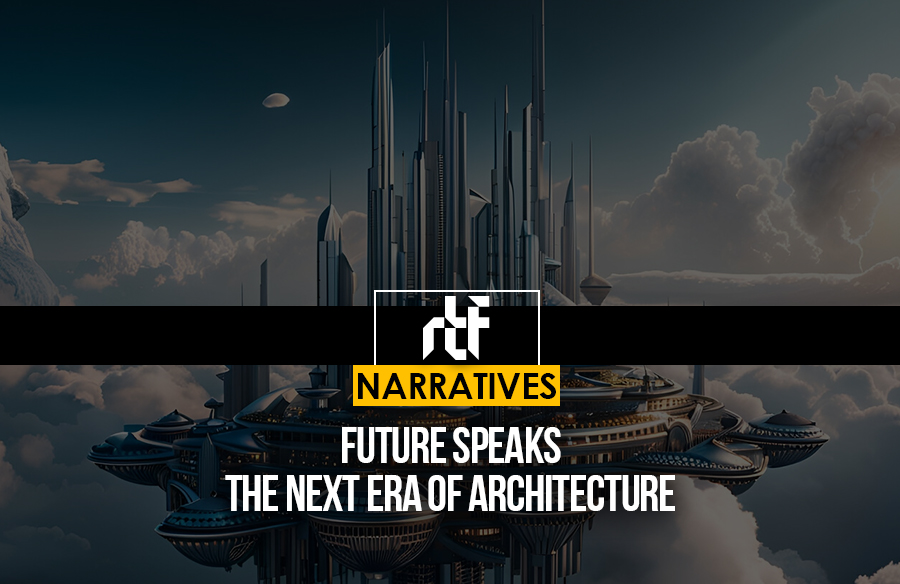
Imagine a world in which buildings are able to perceive and respond in real time to our emotions, and cities glide effortlessly over the sky. What if science fiction’s imaginative and mystical depictions of these worlds were about to become reality on a daily basis? This is the potential of Conscious Architecture, a revolutionary movement that combines state-of-the-art technology and creativity.

Do you recall Archigram’s futuristic ideas of movable and floating cities? Something that didn’t seem possible is getting closer to happening. Take Saudi Arabia’s Line City, a 170-kilometre linear city that reinvents urban living by condensing it into a practical and ecological shape.
“The Line is a revolution in civilization, offering an unprecedented urban experience while preserving 95% of nature,” according to NEOM’s designers.
This article examines how cities are changing due to Conscious Architecture, and it also points us in the direction of a future that will fundamentally alter how we live and interact with the environment.
Are Cloud Cities that Float the Next Big Thing in Urban Living?

For a very long time, the magical and fanciful have dominated the world of magic and mysticism; think of flying witches and enchanted carpets from our childhood stories. What if someone told you that Conscious Architecture aims to create a comparable feeling of awe in cities? Now let’s explore the bold idea of floating cloud cities. It is envisaged that these cities float freely through the atmosphere, supported by enormous structures filled with hydrogen or helium that move in sync with Earth’s weather cycles. Although it seems like a storyline from a science fiction book, this concept has its roots in conscious architecture and reflects our desire for eco-friendly, flexible homes that lessen the strain on our terrestrial resources.
Consider the film Kalki 2898 AD (2024), which presents the “Complex” as a city where everything gently floats in the air and is connected to the ground by a single point of contact. In this picture of the future, ‘Complex’ represents a technologically advanced utopia in which structures that defy gravity represent a radical way of living in cities. This representation clearly fits with the idea of Floating Cloud Cities, showing how Conscious Architecture is becoming more and more like real-world innovation rather than just a pipe dream.

These cities, which take their cues from Buckminster Fuller‘s Cloud 9 plan, represent a radical change in sustainable living.
According to sustainable architecture specialist Professor Michael Barnett, “Architecture that floats above the surface not only addresses the physical needs of space but also represents humanity’s rising desire for minimal ecological footprint.”
Cloud cities have the potential to provide a haven in the face of urban development and overcrowding, ushering in a new era of Conscious Architecture that blends ecological stewardship with human inventiveness.
Architectural Awakening: The Emergence of Conscious Structures
Have you ever considered a scenario in which structures have sentience and respond to our every whim?
Artificial Intelligence (AI) becoming a part of Conscious Architecture is not a pipe dream; it is an impending reality that has the potential to completely change the way we interact with our environment. Imagine working in an office building where the lighting and temperature are automatically adjusted to reduce stress or a home that talks to you and learns about your feelings, all while anticipating your requirements.

The options are not limited at this point. Within the field of Conscious Architecture, robotics and artificial intelligence (AI) are being explored by architects who foresee autonomous systems that will “self-build” cities, dynamically changing and reconfiguring themselves in response to the requirements of the occupants. These AI-driven structures might develop sentience, recognize changes in the weather and population patterns, and even physically change to adapt to these changes. Take a look at the amazing 3D-printed creations from ICON in Mexico. These are the beginnings of a new era in which construction processes are incredibly mechanised.

However, the vision does not end there. Envision a world in which entire cities are entities that can change their shape and function in response to changes in the weather, time, or population density. Conscious architecture is already advancing, despite the fact that this may sound like science fiction. One example is OMA’s Prada Transformer in Seoul, which changes shape to fit different events. These adaptable systems represent the revolutionary promise of Conscious Architecture and may soon be able to respond on their own to social, environmental, and cultural changes.
DNA-Grown Structures: Will Biology Build Our Future?
The saying that “construction ruins nature” has been instilled in our consciousness for a long time and is true. However, what if we could imagine an alternative kind of reality? Imagine a metropolis where structures are developed from designed DNA to become living, breathing entities, rather than just being made of brick and mortar. With this revolutionary step forward in bio-architecture, DNA-Grown Buildings will be able to change and grow just like living things. This idea is still in its infancy, but it is based on groundbreaking biotechnological research on the construction of organic structures. Could this change signal the beginning of a new era in which architecture coexists peacefully with nature rather than upsetting it?

Thinking of Mycelium, the clever fungus that ‘The Living’, a cutting-edge New York architectural firm, is using. Their biodegradable constructions provide a window into a time when all buildings will be organic and environmentally responsible.
According to David Benjamin, the creator of ‘The Living’, “The future of architecture lies in biology, where buildings can be designed to live, breathe, and adapt like any natural organism.”
Is a new era of development that blends in with nature instead of upsetting it heralding in the arrival of Conscious Architecture? A future in which our built and natural environments are fully linked is promised by the possibility of buildings that regenerate and interact with their surroundings as we stand on the cusp of this shift.
Invisibility Architecture: A New Frontier

The idea of Invisibility Architecture represents a more direct and concrete advancement in architectural innovation. These structures can blend in perfectly with the urban or natural surroundings by using cutting-edge light-bending technology to make them undetectable to the unaided eye. This technique is being pioneered by projects such as GDS Architects’ (South Korea) The Invisible Tower. These buildings blend into the surroundings by projecting images of the surrounding area via cameras and LED panels. This is one of the best illustrations of how Conscious Architecture can turn conventional design concepts into creative solutions.
The theory changes how structures interact with the environment, allowing cities to expand without sacrificing ecological or aesthetic balance. Imagine a skyline, where the buildings disappear and the vegetation takes over. These developments herald a new age in sustainable design in which the built environment is harmoniously integrated with the natural surroundings. The integration of architecture and environment will be redefined by Conscious Architecture, which is poised to transform our relationship with space.
As we progress ahead, Conscious architecture will serve as a storytelling medium in addition to meeting society’s physical demands. Buildings will change from being immobile objects to dynamic, ever-evolving structures that capture the richness and fluidity of human existence. These audacious concepts, which range from invisible architecture to floating cloud cities, show how creativity, technology, and sustainability can come together to produce entirely new lifestyle options. It was reportedly noted by eminent architect Zaha Hadid, “There are 360 degrees, so why stick to one.”
Architects of the future will create more than simply structures; they will also create the narratives of entire civilizations.
Citation’s & Credits:
- Books
Fuller, R.B. (1969). Operating Manual for Spaceship Earth. New York: E.P. Dutton & Co.
- Articles
Print Journals:
- Barnett, M. (2021). Sustainable Architecture: Rethinking Urban Living. Journal of Eco-Architecture, Volume 13 (2), pp. 33-49.
Journal Articles Accessed on a Website:
- Benjamin, D. (2017). Mycelium and Bio-Architecture: A New Approach. The Living, Volume 5 (4), pp. 21-29. Available at: www.thelivingarchitecturejournal.com/benjamin [Accessed: 15 September 2024].
Newspaper Articles – Print or Online:
- Hadid, Z. (2004). The Future of Architecture. The Guardian. Available at: www.theguardian.com/futurearchitecturehadid [Accessed: 15 September 2024].
Magazine Articles – Print or Online:
- Jenkins, O. (1996). Unusual Recipes and Cantonese Cuisine. Culinary Research, Volume 5 (8), pp. 47-59.
- Online sources
- NEOM. (2023). The Line: A Revolution in Urban Living. NEOM Official Website [online]. Available at: www.neom.com/the-line [Accessed: 15 September 2024].
- GDS Architects. (2020). The Invisible Tower. [online]. Available at: www.gdsarchitects.com/invisible-tower [Accessed: 15 September 2024].
- ICON. (2023). 3D Printed Homes for Sustainable Living. [online]. Available at: www.iconbuild.com/3dprintedhomes [Accessed: 15 September 2024].
- Images/visual mediums
Citations for Images
- Image 1: Unknown. (Year of production not specified). UHNW + Family offices. [PNG image]. (Available at: https://cdn.prod.website-files.com/626f3c1e56016909ca3c8495/6583a66dc4c20e77a8d45bf7_UHNW%20%2B%20Family%20offices%20(1).png)
- Image 2: Conar, G. (2023). Futuristic Floating City Concept. [Digital Illustration]. (ArtStation: https://cdnb.artstation.com/p/assets/images/images/066/362/377/large/goran-conar-fltctyftr.jpg).
- Image 3: Unknown. (n.d.). Modern Architecture Building. [Photograph]. (Flickr: https://live.staticflickr.com/7735/28005394250_2bfd2a02cd_b.jpg).
- Image 4: Unknown. (n.d.). Contemporary Home Interior. [Photograph]. (Dwell: https://images.dwell.com/photos/6063391372700811264/6610581394988380160/large.jpg).
- Image 5: Unknown. (n.d.). Cityscape architecture. [Photograph]. (Sanity: https://cdn.sanity.io/images/5azy6oei/production/573837c6afc8595fea039fc1531eb736d23122d8-3522×2180.jpg?rect=308,0,2907,2180&w=1100&h=825&q=80&fit=crop&auto=format).
- Image 6: Unknown. (n.d.). Modern Building Facade. [Photograph]. (The New Republic: https://images.newrepublic.com/45faac36716fe0ad7b02b38bbee3bb7db022f2d4.jpeg?auto=format&fit=crop&crop=faces&q=65&w=1000&h=undefined&ar=3%3A2&ixlib=react-9.0.2&w=1000).
- Image 7: Unknown. (n.d.). Architectural Structure. [Photograph]. (Archinect: https://archinect.gumlet.io/uploads/ji/ji818udj3a04ebm8.jpg?fit=crop&auto=compress%2Cformat&w=1500).