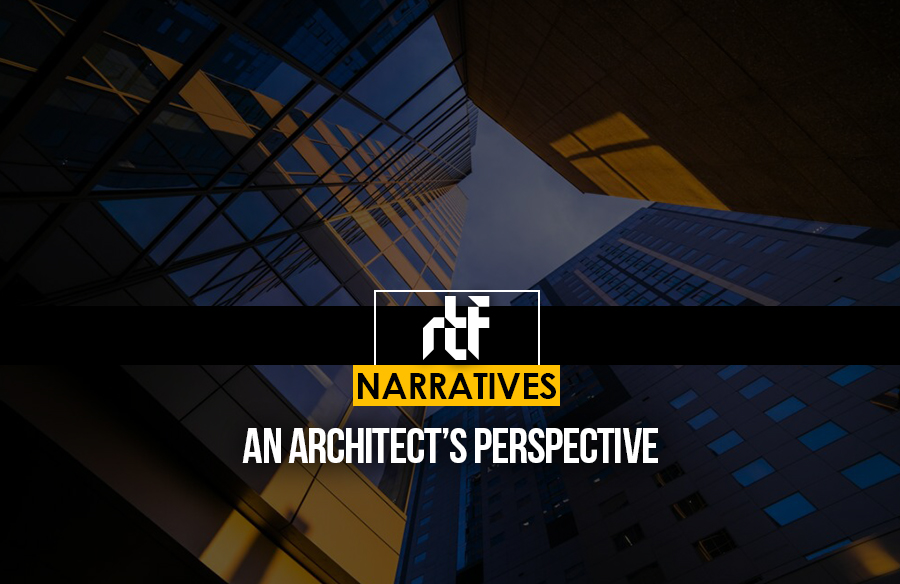
The way an architect views the world is completely different from the way a common man views the world. One might argue that it is an arrogant and elitist statement, but it is true nonetheless. The perspective of an architect is multifaceted. It is like looking through a kaleidoscope. Architects have to put themselves in the shoes of multiple users to perceive a space. Because holistic designs are not created with a single perspective.
Observation is the bread and butter of an architect
As an architect, you tend to observe anything and everything around you. When you set foot in a space, you observe the way the door opens, the way light floods the space, the material of the floors and walls, the size of the windows, the colour of the paint, the type of light fixtures, the flow of wind through the space, etc. And it doesn’t stop there, you tend to analyse how you can improve the space. That is the perspective of an architect. You immediately put yourself as the user and critique the space from that perspective. And this is not restricted to just a space with four walls, but also with any space be it a park, promenade, streets, plazas, etc.
This perspective helps an architect to stay grounded in his surroundings. He is more in tune with nature and the natural order of things. Observing your environment is key to creating a wholesome design experience. As you venture deeper into the field, it becomes something of a norm. An architect not only observes his environment but he also needs to observe the people in the environment and their perspective of the environment. Observing and studying the users of a space provides the architect with the necessary tools that are needed to design an inclusive space that caters to people from different walks of life.

Architects are storytellers at heart
A space is never just a space. Spaces narrate the stories of their users. The same space can be perceived differently by different users. Spaces are not limited to just one perspective. As an architect, the curator of a space, it becomes our cardinal rule to narrate the story of the space. How is one space experienced by multiple users? Let’s take the example of a school. It is used by children aged 3 to 17 and adults of varying ages playing various roles – caregiver, teacher, administrator, etc. An architect needs to perceive the space through the eyes of all these users and come up with a solution that caters to all their needs. He becomes a storyteller, who narrates the story behind how that space was born.
It is the beauty and privilege of being an architect, to learn in depth about the users to create a comprehensive space that is appreciated by all. The thought process of an architect, the journey of a space into a meaningful entity, and the way the space is experienced by its users are all tied to the perspective of the architect. To curate a meaningful space, an architect needs to delve deep into various facets of what encompasses a space. It all stems from the outlook of an architect towards his environment.

Devil is in the details
Details are a key aspect of architecture. As one ventures into the field of architecture, one learns the importance of details. Minor and major details play a key role in design and in the way a space is perceived. Details also showcase the individuality of the architect and paves the way for his perspective to shine through. No two details are the same just like no two architects are the same. It helps in moulding the niche of an architect and exhibits his ideologies. It shines a light into the thought process of the architect and how the space came to be in his mind. The deeper you go into the details of a space, the more you go into creating it as unique as it can be.
What makes an architect an architect? Is it just his observation skills? His ability to narrate the story of the spaces he creates? Creating a niche for himself with the detailing in his space? It is all this and much more. An architect can be a designer, a creator, a curator and also a user. Even though we started by saying that the way an architect views the world is completely different from the way a common man views the world, one can also say that the way an architect views the world is also the way a common man views the world. It is the same and yet different. That is an architect’s perspective. To view the world from so many different angles and come up with multiple solutions for its numerous problems. After all, aren’t architects problem solvers?
Architects can take on multiple roles in our society and bring about a positive change in our environment for the betterment of our future. An architect’s perspective has the power to change others’ perspectives.